
FABRIC SOURCING for Fashion
At ARNIA TEXTILE FASHION, our Fabric Sourcing service helps fashion brands translate creative references into technically and commercially feasible textile solutions.
We can work from a physical sample, archive fabric, image or creative brief to identify close alternatives, adapt an existing construction or develop a custom route aligned with the intended use, target price and production requirements.
ARNIA's 2025 Social Report records 85% of total purchases from local suppliers. This gives us direct access to specialised expertise in printing, jacquard weaving, embroidery, quilting and piece dyeing.
Review the textile capabilities relevant to your sourcing brief and the 2025 Social Report, local purchasing data. Local purchasing is measured by purchase value; it is not the percentage of suppliers or production volume.
Reading note (11 November 2026): This social report documents company-level indicators. Article counts are not transaction evidence. Confirm the selected article, production route, lot and applicable FSC® claim against current certification scope and sales/delivery records before ordering or making a product claim.

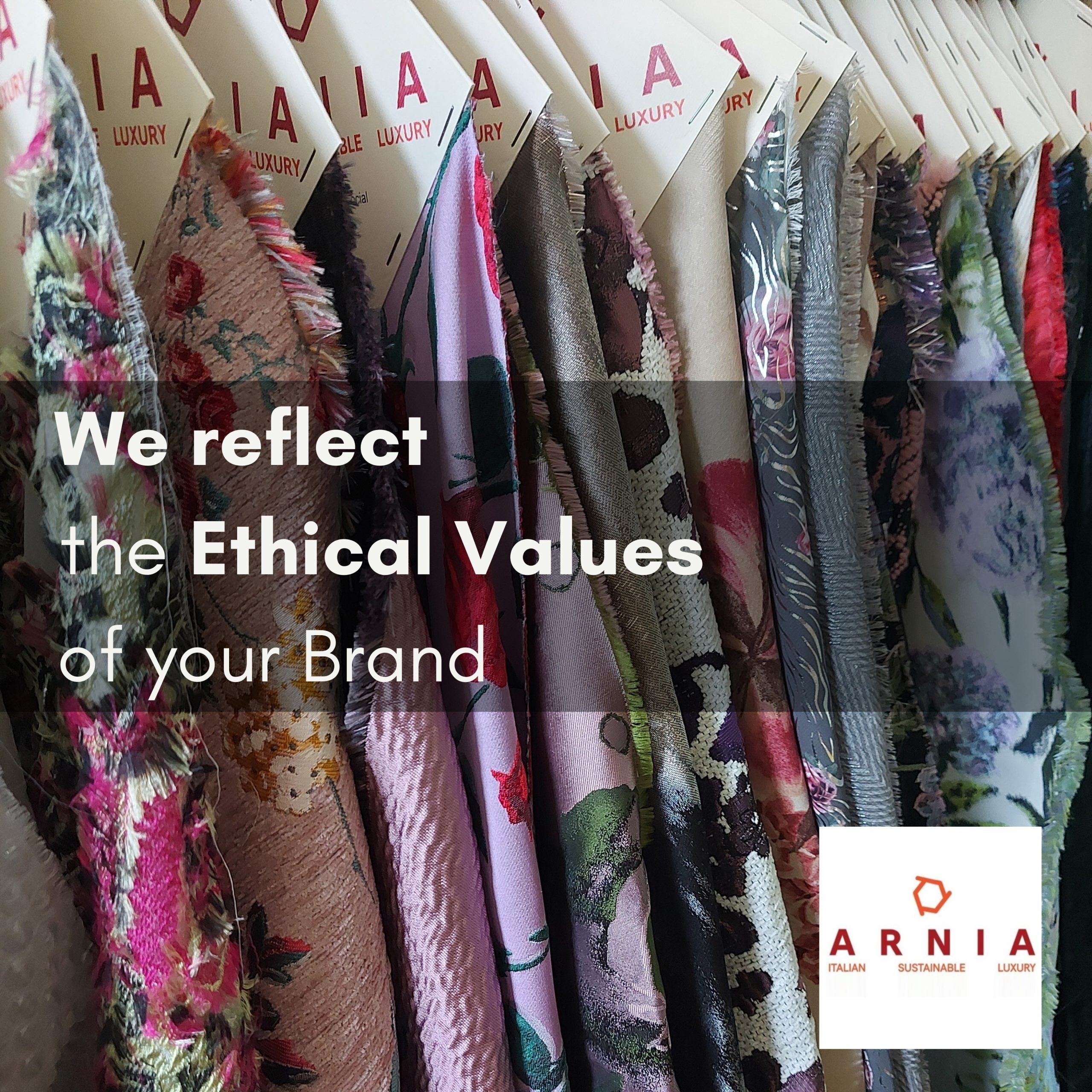

Technical fabric sourcing for luxury fashion brands.
From the Lombardy Textile District, ARNIA supports buyers, sourcing teams and design offices with textile research, reference swatch matching, custom fabric development and responsible sourcing pathways — connecting creative direction with technical feasibility.
Fabric sourcing is the starting point of every successful luxury fashion collection. From the very beginning, our service is focused on complete client satisfaction, delivering efficient, traceable, and ethical solutions. Project timelines are defined and confirmed after technical review, while expertly addressing the challenges of selecting high-quality, sustainable textile materials.
A reference swatch, archive fabric or image can start a custom fabric development project. We assess which characteristics can be reproduced, which require adaptation and which depend on materials or processes that may no longer be available. The aim is a technically feasible fabric aligned with the collection’s intended use, target cost and production requirements. Our guide to custom fabric development in Italy explains the decisions between a reference and an approved production specification.
Our non-profit model further strengthens transparency and our long-term commitment to responsible sourcing. In short, this is FABRIC Sourcing designed for the future of TEXTILE fashion — innovative, ethical, and entirely Made in Italy.
What We Provide in Fabric Sourcing
We assess three possible routes against your creative brief, intended garment, target cost, quantities and required timing:
- Source an existing fabric: identify suitable alternatives and assess availability, continuity and technical fit.
- Adapt an existing construction: review changes to colour, print, finish or other specifications with the relevant production partners.
- Develop a custom fabric: define a sampling route to evaluate the requested construction, appearance and performance before production approval.
ARNIA coordinates the agreed route through specialist Made in Italy production partners, drawing on expertise in the Lombardy textile district. Sampling, minimum quantities and delivery milestones depend on the selected materials and processes.
Include traceability and certification requirements in the initial brief. Any certified pathway and supporting documentation must be confirmed for the specific article, production lot and companies involved.
Quality control and production reliability: before bulk confirmation, we agree the approved reference, composition, finished width and weight, relevant performance checks and acceptance tolerances. We review raw-material continuity and sample-to-bulk repeatability, with approval responsibilities and delivery milestones defined for the selected production route.
Before approving a sample, use our seven checks for luxury fabric production to define what to validate and record.
How to prepare a fabric sourcing brief that can be evaluated quickly
Fabric sourcing is most effective when the request explains what the material must do in the garment, not only what it should look like. A professional brief connects aesthetic direction with construction, quantities, budget architecture, compliance and timing. This allows ARNIA to search within the Lombardy textile network without generating an unfocused list of attractive but commercially unsuitable options.
Start with the garment and use case
State the product category and silhouette first. A fluid dress, structured skirt, jacket, blouse, lining and decorative overlay each require a different balance of weight, drape, opacity, stability and surface. If the garment has unusual construction, explain the critical areas where the fabric must perform.
Translate a reference into measurable characteristics
If you provide a swatch, photograph or competitor garment, identify what matters most: fibre, weave or knit construction, weight, hand, transparency, stretch, motif, colour or finishing. Not every feature needs to be reproduced exactly. Separating essential and optional characteristics gives the sourcing team more realistic alternatives.
Define the quantity architecture
State sample metres and expected production metres separately and divide the production estimate by colour. If the project is still testing demand, identify the quantity as provisional. This helps ARNIA distinguish between stock-supported options, standard production, special minimums and a custom-development route.
Give the commercial context
Target retail price and sales channel help the sourcing team understand the material budget that may be sustainable for the product. This does not replace technical costing, but it prevents a project from moving too far with a fabric whose economics are incompatible with the final garment.
Identify compliance before the shortlist is final
If the brand requires GOTS, GRS, FSC, specific RSL/MRSL conformity, testing or traceability data, state that requirement at the beginning. A visually suitable article may need to be excluded if the required documentation cannot apply to the selected route. Certification should therefore be part of sourcing criteria, not a request added after the material has been chosen.
Use samples to reduce the shortlist
Do not request large numbers of swatches without a decision framework. Select a small number of references that represent different viable routes, then compare them physically for hand, drape, colour, surface and garment suitability. Record why each reference was retained or rejected so the next search becomes more precise.
When custom development is the better route
A custom fabric is appropriate when an existing article is close but the brand needs a specific colour relationship, motif, scale, surface or construction characteristic. Define the desired change and the characteristic that must remain. ARNIA can then assess whether adaptation of an existing base is more efficient than developing a new construction from the beginning.
Protect confidential references and sourcing know-how
Tech packs, prototypes, proprietary fabrics and supplier information can contain trade secrets. Sensitive files can be shared under NDA where appropriate. Likewise, ARNIA’s specialist network is part of its industrial know-how; supplier identities and process details are disclosed selectively according to the project purpose and applicable protection clauses.
What ARNIA needs for a focused sourcing search
- Product category and intended silhouette.
- Reference swatch, image or artwork.
- Required composition or acceptable alternatives.
- Target hand, weight, drape, stretch and opacity.
- Sample metres and estimated production metres per colour.
- Target retail price or material-cost framework.
- Certification, testing and traceability requirements.
- Target sample-review and production dates.
A sourcing result should be more than a fabric link. The useful output is a shortlist of articles that fit the creative brief and can be assessed against production, documentation and commercial requirements.
Send your sourcing brief to ARNIA with the available technical references.
Tailored Support in Fabric Sourcing for Luxury Fashion Brands
We work closely with each client to understand their values, timelines, and creative direction. Thanks to our flexible structure, even emerging luxury fashion brands can access premium Made in Italy textiles without compromising on budget or quality. In this way, we help you translate vision into value.
Start with a Fabric Development Brief
Tell us what the fabric needs to achieve in the finished collection. Share your reference swatch or images, intended garment, preferred composition, approximate quantity, target fabric cost and required delivery date. Include any performance, traceability or certification requirements.
We use this information to identify the appropriate sourcing or development route and the technical questions to resolve before sampling. Feasibility, scope, pricing and timing are confirmed for the project; submitting a brief is not a production quotation.
Submit your fabric development brief
Need the fabric developed into a finished collection? Explore our Made in Italy Cut & Sew service. If your team needs coordination across materials, sampling and production, review our textile project management approach.
Responsiveness to Customer Needs
Our dedicated team helps you:
• Develop fabrics from physical samples, archive references, images or creative briefs.
• Source specific yarns, constructions, textures and finishes according to the intended use.
• Evaluate repeatability, material availability, technical MOQ and production feasibility.
• Define realistic development and production timelines.
• Align quality requirements and target cost before committing to production.
• Access Made in Italy textile solutions with certified material pathways where applicable.
• Define the order- and lot-specific traceability and compliance documentation required by the project.
ARNIA coordinates the agreed sourcing and production route and collects the documentation applicable to the project.
Depending on the selected material, article and production lot, the available evidence may include supplier declarations, technical data sheets, test reports, chain-of-custody documentation, Scope Certificates or Transaction Certificates.
The type and extent of documentation are confirmed project by project and do not automatically certify the finished product.
Check ARNIA's published certificates, validity dates and official verification sources against the documentation required for your selected article and lot.
Project-Specific Traceability and Responsible Sourcing
ARNIA’s Type B social-cooperative model strengthens governance, accountability and responsible business conduct.
Traceability, certification and compliance documentation are defined separately for each project and depend on the material, article, production lot, technical MOQ, Chain of Custody and applicable standard.
This approach helps brands make better-informed sourcing decisions and reduce the risk of unsupported environmental, social or certification claims.
ESG Responsible Sourcing, Evidence and Brand Reputation
Responsible sourcing is not defined by a single label or corporate status. It requires product-specific evidence, realistic certification boundaries and transparent communication across the relevant production route.
Working with ARNIA does not automatically make a product, collection or supply chain sustainable or certified.
Our contribution is to combine responsible business governance, a selected and monitored production network, certified material options where applicable, and project-specific evidence that can support accurate and defensible communication.
Any environmental, social, Made in Italy or certification claim must be assessed against the actual material, article, production lot and production route.
Sustainability section and discover how our Fabric sourcing expertise strengthens your impact.

FAQ
Does ARNIA TEXTILE source fabrics outside her own collections?
Yes. We can source, develop, or adapt fabrics from partner mills to meet your specifications.
Can ARNIA TEXTILE match an existing fabric sample or a photo?
In most cases, yes—provided we can access the technical specifications and fiber composition.
What is the typical lead time for custom fabric development?
Around 4–7 weeks for sampling, depending on complexity and yarn availability. [about 2 - 3 weeks for the setup and other 3 - 4 weeks to weave / dye / print the prototype / sample]
Does ARNIA TEXTILE accept low MOQ for custom fabrics?
We assess MOQ case by case, based on fiber type, loom setup, and finishing process. Often with a surcharge it is possible to produce lower quantities
TEXTILE TECHNICS / EMBELLISHMENTS
that WE CAN PROVIDE


