
Fashion product development starts with listening: understanding what a client wants to achieve before deciding how to make it. Within the Made in Italy textile district of Lombardy (Lombardia), connecting Milan (Milano), Como and Varese, ARNIA TEXTILE FASHION brings a brand’s creative vision together with the textile and production expertise needed to develop it.
A sketch can describe a silhouette. An image can suggest an atmosphere. A swatch can evoke a feeling. None of these, on its own, answers every question involved in developing a collection.
Listening means understanding what must remain true to the original idea—and what can evolve to make it achievable.

The Socratic Approach: Helping a Vision Emerge, Not Imposing a Solution
Listening Does Not Mean Always Saying Yes
“I would like a soft fabric.” The request sounds straightforward, but it deserves a question: soft against the skin, fluid in movement, or less rigid in its construction?
“We want a quality garment” also invites a conversation. What should the wearer notice? The fit, the fabric’s feel, the finishing, or the consistency between the approved sample and production?
A knowledgeable partner should not decide what matters on the client’s behalf. It should help the client define it.
A useful response is to reflect back what has been understood: “This is the result we are working towards. These details are essential. These are the areas where we can consider alternatives. Have we understood correctly?”
That confirmation turns listening from a courtesy into a practical check. It gives the client an opportunity to correct an interpretation before it becomes a material purchase or a prototype.
The Socratic Approach: Helping a Vision Emerge, Not Imposing a Solution
In Plato’s Theaetetus, Socrates compares his work to that of a midwife: helping another person bring ideas into the open and examine whether they stand up to scrutiny. This is the philosophical reference behind maieutics, an approach that uses dialogue to explore and test understanding.
In the relationship between a fashion brand and its production partner, we can borrow one principle: before proposing a solution, help define the problem more clearly.
The analogy has an important limit. A manufacturer does not simply draw out knowledge the client already possesses. It contributes technical expertise, checks possibilities and introduces new information. The outcome comes from combining two contributions, not from one overruling the other.
Open Questions, Not Leading Questions
“Wouldn’t this available fabric be perfect?” already points towards a preferred answer.
“Which quality of this reference must we preserve?” creates room for understanding.
The purpose is not to persuade the designer to fit the collection around a catalogue. It is to establish when an existing material is appropriate, when custom development is needed, and when a particular route is incompatible with the project.
A limitation, explained alongside the alternatives, can also be a form of care.

He who believes he knows when he does not;
Me, at least, I do not know, but at least I do not believe to know.
And it is precisely because of this small difference that I appear to be wiser—because I do not believe I know what I do not know.
SOCRATES
Fashion Product Development: Turning Requests into Shared Decisions
A conversation becomes useful when it connects creative intent, the end customer and production requirements.
The following framework is a discussion tool, not a questionnaire to impose on every client.
“We are starting with a small run.”How will quantities be split across styles, sizes and colours?An assortment to check against technical minimums.
| Initial request | Question that clarifies the need | Decision to record |
|---|---|---|
| “It must express our brand.” | Which detail makes this garment recognizable? | Non-negotiable creative elements. |
| “We want this effect.” | Is the specified fibre essential, or is it the fabric’s behaviour that matters? | Required properties and acceptable alternatives. |
| “It must work commercially.” | Who is it for, through which sales channel, and at what target retail price? | Positioning and development and production budgets. |
| “We are starting with a small run.” | How will quantities be split across styles, sizes and colours? | An assortment to check against technical minimums. |
| “We need it for our launch.” | When are samples, approvals and delivered goods required? | Milestones, responsibilities and unresolved decisions. |
These are marketing questions as much as manufacturing questions. They connect the brand’s promise with the qualities the product must actually deliver.
A target price is not an instruction to find the cheapest solution. It helps establish where to invest so that quality, identity and commercial viability remain aligned.
This is also why a quotation alone is not enough to define a production project: before confirming a final price, both parties need to understand what is being developed.
Explore ARNIA’s Cut & Sew services to understand how development, prototyping and production can be coordinated around your collection’s requirements.
Fabric Sourcing Begins with Understanding the Project
ARNIA’s fabric sourcing service connects a client’s references with textile research, adaptation and development.
The question is not only, “Where can we find something similar?” It is also, “Which characteristics must we preserve, and which still need to be checked?”
A photograph can guide the aesthetic search. A production decision also requires clarity on composition, fabric feel, weight, intended use, quantity and availability. Confirmed information should remain distinct from characteristics still awaiting assessment.
An Example: Preserving Movement Without Losing Shape
Consider a hypothetical project: a dress with fluid movement and a clearly defined sleeve shape. This is an illustration, not a client case or a validated solution.
A useful question would be: “Is the priority overall lightness, or maintaining shape in a particular area?”
The answer could lead to evaluating a different fabric construction, localized support or an adjustment to the pattern. None of these alternatives should be treated as equivalent before it has been assessed.
What to Validate Before Approving the Material
In this hypothetical project, the comparison should focus on the fabric in the garment: how it falls, how it behaves at the seams, what happens in the relevant areas, and which checks the intended use requires.
The physical swatch and prototype allow the proposed solution to be compared with the actual result.
A considered fabric shortlist supported by a sampling plan helps make the alternatives understandable. The aim is not an indiscriminate collection of possibilities, but options assessed against the same objective.

CALL ONBOARDING
In Cut & Sew, Dialogue Must Become a Specification
Listening does not stop once a fabric has been chosen. It continues through pattern development, fitting, finishing and preparation for production.
“More comfortable”, “cleaner” and “more elegant” are legitimate observations. To act on them, however, the team needs to understand where and how they should translate into a change.
A useful revision connects the client’s observation to an identifiable part of the garment, a proposed adjustment and a subsequent approval.
For a small run, garment quantities and material minimums do not automatically coincide. ARNIA can assess production starting from 20 pieces per style, subject to product category and feasibility. Fabrics, dyeing and trims may require different quantities.
The guide to small-batch cut and sew manufacturing in Italy explores these constraints. Final production pricing requires a validated prototype, confirmed materials, and technical and client approval.
Meeting a request does not mean promising every combination of features. It means making the options understandable and agreeing on a solution that can be checked.
Make the Conversation More Productive, Not Simply Shorter
To use dialogue efficiently, it helps to distinguish three moments.
Before the discussion, gather what is already known: references, product categories, approximate quantities, commercial objectives and the intended calendar. Missing information should be identified, not replaced with assumptions. The guide to what should be ready before sampling helps organize this starting point.
During the discussion, address connected decisions together. An alternative material may change the construction; a different colour assortment may change fabric requirements. A focused technical conversation allows these relationships to be considered together rather than scattered across separate requests.
After the discussion, record what has been approved, what still needs checking, who must respond and which next step can begin. A shared summary should leave no ambiguity between a suggestion and a decision.
Email remains essential for confirmations and documentation. A technical conversation helps decisions take shape; the written record preserves them.
Not every revision is wasted effort. Some revisions produce necessary learning. The aim is to avoid those caused by misunderstandings that could have been clarified earlier.
What ARNIA Contributes: Expertise That Listens and Coordinates
ARNIA TEXTILE FASHION is the trading name of ARNIA – Società Cooperativa Sociale Made in Italy, a Type B non-profit social cooperative and textile and production partner for premium and luxury brands.
The team brings over 100 years of combined textile and fashion experience. The value of that experience is not knowing in advance what the client should want. It is recognizing which technical questions their project requires.
ARNIA operates as a textile converter and development partner, coordinating a selected network of specialists while overseeing the project, quality and documentation. Not every manufacturing operation takes place in-house.
As an ambassador for Made in Italy excellence in the Lombardy textile district, ARNIA also makes these capabilities accessible to emerging brands, supporting the agreed stages from brief development through to production.
Respect for people runs through this model: the expertise of the internal team, the responsibilities of production partners, and inclusion through meaningful work. It is the connection between responsible relationships and supply-chain organization, rather than a statement of values alone.
Listening to the Brand’s Ethical Commitments
When a client requires traceability or particular certifications, those objectives should enter the initial discussion.
Certified fabric does not automatically make the finished garment certified. The product, supply chain, documentation and applicable rules must be checked, as explained in the Sustainability Practical Guide.
The aim is to help protect the client brand’s reputation and align its production choices with the ethical commitments it communicates.
Client Satisfaction Should Be Visible in the Result
The client should be able to recognise the original idea in the finished result and understand the decisions that made it possible.
To assess the collaboration, useful questions include: does the product preserve the agreed features? Were alternatives explained? Were changes to cost and timing understood before approval? Did feedback on the sample receive a specific response?
These questions can accompany development reviews and the final assessment. They do not guarantee satisfaction. They make it something to discuss and evaluate rather than assume.
The client’s creativity sets the direction. Technical know-how helps build the route. Listening keeps the two aligned.
Share your project brief with ARNIA, including the collection type, preferred materials, approximate quantities and intended timeline. Identify the elements that are essential and the areas where you are open to alternatives. Before exchanging confidential technical details, we arrange a non-disclosure agreement (NDA).
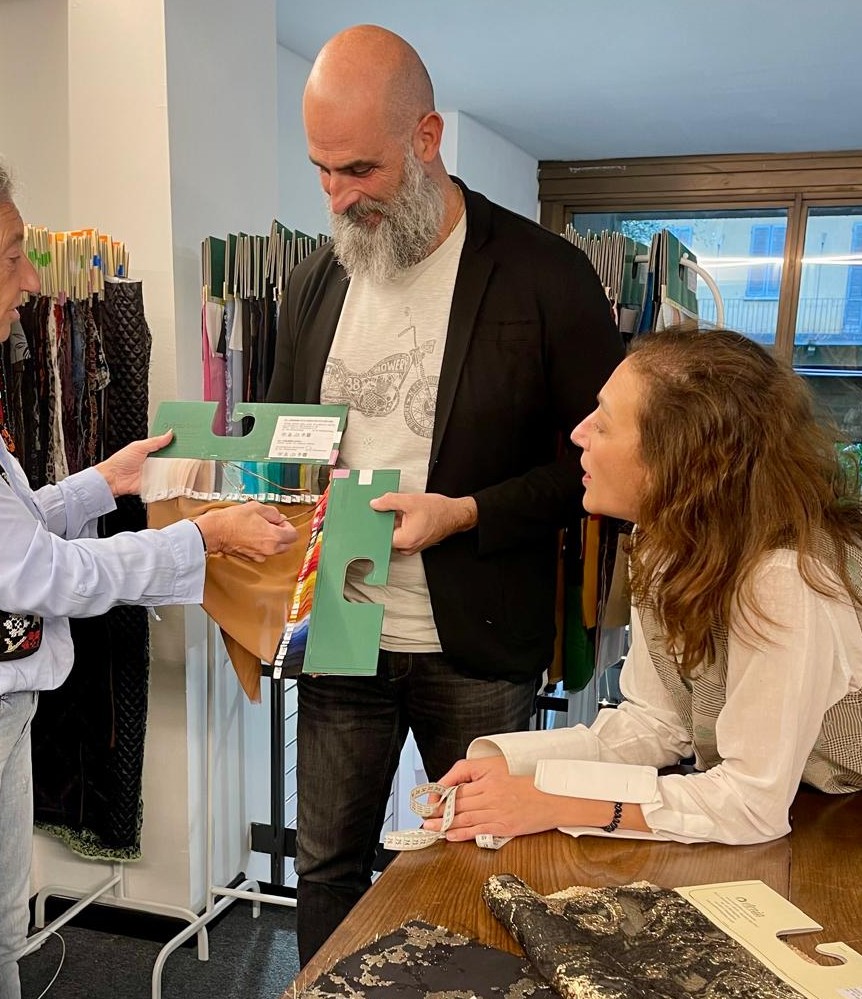
Custom fabric development in Italy from reference swatch to repeatable production
FAQ – Fashion Product Development: The Art of Listening Before Manufacturing
What does active listening mean in fashion product development?
It means understanding the request, clarifying priorities and reflecting that understanding back to the client for confirmation. Listening becomes operational when it produces shared requirements, not simply a pleasant conversation.
How can the Socratic approach inform fabric sourcing?
As an inspiration for dialogue: open questions help distinguish the desired result from the solution initially imagined. Technical expertise and samples then help assess the options. This is not an industrial protocol attributed to Socrates.
Can technical discussions change a designer’s original idea?
They can reveal alternatives, but should not replace the brand’s creative direction. Non-negotiable features need to be identified, and proposed adaptations should be explained and approved.
Can I approach ARNIA without a complete tech pack?
An initial discussion can start with the references and objectives available. Missing specifications must then be developed within an agreed scope before the production stages that require them. This does not imply free development work or confirmed feasibility.
How can a brand reduce repetitive email exchanges?
Group related questions, identify who can approve decisions and close each discussion with a written summary. A revision should state what changes and what needs checking, without leaving contradictory versions of the brief in circulation.
How do we check whether the result meets the original request?
Compare samples and the product against approved characteristics, acceptance criteria and creative priorities. Discuss differences explicitly: approval should concern identifiable features, rather than a general “looks fine”.


