
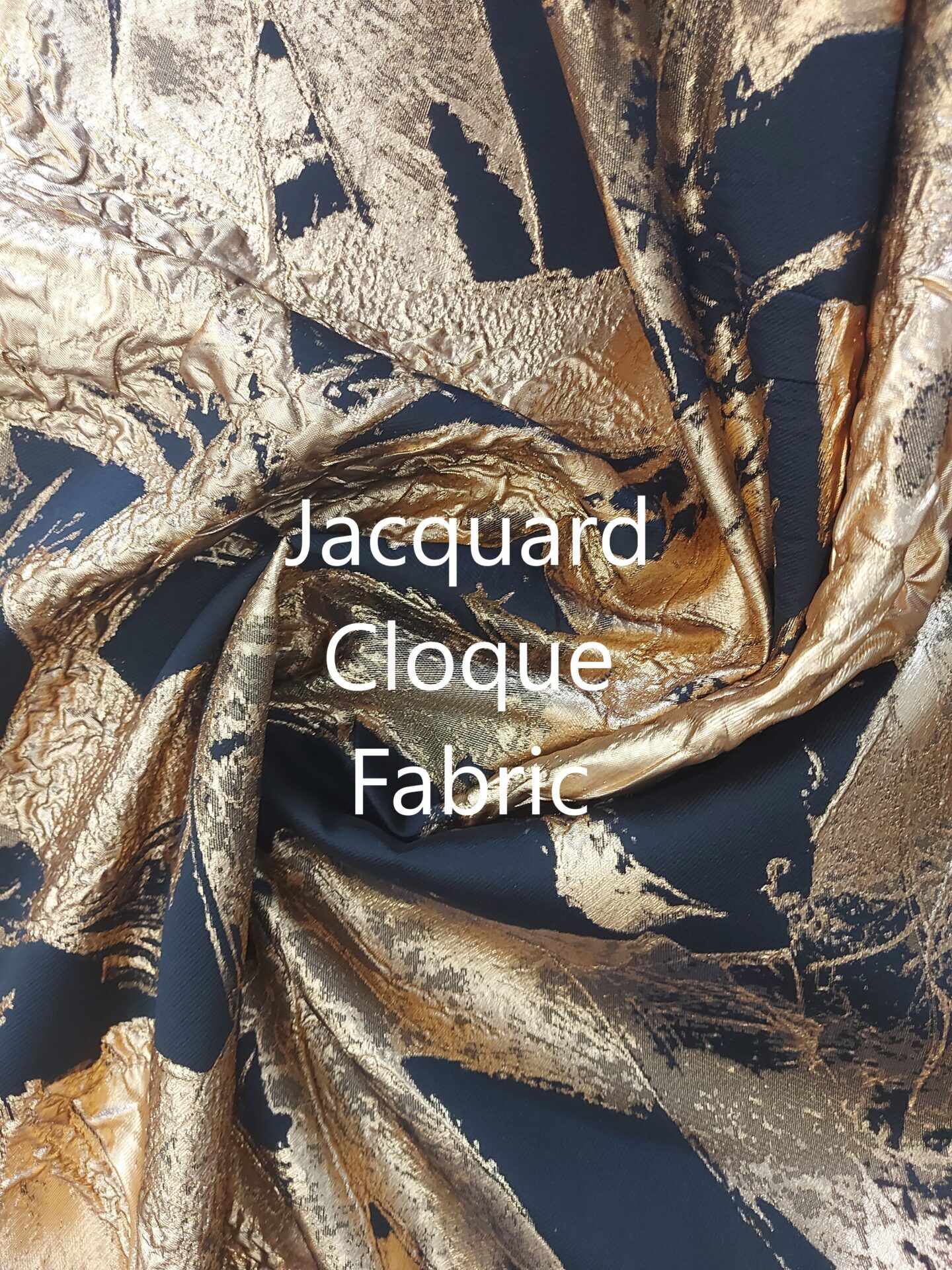
Jacquard cloque fabric is a woven textile in which pattern, yarn behavior and finishing interact to create a raised, puckered or blister-like surface.
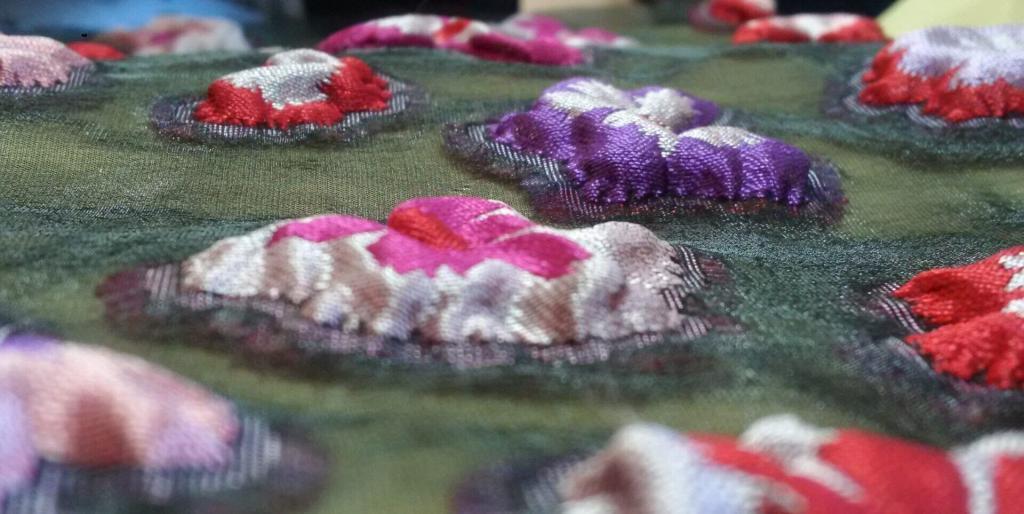
Jacquard cloque fabric with a raised three-dimensional woven surface – art. CIRCE
In strict textile terminology, cloque fabric is woven rather than knitted. “Jacquard” describes the patterning system that makes complex woven structures possible, while “cloqué” describes the dimensional surface effect. The two terms are therefore closely connected, but they are not interchangeable.
For fashion designers and fabric buyers, this distinction matters. The name jacquard cloque does not, by itself, reveal:
- the fibre composition;
- the exact weave construction;
- how the relief was produced;
- the finished weight;
- the dimensional stability;
- how the fabric will behave during cutting, sewing and pressing;
- whether the approved sample can be repeated in bulk.
A successful cloqué project therefore begins with the surface, but it must be validated through structure, application and production feasibility.
Key Takeaways
- Cloqué fabric is defined by its raised woven surface, not by one specific fibre.
- Jacquard cloqué is not automatically the same as matelassé, brocade, seersucker or an embossed fabric.
- Different textile constructions can produce visually similar cloqué effects.
- The intended garment must be considered before the fabric is approved.
- A visual reference alone is not sufficient for reliable custom development.
- Certification, origin and traceability must be confirmed article by article and lot by lot.
What Is Jacquard Cloque Fabric?
The Office Quebecois de la langue française defines cloqué as a woven fabric whose surface presents an irregular raised effect. It also specifies that the term should be used for woven fabric, rather than knitted fabric. The accented spelling cloqué is the preferred editorial form, although English-language searches frequently use the unaccented expression cloque fabric.
A jacquard loom or jacquard control system allows selected warp yarns to be controlled independently, making complex woven motifs and multiple structural zones possible. Historically, punched cards controlled the warp selections required for each part of a pattern.
In a jacquard cloqué fabric, this patterning capability can be used to create areas that behave differently from the surrounding ground. After weaving and finishing, these areas may rise, contract, expand or form pockets, producing the characteristic three-dimensional surface.
The essential distinction is:
Jacquard describes how a complex pattern or structure is controlled in the weave. Cloque describes the resulting raised or blistered surface.
Not every jacquard is cloque, and not every dimensional jacquard should automatically be labeled cloque.
Designers exploring dimensional woven surfaces can also review ARNIA’s broader range of Italian jacquard fabrics, including fil coupé, gobeline, velvet jacquard and heavyweight constructions.
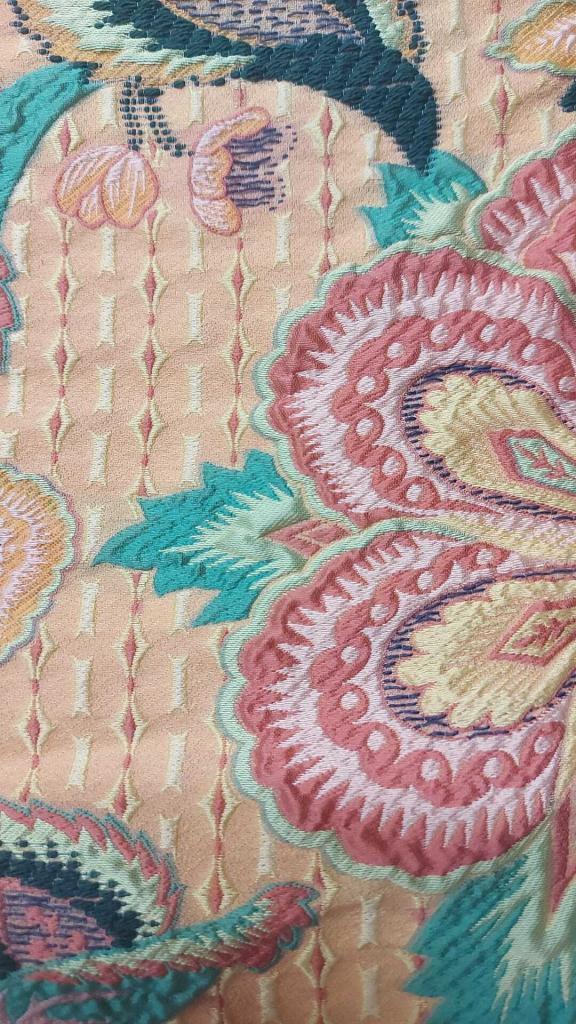
Jacquard cloque fabric with a raised three-dimensional woven surface – art. QUASANO jacquard cloque
Jacquard Cloque Is Not One Universal Construction
One of the most common oversimplifications is that cloque fabric is always created through differential shrinkage.
Differential shrinkage is an important route, but it is not the only one.
1. Double-Cloth or Pocket-Weave Construction
A historical textile preserved by the Smithsonian demonstrates a jacquard cloque-type construction made as a double-woven pocket weave. In this example, wool creates the ground while silk warp and weft form raised patterned areas. The fabric was marketed under the trade name “Klo-Ka,” derived from the French term cloqué.
This example is significant because it shows that a raised cloque surface can be structurally engineered through:
- two warp systems;
- two weft systems;
- selective interlacing;
- locally separated or connected woven layers;
- contrasting yarn behavior.
2. Differential-Shrinkage Yarns
Other woven constructions use yarn components that react differently during heat treatment. One component may contract while another remains longer or expands relative to it, producing bulk, undulation or surface relief after finishing. Technical patents document fabrics made with differentially shrinking yarn components specifically to create bulkier, textured woven surfaces.
3. Controlled Heat and Finishing
A cloqué or undulating effect can also be created or intensified after weaving through controlled thermal treatments. A documented process for synthetic fabrics uses sequential heat treatments and patterned resist application to create areas with different thread density and surface behavior.
4. Combined Construction and Finishing
In practice, a luxury jacquard cloque may combine:
- weave engineering;
- double-cloth structures;
- yarns with different shrinkage behavior;
- local floats or pockets;
- tension management;
- washing, steaming or heat setting;
- additional finishing processes.
For this reason, two fabrics that look similar in a photograph may behave very differently during garment development.
The commercial name is only the starting point. The technical construction must be confirmed for the specific article.
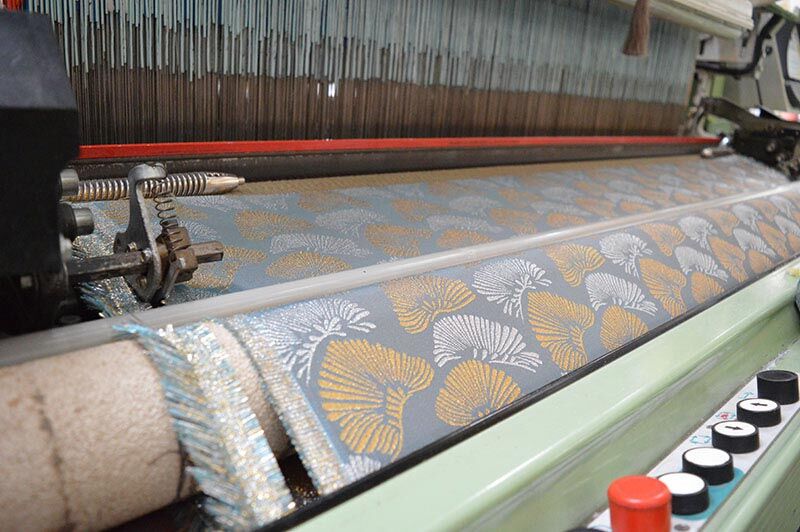
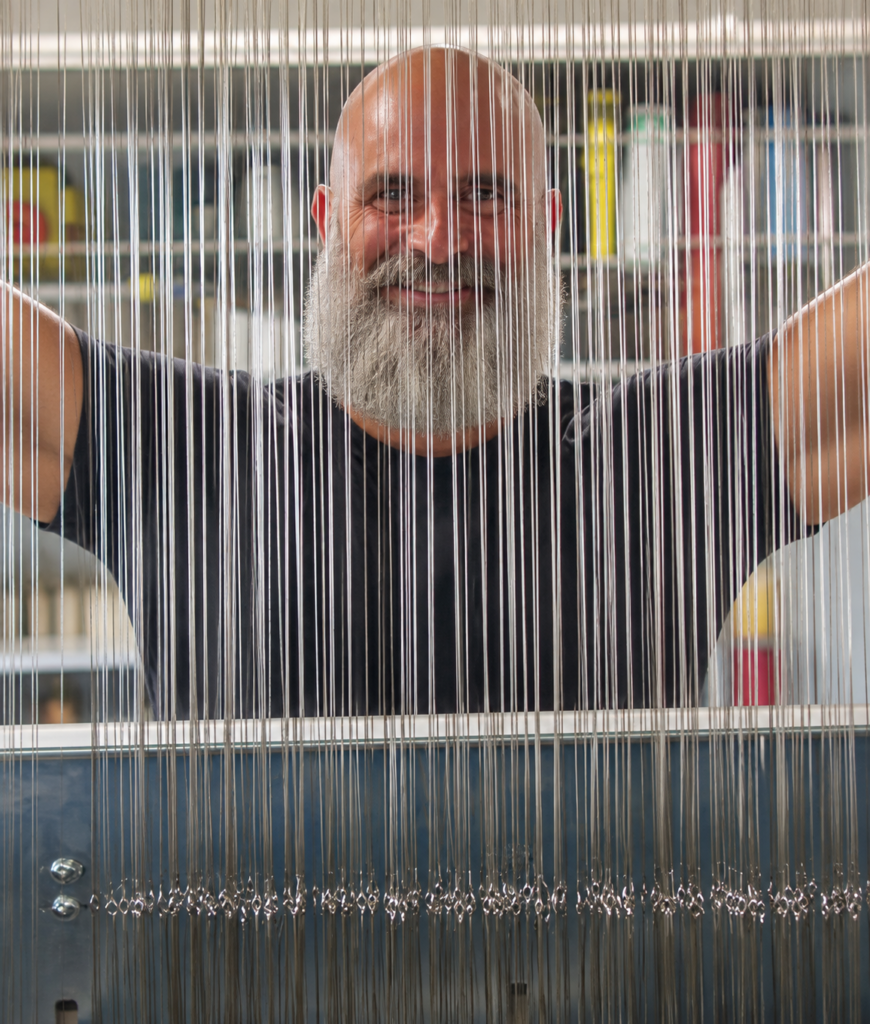
ARNIA MADE IN ITALY- loom
Cloque vs Matelasse, Brocade, Seersucker and Embossed Fabric
These fabrics may all create texture or visual depth, but their structures and development implications are different.
| Textile | Main Surface Effect | Typical Structural Principle | What a Buyer Should Verify |
|---|---|---|---|
| Jacquard Cloque | Irregular raised, puckered or blistered areas | Jacquard or figured weave, double cloth, yarn behaviour and/or finishing | How the relief is created; stability after finishing; face and reverse |
| Matelasse Fabric | Quilted, padded or cushioned appearance | Double or multilayer weave, sometimes with filling or wadding effects; often jacquard woven | Layer structure, weight, bulk, stitch points and garment suitability |
| Brocade | Ornate woven motifs, sometimes in relief | Figured jacquard weave, often with supplementary or floating yarn effects | Floats, abrasion sensitivity, motif repeat and yarn composition |
| Seersucker | Regular puckered stripes or checks | Different warp-yarn tensions during weaving | Genuine woven pucker versus applied finish; direction of the texture |
| Embossed or Cloque-Effect Fabric | Surface relief applied to an existing base | Mechanical, thermal or chemical post-weave treatment | Durability of the effect, care conditions and response to pressing |
Matelasse is generally associated with a more regular quilted effect and may use double or multilayer woven structures. The Office Quebecois de la langue française describes it as a fancy woven fabric with a padded appearance, commonly produced with jacquard patterning.
Brocade is primarily a decorative figured jacquard fabric. Its motifs may be raised, lustrous or multicolored, but the design effect does not necessarily create the irregular blistered surface associated with cloque.
Seersucker typically obtains its puckered areas through warp yarns held at different tensions, often producing regular stripes rather than isolated sculptural motifs.
The practical lesson is simple:
A three-dimensional appearance does not automatically identify the textile construction.
Is Cloque Always a Heavy Fabric?
No.
Cloqué describes a surface effect rather than a fixed weight category. The finished article may feel:
- light and crisp;
- dry and papery;
- softly structured;
- compact and sculptural;
- padded;
- fluid with local relief;
- firm enough to hold a silhouette.
A historical Smithsonian cloqué example combines wool and silk in a double-woven jacquard structure, while technical developments also document synthetic differential-shrinkage systems. This confirms that the term cannot be reduced to one composition or one physical profile.
Fashion history also demonstrates the breadth of possible applications. The Museum at the Fashion Institute of Technology has documented a navy-and-white cotton cloque dress and coat by Pauline Trigère, as well as a metallic cloqué bodice used with a gazar skirt.
The correct questions are therefore not:
- “Is cloque heavy?”
- “Is cloqué made from silk?”
- “Is cloque suitable for a dress?”
The correct questions are:
- What is the exact composition?
- What is the finished weight?
- How much body does the fabric have?
- How deep is the relief?
- How stable is the structure?
- What garment is being developed?
Why Luxury Fashion Uses Jacquard Cloque
Jacquard cloqué fabric creates volume and visual depth without requiring a separate embroidered or applied decoration.
The relief interacts with light, producing:
- shadow;
- tonal variation;
- changing visual depth;
- different effects in movement;
- a strong tactile identity.
This makes cloqué particularly relevant to premium and luxury collections in which the textile itself becomes part of the design language.
Potential applications include:
- structured or semi-structured dresses;
- cocktail and occasion-wear;
- sculptural skirts;
- fitted or boxy jackets;
- statement tops;
- selective garment panels;
- outer layers;
- accessories;
- limited capsule pieces.
However, suitability must always be assessed against the specific weight, scale, composition and finished hand.
A lightweight cloque may support a dress or top. A compact, high-relief article may be more suitable for a jacket, skirt or controlled panel. A very large repeat may dominate a small garment component, while a small repeat may lose impact on a voluminous silhouette.
Surface Beauty Is Not the Same as Garment Feasibility
A jacquard cloque can look highly attractive as a small swatch but behave differently when extended across a complete garment.
Before approving the fabric, the product-development team should evaluate:
Motif Scale
The repeat must be proportionate to:
- the size of the garment;
- the size of individual pattern pieces;
- the intended visual focal point;
- the grading range.
Relief Placement
Raised areas may cross:
- darts;
- princess seams;
- pockets;
- collars;
- lapels;
- waist seams;
- zips;
- buttonholes.
The placement can affect both appearance and construction.
Face and Reverse
The reverse may contain:
- floats;
- binder yarns;
- joining points;
- pocket structures;
- contrasting colours;
- yarn concentrations.
It should be examined before deciding whether lining is necessary.
Dimensional Stability
A fabric whose surface depends on shrinkage or finishing must be evaluated for:
- residual shrinkage;
- relaxation;
- response to steam;
- response to pressing;
- width stability;
- repeat stability.
Seam Bulk
Raised areas can create uneven thickness inside a seam allowance. This may influence:
- seam balance;
- feed during sewing;
- top-stitching;
- edge definition;
- zipper insertion;
- hem construction.
Pressing
Excessive pressure, heat or steam may alter a three-dimensional surface. Pressing parameters must therefore be tested on an off-cut or development sample before they are applied to the garment.
The supplier-approved care and pressing instructions must take precedence over generic recommendations.
Cutting and Pattern Placement for Jacquard Cloque
Pattern placement should be planned before the final fabric consumption is calculated.
Match the Design Intentionally
A visible jacquard repeat may require matching across:
- center-front panels;
- center-back seams;
- side seams;
- sleeves;
- collars;
- pockets.
Matching increases fabric consumption and cutting waste.
Decide Whether the Relief Should Be Symmetrical
Perfect symmetry can reinforce a formal luxury appearance. Deliberate asymmetry can create a more contemporary result.
The decision should be made at design stage rather than during cutting.
Check the Direction of the Surface
The relief may react differently when viewed from opposite directions. Light, shadow and motif orientation should therefore be checked on the mannequin or prototype.
Test Curved Areas
A sculptural surface may behave differently around:
- bust shaping;
- shoulders;
- sleeves;
- hips;
- curved waistlines.
A flat swatch cannot predict every three-dimensional result.
Validate the Garment Prototype
For complex textured fabrics, a prototype is not merely a visual sample. It should confirm:
- silhouette;
- volume;
- seam construction;
- pressing;
- lining;
- closures;
- motif placement;
- consumption;
- manufacturing time.
ARNIA’s Cut & Sew development and production process connects textile selection with pattern, prototype, industrialisation and production review.
Three Routes for Sourcing Jacquard Cloque Fabric
A buyer does not always need a fully custom development.
The most realistic route depends on the creative objective, volume, timing and target price.
Route 1 — Existing Collection Article
An existing jacquard cloqué fabric may already offer:
- a suitable construction;
- an acceptable weight;
- available sampling;
- known production parameters;
- a lower development burden.
Possible customisation may be limited to colour or finishing.
Route 2 — Adapted Development
An existing construction may be adapted through:
- a new colorway;
- different yarn combinations;
- altered contrast;
- modified relief;
- adjusted finishing;
- changes to motif scale.
Even a seemingly simple change can affect shrinkage, handle, weight and repeatability.
Route 3 — Fully Custom Jacquard Cloque
A custom development may begin from:
- a creative brief;
- an archive textile;
- a physical swatch;
- a garment reference;
- an original artwork;
- a photograph;
- a requested surface direction.
A photograph can communicate the intended appearance, but it cannot reliably reveal:
- fibre composition;
- weave construction;
- reverse side;
- weight;
- width;
- yarn count;
- shrinkage;
- finishing route;
- industrial repeatability.
For this reason, a physical reference and a complete technical brief significantly improve the reliability of custom development.
ARNIA supports technical fabric sourcing and custom fabric development in Italy through collection research, swatch matching, adapted routes and project-specific developments.
What Must Be Defined Before Sampling
A professional jacquard cloqué brief should include:
| Required Input | Why It Matters |
|---|---|
| Intended garment | Determines required body, drape and surface scale |
| Expected metres or units | Affects development route and feasibility |
| Preferred composition | Influences hand, care, certification and price |
| Target weight | Determines garment suitability |
| Required width | Affects pattern efficiency and consumption |
| Motif scale and repeat | Influences design placement and loom setup |
| Colour direction | Affects yarn selection and finishing |
| Target hand | Clarifies crisp, soft, dry or structured expectations |
| Target price architecture | Prevents technically unsuitable developments |
| Required timing | Determines realistic sampling and production route |
| Intended sales markets | Affects labeling and compliance requirements |
| Certification needs | Must be assessed before material selection |
| Continuity expectations | Distinguishes one capsule from repeat production |
A beautiful visual reference is not a complete development brief.
Jacquard-cloque-fabric-with-a-raised-three-dimensional-woven-surface
From First Swatch to Repeatable Bulk Production
The objective of development is not simply to produce one attractive sample.
The objective is to create an article that can be:
- specified;
- approved;
- ordered;
- documented;
- reproduced within agreed tolerances.
A robust approval should define:
- article code;
- fibre composition;
- colour standard;
- face and reverse;
- finished width;
- finished weight;
- motif repeat;
- surface depth or agreed visual reference;
- shrinkage and dimensional behavior;
- finishing route;
- care conditions;
- approved physical master;
- acceptable lot variation;
- production MOQ;
- applicable documentation.
The approved sample should be connected to a technical specification. Without that connection, “sample approved” may remain an aesthetic decision rather than a reliable production reference.
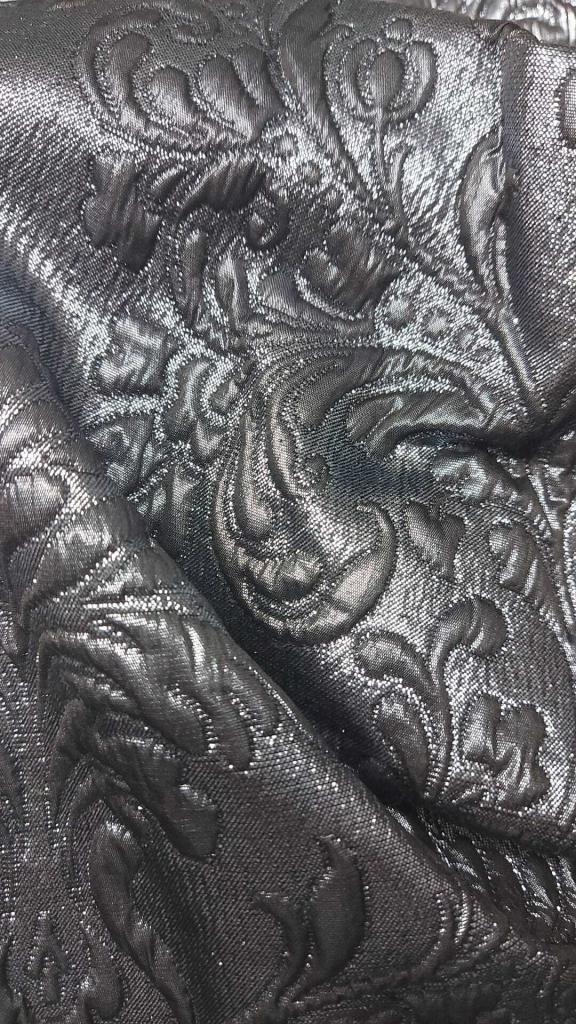
Jacquard cloque fabric with a raised three-dimensional woven surface – art TRICASE jacquard cloque
Can Jacquard Cloque Fabric Be Sustainable or Certified?
Cloqué is a textile structure or surface effect. It is not, by itself, an environmental certification or sustainability claim.
The environmental and compliance profile depends on factors including:
- fibre origin;
- yarn production;
- weaving;
- dyeing;
- finishing;
- chemical inputs;
- energy and water use;
- durability;
- production quantity;
- waste;
- transport;
- traceability;
- certification pathway.
GOTS, GRS, FSC or other relevant material pathways may be available for specific articles, subject to:
- the active certification scope;
- the selected fibre and process;
- the production partner;
- the order quantity;
- segregation requirements;
- Chain of Custody;
- Transaction Certificate feasibility.
An upstream certified fabric does not automatically make a finished garment certified.
For a detailed explanation, read:
- Certified Fabric vs Certified Garment: GOTS, GRS and FSC
- Transaction Certificates, MOQ and Chain of Custody
Certification and marketing claims must be confirmed for the specific article, colour, production lot and order.
Jacquard Cloque Development in the Lombardy Textile District
Three-dimensional jacquard development rarely depends on one isolated operation.
It may require coordination between:
- yarn sourcing;
- jacquard design;
- weaving;
- dyeing;
- heat treatment;
- washing;
- finishing;
- testing;
- garment prototyping.
The Lombardy Textile District connects specialised capabilities across Como, Varese and Milan. ARNIA TEXTILE FASHION operates as an Italian textile converter and production partner, coordinating selected mills and workshops while retaining responsibility for project direction, documentation, quality oversight, traceability and client communication.
This structure allows a brand to evaluate the textile together with:
- its intended garment;
- its production quantities;
- its target price architecture;
- its compliance requirements;
- its repeatability needs.
Learn more about the Lombardy Textile District and its specialised production ecosystem.
ARNIA TEXTILE Jacquard range type:
How ARNIA Supports a Jacquard Cloque Project
ARNIA can evaluate different project routes.
Fabric Selection
For brands seeking an existing textured jacquard with a suitable weight, hand and production route.
Adapted Jacquard Development
For projects requiring a new colour, yarn combination, scale or finish based on an existing construction.
Custom Fabric Development
For brands starting from a brief, swatch, archive reference or original design.
Fabric and Garment Feasibility
For teams that need to understand how the textile will behave in a specific silhouette before confirming production.
Fabric Plus Cut & Sew
For projects requiring coordinated textile development, garment prototyping, industrialisation and capsule production.
Availability, feasibility, pricing, timing, Made in Italy origin and certification pathways are confirmed project by project after technical review.
Fashion brands can submit their textile or garment requirements through the ARNIA Textile Project Brief.
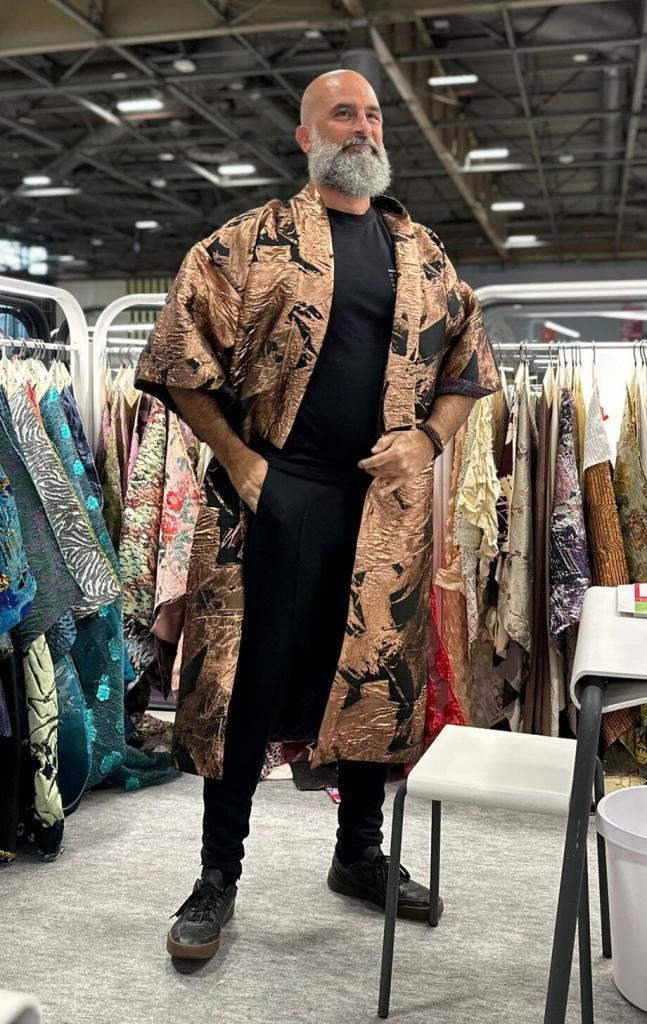
Jacquard cloque fabric with a raised three-dimensional woven surface – art. PROVA 44
Buyer Checklist Before Ordering Jacquard Cloque
Before confirming a jacquard cloqué fabric, verify:
- Is the fabric genuinely woven?
- What creates the raised surface?
- What is the full fibre composition?
- What are the finished weight and width?
- What is the motif repeat?
- How different are the face and reverse?
- Does the surface change after steaming or pressing?
- What are the shrinkage and stability values?
- Does the fabric require lining?
- Can the motif be matched across garment panels?
- Has a garment prototype been completed?
- What is the realistic production MOQ?
- Can the same yarns and finishing route be repeated?
- What documentation will accompany the production lot?
- Are certification and origin claims confirmed in writing?
Related ARNIA Textile Guides
Continue exploring specialist woven fabrics and Made in Italy development:
- Italian Jacquard Fabrics for Luxury Fashion
- Jacquard Fil Coupé: Woven Texture and Transparency
- Jacquard Gobeline: Structure, Heritage and Garment Uses
- Heavyweight Jacquard Fabrics
- Velvet Jacquard Fabrics
- Fabric Sourcing and Custom Textile Development
- Italian Cut & Sew Services
Selected Technical References
- The Office Quebecois de la langue française defines cloqué as a woven fabric with an irregular raised surface and distinguishes the term from knitted fabric.
- Its matelassé definition describes a double or multilayer fancy weave with a quilted appearance, frequently produced through jacquard patterning.
- The Smithsonian’s “Klo-Ka” textile documents a silk-and-wool, double-woven pocket-weave jacquard associated with the French term cloqué.
- Patented woven constructions demonstrate how differential yarn shrinkage can create bulk and dimensional surface effects.
- The Museum at FIT has documented cloqué in cotton dress-and-coat construction and in a metallic bodice, illustrating the material’s range of garment applications.
FAQ — Jacquard Cloque Fabric
What is jacquard cloque fabric?
Jacquard cloque fabric is a woven textile with a deliberately raised, puckered or blistered surface. Jacquard patterning helps control the woven design, while the cloqué effect may result from the structure, yarn behavior, finishing or a combination of these elements.
Is “cloqué” or “cloque” the correct spelling?
Cloqué is the preferred French spelling. Cloque fabric is widely used in English searches and commercial descriptions. The accented form is preferable in editorial text, while the unaccented form can be included naturally for search visibility.
Is every cloque fabric a jacquard?
No. Complex figured cloque fabrics are frequently developed with jacquard weaving, but cloque describes the raised woven effect rather than one mandatory loom or construction.
Is cloque fabric woven or knitted?
Strict textile terminology defines cloqué as woven. Some commercial descriptions use expressions such as “cloqué effect” for knitted or embossed surfaces, so the actual construction should always be confirmed.
What is the difference between cloque and matelasse?
Cloqué generally has an irregular blistered or puckered surface. Matelasse normally presents a more regular quilted or padded appearance and often uses double or multilayer woven structures.
What is the difference between cloque and brocade?
Brocade is primarily a decorative figured woven fabric, often created through supplementary or floating yarn effects. Cloque is identified by its dimensional, raised or puckered surface. A fabric may combine characteristics of both, but the terms are not synonymous.
What fibres can be used in cloque fabric?
There is no single required fibre. Cloque constructions may use natural fibres, regenerated fibres, synthetic fibres or blends. The composition must be checked for the specific article.
Is cloque suitable for dresses?
It can be, provided the weight, hand, relief and stability suit the silhouette. Lightweight or medium-weight qualities may work for dresses, while more compact constructions may be better suited to jackets, skirts or structured panels.
Does cloque fabric stretch?
The word cloqué does not imply stretch. Stretch depends on the yarns, weave construction, elastomer content and finishing. Apparent surface flexibility should not be confused with measured elastic recovery.
Can a jacquard cloque be developed from a photograph?
A photograph can define the desired visual direction, but it cannot reveal composition, weight, reverse construction, shrinkage or finishing. A physical swatch and technical brief provide a more reliable basis for development.
What is the MOQ for custom jacquard cloque?
MOQ depends on yarn availability, loom setup, motif complexity, colour, finishing and certification requirements. It must be evaluated project by project.
Can jacquard cloque fabric be GOTS, GRS or FSC certified?
Potentially, when the selected materials, facilities, processes, order quantity and Chain of Custody meet the applicable standard. Certification cannot be assumed from the fabric name and must be confirmed for the specific article and production lot.
How should cloque fabric be pressed?
Pressing must follow the technical instructions for the specific article. High pressure, heat or steam may alter some raised surfaces, so an off-cut or prototype test should be completed before final garment pressing.
Why is a garment prototype important?
A prototype reveals how the relief behaves across seams, curves, closures, lining, pressing and motif placement. It is the most reliable way to connect fabric approval with production feasibility.
How can a brand start a Jacquard Cloque project with ARNIA TEXTILE?
Prepare the intended garment category, expected metres or units, creative reference, preferred composition, target timing, target price architecture and any certification or traceability requirements. Submit the information through the ARNIA Textile Project Brief.


