
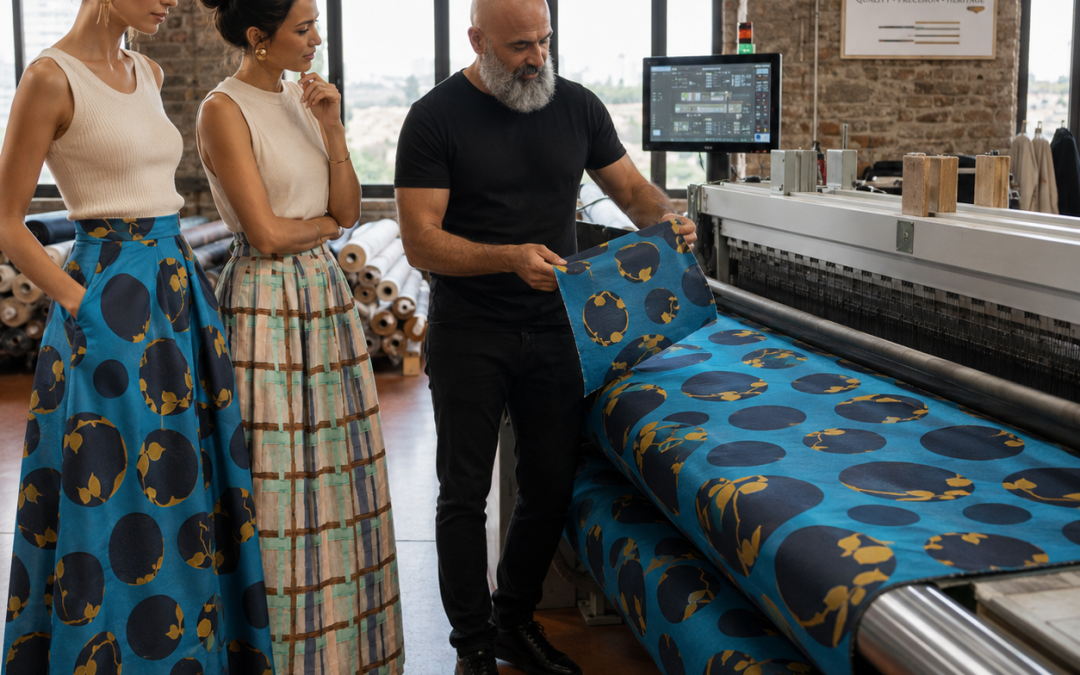
Fashion brands frequently use the words Italian Textile Converter, textile mill, specialist supplier and sourcing agent as if they described the same role.
They do not.
A mill physically performs one or more textile manufacturing processes. A specialist may have exceptional expertise in a single operation, such as weaving, printing, dyeing, embroidery or finishing. A sourcing agent normally helps a client identify and communicate with suppliers.
An Italian textile converter performs a different integrating function.
It connects a creative or commercial brief with the combination of materials, processes, suppliers, tests, approvals, quality controls and documentation needed to turn that brief into a repeatable, market-ready textile article.
In the traditional definition, a textile converter buys or commissions greige fabric—the unfinished fabric coming from a loom or knitting machine—and arranges preparation, dyeing, printing and finishing before selling the completed fabric.
In contemporary Italian luxury textiles, the converter’s role may begin much earlier. It can include creative research, fabric engineering, yarn and base-cloth selection, target-price alignment, sampling, supplier coordination, quality control, traceability, certification planning and delivery.
The essential distinction is therefore not whether the company owns a particular machine.
The essential distinction is whether it assumes responsibility for integrating the whole textile route.
Industry definitions describe the converter as the organization that transforms greige or semi-processed fabric into a finished, commercially usable textile and coordinates the necessary processing stages. Contemporary Italian converter models may also include design, development, sampling and manufacturing coordination through specialist networks.
At ARNIA TEXTILE FASHION, this means connecting creative direction, technical feasibility, selected Lombardy production partners, quality oversight, project-specific documentation and responsible Made in Italy production through one accountable management framework.
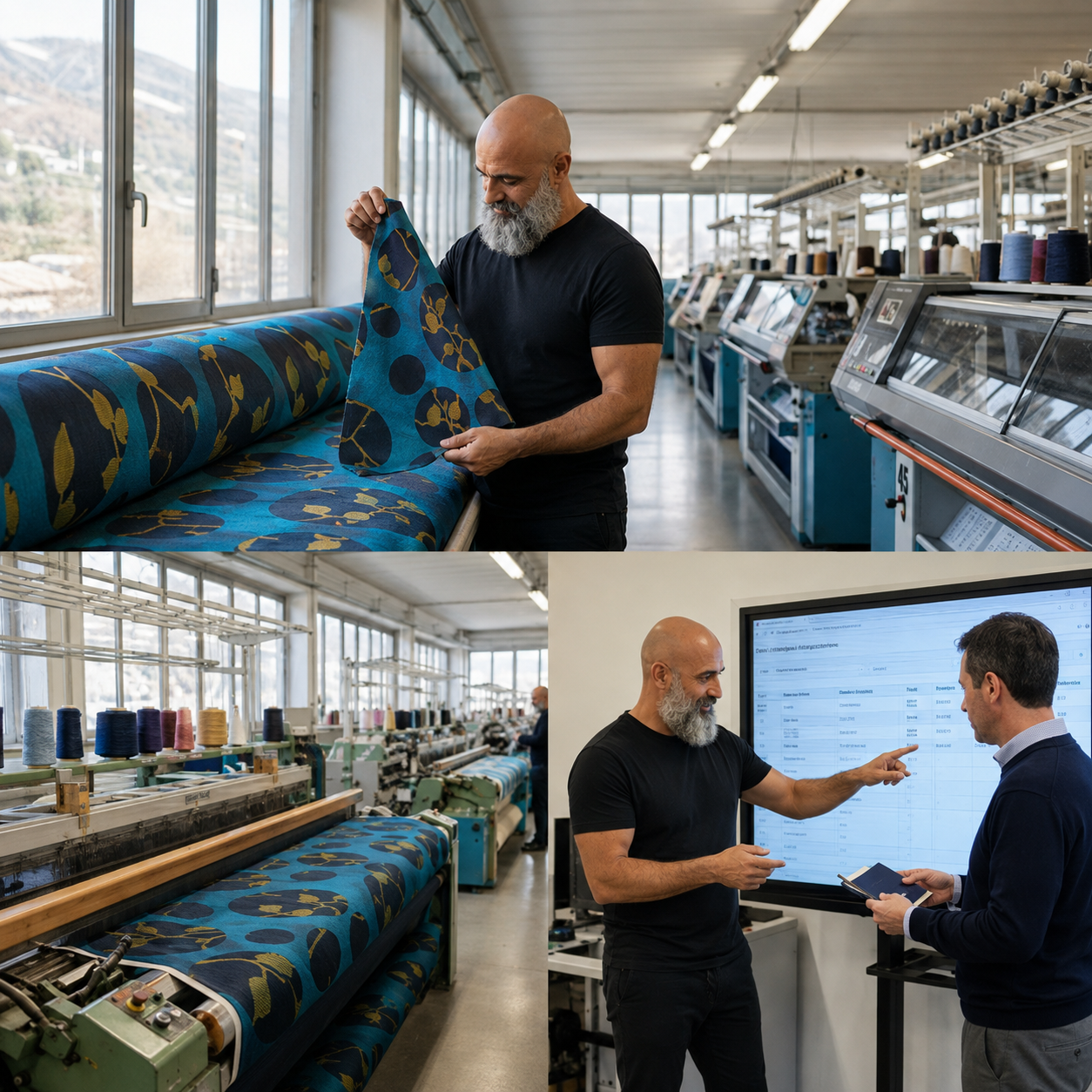
Italian textile converter coordinating mills, printers and finishers in the Lombardy Textile District
Quick Answer: What Is an Italian Textile Converter?
An Italian textile converter is a B2B textile company that transforms a design idea, fabric brief or unfinished textile base into a finished, repeatable and commercially viable fabric.
The converter normally coordinates several connected activities:
- product and fabric research;
- yarn or base-cloth selection;
- weaving or knitting;
- preparation;
- dyeing;
- printing;
- embroidery;
- coating, lamination or special finishes;
- quality control;
- testing;
- traceability;
- certification documentation;
- delivery planning.
A converter may perform some operations internally and outsource others to selected specialists.
It may also purchase materials, place processing orders, take ownership of the goods and sell the finished fabric in its own name. In other projects, it may operate through a project-management or development agreement.
The precise ownership, warranty, liability and commercial responsibilities depend on the contract.
The core function remains the same:
A mill controls a machine park. A specialist controls a process. A sourcing agent connects parties. A textile converter integrates the product route.
1. The Traditional Textile Converter
Historically, the classic textile converter worked with greige goods.
Greige fabric is woven or knitted material that has not yet completed the wet-processing and finishing stages required to make it suitable for final use.
The converter would:
- select or purchase the greige fabric;
- define the required color, print or finish;
- allocate the work to specialist dye-houses, printers and finishers;
- control the results;
- sell the completed fabric to garment manufacturers, wholesalers, retailers or fashion brands.
This model was particularly important in textile districts where companies specialized in individual stages rather than carrying out every operation inside one large vertically integrated factory.
The converter became the connecting intelligence between those specialized companies.
2. The Contemporary Italian Textile Converter
The role has evolved.
Today, an Italian textile converter working with premium or luxury fashion brands may start not from an existing greige fabric, but from:
- a moodboard;
- a physical swatch;
- an archive textile;
- a photograph;
- an artwork;
- a garment reference;
- a required hand feel;
- a target selling price;
- a sustainability objective;
- an expected production quantity.
The converter must then determine what is technically realistic.
For example:
- Should the effect be woven, printed, embroidered or finished?
- Which fiber and yarn can create the required appearance?
- Is a stock-supported base suitable?
- Is a new weaving construction necessary?
- Can the visual result be industrially repeated?
- Will the fabric behave correctly after garment construction?
- Is the requested price compatible with the chosen process?
- Can the material be reordered?
- Can the planned environmental claim be documented?
- Is the production quantity sufficient for the process and certification route?
This makes the contemporary textile converter closer to a combination of:
- product developer;
- textile engineer;
- sourcing manager;
- supply-chain coordinator;
- quality manager;
- commercial risk manager.
It does not mean that the converter replaces each specialist.
It means that the converter connects their specialist knowledge into one product route.
AW27/28 Italian Fancy Fabrics at Première Vision Paris
3. Textile Converter vs Mill vs Specialist vs Sourcing Agent
| Role | Primary function | Typical physical production | Commercial role | Main value | Main limitation |
|---|---|---|---|---|---|
| Textile mill | Manufactures yarn, woven or knitted fabric, or performs another defined industrial process | Usually owns and operates machinery | Sells its own production or processing capacity | Direct technical control, capacity and process depth | Often optimized around its own machinery, materials and production economics |
| Highly specialized supplier | Performs one specific operation such as printing, dyeing, embroidery or finishing | Owns specialist equipment and know-how | Sells a specialized processing service or finished output | Very deep expertise in one technique | May not control upstream materials or downstream transformations |
| Textile converter | Integrates materials, processes and specialist partners into a finished textile route | May own some equipment, but may also use an external network | Often purchases, develops, coordinates and sells the finished article | One integrated route, flexibility, product vision, quality and risk coordination | Quality depends on the strength of its network, controls and transparency |
| Sourcing agent | Finds, introduces or negotiates with suppliers on behalf of a client | Normally none | Usually acts for the buyer and is paid a fee or commission | Local access, language support, supplier search and negotiation | Technical integration, ownership and warranty responsibilities may be limited |
| Vertically integrated manufacturer | Performs several production stages within one industrial group | Owns multiple departments | Manufactures and sells directly | Strong internal control and scale | Higher fixed structure and potentially less neutrality between alternative processes |
A sourcing agent commonly acts on behalf of a principal without taking ownership of the goods, although the exact role always depends on the agreement. A distributor or converter may instead take ownership and resell the product.
A converter can also be partly verticalised. Some converters own printing, finishing, coating or inspection departments while continuing to coordinate other external processes.
Therefore:
“Converter” describes an integrating business function, not a prohibition against owning machinery.
4. A Converter Is Not Simply a Broker
A broker’s principal task is to bring parties together.
A serious textile converter goes further.
The converter should understand:
- how the material was constructed;
- which preparation route it needs;
- which process can create the required effect;
- how the fabric will change during processing;
- where dimensional or color risks may appear;
- how to approve a sample;
- how to translate the sample into bulk production;
- how to define responsibilities;
- how to manage a non-conformity;
- which documents must follow the product.
The converter may also be the company invoicing the finished fabric and responding commercially to the client.
This does not mean that every risk is automatically transferred to the converter. Contracts, specifications, tolerances, approvals and general sales conditions remain essential.
It means that the converter should not disappear when two production stages do not communicate correctly.
5. How an Italian Textile Converter Works Step by Step
Step 1 — Understanding the brief
The first task is not to select a supplier.
It is to understand the intended product.
A complete brief may include:
- garment or accessory category;
- visual direction;
- fiber preference;
- target hand feel;
- fabric weight;
- transparency or opacity;
- required performance;
- expected quantity;
- target cost;
- sales channel;
- launch date;
- certification or traceability requirements.
Without this information, a supplier can propose a beautiful fabric that is wrong for the product, price or market.
Step 2 — Translating the brief into a textile specification
The converter translates creative language into technical decisions.
“Soft but structured” may require decisions about:
- fiber;
- yarn count;
- yarn twist;
- weave;
- density;
- weight;
- finish;
- mechanical treatment.
“Luxury print” may require choices concerning:
- base construction;
- preparation;
- dyestuff chemistry;
- print technology;
- penetration;
- color fastness;
- final hand.
The specification is the bridge between the creative team and the production network.
Step 3 — Choosing the route
A converter should not select a process only because it owns or regularly sells that process.
It should evaluate the route that best serves the approved product.
A decorative effect could be created through:
- jacquard weaving;
- fil coupé;
- digital printing;
- rotary printing;
- flat-screen printing;
- embroidery;
- foil;
- coating;
- devoré;
- plissé;
- laser cutting;
- a combination of processes.
The correct route depends on appearance, repeatability, quantity, cost, timing and final use.
Step 4 — Selecting the specialists
The converter allocates the individual stages to mills and workshops whose equipment and know-how fit the project.
This may include:
- yarn suppliers;
- weaving mills;
- knitting mills;
- fabric-preparation specialists;
- dye-houses;
- printers;
- embroidery companies;
- coating and lamination specialists;
- finishing companies;
- inspection services;
- testing laboratories;
- garment manufacturers.
Supplier selection should not be based only on price.
It should also consider:
- technical suitability;
- reliability;
- capacity;
- documentation;
- workplace conditions;
- subcontracting practices;
- ability to repeat the result;
- willingness to communicate problems;
- alignment with the required ethical framework.
Step 5 — Creating and approving trials
Depending on the product, development may require:
- yarn trials;
- weaving trials;
- lab dips;
- strike-offs;
- print panels;
- finishing trials;
- embroidery samples;
- hand-feel tests;
- wash tests;
- garment prototypes.
Each approval should have a clear purpose.
A color approval does not automatically approve hand feel.
A print approval does not automatically approve bulk width.
A prototype does not automatically approve production cost.
A fabric swatch does not automatically confirm certification eligibility.
Step 6 — Locking the approved standard
Before bulk production, the parties should identify the approved reference.
This may include:
- physical standard;
- article code;
- composition;
- weight and width;
- construction;
- color reference;
- approved lab dip or strike-off;
- finishing route;
- tolerances;
- testing requirements;
- documentation;
- intended claim.
Without a locked standard, quality becomes subjective.
Step 7 — Planning bulk production
The converter coordinates:
- material availability;
- processing sequence;
- production capacity;
- technical MOQ;
- expected lead time;
- approval gates;
- inspection stages;
- documentation requirements;
- transport.
A realistic production calendar must include waiting time between operations, not only machine time.
Step 8 — Monitoring intermediate stages
The highest-value control often happens before final inspection.
Intermediate monitoring may identify:
- incorrect base cloth;
- wrong yarn;
- incomplete preparation;
- color drift;
- fabric bow or skew;
- excessive shrinkage;
- incorrect width;
- print-registration problems;
- finishing changes;
- unapproved subcontracting;
- documentation gaps.
Correcting a problem at this stage is normally less damaging than finding it after the final fabric has been delivered.
Step 9 — Final inspection and documentation
The final review may involve:
- visual inspection;
- measurement of width and weight;
- shade continuity;
- defect mapping;
- roll identification;
- quantity reconciliation;
- test reports;
- composition information;
- certification documentation where applicable;
- packing and shipment instructions.
Step 10 — Learning from the production lot
A converter should preserve the production history required for:
- repeat orders;
- color continuity;
- corrective actions;
- future developments;
- claim substantiation;
- supplier evaluation.
The objective is not only to deliver one order.
It is to build repeatable product knowledge.
6. Why the Lombardy Textile District Matters
The Lombardy Textile District is not one single industrial site.
It is a concentrated ecosystem of companies, technicians, craftspeople, designers, laboratories and production specialists.
Within ARNIA’s working area:
- Varese and the Busto Arsizio–Gallarate area contribute cotton weaving, dyeing, finishing and industrial embroidery expertise;
- Como contributes silk culture, jacquard, textile design, printing and specialist finishing;
- Milan contributes design, product development, pattern making, prototyping and garment production.
ARNIA’s current company profile describes these capabilities as a connected Lombardy-based network, with most of its production partners located in the region.
Como has also been recognized as a UNESCO Creative City for its textile and silk culture. Regione Lombardia describes the area as a centre where technical and artistic skills transmitted across generations have continued to develop through innovation, education, artisanship and industrial activity.
The district as a distributed factory
The Lombardy Textile District can be understood as a distributed factory.
One company may weave.
Another may prepare the greige.
Another may print.
Another may wash and finish.
Another may embroider.
Another may inspect.
Another may make the garment.
The converter’s task is to make this distributed structure work as one coherent production route.
The value is in the handovers
The value of a textile district is not only the excellence of each company.
It is the quality of the handovers between them.
A technically perfect weaving lot can fail if it is prepared incorrectly.
A perfectly prepared base can be damaged by the wrong print chemistry.
A strong print can change after finishing.
A beautiful fabric can become commercially unusable if width or shrinkage is wrong for the garment.
The converter manages these interfaces.
That is where much of the hidden value lies.
Read more in Lombardy Textile District: Why Short Supply Chains Reduce Fashion Production Risk.
7. The Chain of Professional Expertise
A high-end fabric is rarely the result of one isolated operation.
| Stage | Specialist knowledge | Main risk if disconnected |
|---|---|---|
| Fibre and yarn | Composition, count, twist, lustre, strength, dye affinity | Incorrect performance, appearance or certification basis |
| Weaving or knitting | Construction, density, tension, repeat, stability | Wrong weight, width, drape or dimensional behavior |
| Preparation | Desizing, scouring, bleaching, degumming, heat setting | Uneven color, print defects, contamination or instability |
| Dyeing | Fibre chemistry, recipe, fixation, washing-off | Shade variation, poor fastness or hand change |
| Printing | Artwork, separation, paste or ink, registration, penetration | Poor definition, wrong color, pale reverse or repeat inconsistency |
| Finishing | Washing, softening, calendaring, raising, coating, dimensional setting | Altered width, weight, shade, hand or performance |
| Embroidery and surface effects | Support stability, thread, tension, placement | Distortion, puckering, damage or repeatability problems |
| Quality control | Standards, tolerances, inspection method, defect analysis | Late detection and subjective acceptance |
| Compliance and documentation | Composition, traceability, tests, Chain of Custody, claims | Legal, buyer, certification or reputation risk |
| Garment production | Consumption, cutting, construction, pressing and fit | Fabric may fail in its intended application |
No single participant necessarily controls every stage.
The converter creates continuity between them.
8. The Printing Example: Why a Pure Printer Cannot Control the Whole Product
A specialist textile printer can possess extraordinary expertise in color, chemistry, screens, digital files, registration and fixation.
But print quality begins before the fabric reaches the printing machine.
A base fabric may contain:
- weaving size;
- oils;
- waxes;
- dirt;
- loose fibers;
- neps;
- uneven absorbency;
- bow or skew;
- dimensional instability.
If preparation is inadequate, the result can include:
- white or pale points;
- halos;
- uneven grounds;
- poor penetration;
- weak color;
- registration problems;
- inconsistent hand feel.
ARNIA’s detailed guide to Textile Printing Techniques explains why desizing, scouring, fiber chemistry, fabric structure, fixation and finishing are part of print quality—not separate considerations.
What the pure printer controls
The printer may directly control:
- artwork preparation;
- color separation;
- print paste or ink;
- screen or print-head settings;
- registration;
- printing speed;
- drying;
- fixation, where internal;
- washing, where internal.
What may be outside the printer’s control
The printer may not have selected or controlled:
- yarn quality;
- weaving construction;
- greige inspection;
- fabric preparation;
- previous chemical treatments;
- final finishing;
- downstream garment behavior;
- the client’s certification claim.
A printer can warn the buyer that the base is unsuitable.
But it cannot retroactively repair an incorrect yarn, unstable construction or missing upstream documentation.
What the converter adds
The converter evaluates the printed article as a complete product.
It connects:
base cloth → preparation → print chemistry → fixation → washing → finishing → inspection → garment use
The specialist remains indispensable.
The converter makes the specialist part of a controlled route.
9. Why a Highly Specialised Supplier Can Still Be the Best Choice
The converter is not always the best answer.
A direct relationship with a specialist may be more efficient when:
- the buyer already has a complete technical specification;
- upstream and downstream stages are already controlled;
- the project requires one clearly defined process;
- the buyer has an experienced internal production team;
- the material has already been validated;
- quantity supports the specialist’s production model;
- the buyer can manage quality, logistics and documentation.
For example, an established brand with an approved base cloth, validated artwork, color standard and internal quality team may work directly with a printer.
Similarly, a brand buying a repeat plain weave at substantial volume may obtain better efficiency directly from a mill.
The converter adds the greatest value when the product route is complex, still undefined or dependent on several interconnected decisions.
10. The Advantages of Working With an Italian Textile Converter
One coordinated product route
The client does not need to manage every handover independently.
Process neutrality
An independent converter can compare different technical routes instead of automatically directing the project toward one owned machine.
This independence must be genuine and transparent.
Access to specialist know-how
The converter gives the brand access to a network that may be difficult to identify or coordinate from outside the district.
Earlier risk detection
A converter can identify conflicts between material, process, quantity, price, timing and final use before bulk production.
Better translation between creative and industrial teams
Creative teams describe an effect. Mills and processors need specifications.
The converter translates between the two.
Quality continuity
The converter can maintain standards, approvals and production records across several partners.
Documentation and claim coordination
The converter can help connect the physical product with:
- composition;
- traceability;
- testing;
- certification boundaries;
- permissible marketing claims.
One commercial point of accountability
The client has a central partner responsible for coordination and escalation, even though different specialists execute the work.
One accountable partner does not mean one factory performs every operation. It means responsibility for coordination is not fragmented.
11. The Limitations of Working With a Converter
A balanced evaluation must also recognise the limitations.
Coordination has a cost
The converter’s product development, supplier management, inspections, documentation and commercial responsibility must be funded.
A converter may not be the lowest-cost route for a simple commodity fabric.
External capacity remains external
If a partner dyehouse or printer is full, the converter cannot create unlimited capacity.
A strong converter can plan, communicate, propose alternatives and manage priorities, but it cannot abolish industrial constraints.
Control is not the same as ownership
A non-vertical converter does not physically operate every machine.
Its control depends on:
- specifications;
- supplier relationships;
- access to information;
- physical inspections;
- contractual rights;
- escalation systems;
- partner reliability.
The model requires trust
The converter must protect its supplier network and know-how while providing the client with sufficient transparency.
This balance may require:
- NDA;
- non-circumvention provisions;
- purpose-limited disclosure;
- audit access;
- controlled document sharing.
Not all companies using the word “converter” offer the same service
Some converters mainly sell collections.
Some specialise in one material.
Some own production departments.
Some operate almost like agents.
Some take full commercial ownership of the fabric.
The client must verify the real operating model.
12. Mill Advantages and Limitations
Advantages of a textile mill
A mill can offer:
- direct control of machinery;
- specialist technicians;
- defined capacity;
- process data;
- economies of scale;
- strong repeatability within its production range;
- faster technical decisions for its own process;
- direct access to machine-specific innovation.
Limitations of a textile mill
A mill may be less suitable when:
- the requested effect requires several external stages;
- the best solution does not fit its machinery;
- quantities are below its economic MOQ;
- the buyer needs neutral comparison between technologies;
- downstream finishing or garment production must be coordinated;
- the brand needs one partner to manage several product categories.
A mill should not be criticized for being specialized.
Its specialisation is its strength.
The question is whether the brand needs a machine owner or a product-route integrator.
13. Sourcing Agent Advantages and Limitations
A sourcing agent can be extremely useful for:
- identifying suppliers;
- overcoming language barriers;
- arranging introductions;
- requesting quotations;
- collecting samples;
- supporting negotiation;
- following logistics;
- representing the client locally.
However, a sourcing agent’s responsibility is normally defined by the agency agreement.
Depending on the contract, the agent may not:
- take ownership of the goods;
- issue the final product warranty;
- engineer the textile;
- control every process;
- assume liability for supplier non-conformity;
- maintain production standards between seasons.
Some sourcing agents do provide technical inspections and production follow-up.
Others provide only supplier search and commercial representation.
The buyer should never infer the scope from the word “agent” alone.
14. The ARNIA Model: One Accountable Lombardy-Based Partner
ARNIA TEXTILE FASHION is an Italian textile converter, production partner and Type B non-profit social cooperative.
Its model combines:
- an experienced internal team;
- selected external production specialists;
- fabric and product development;
- supplier coordination;
- documentation;
- quality oversight;
- traceability;
- sustainability and certification guidance;
- client communication;
- project management.
ARNIA’s current positioning is not that every operation takes place inside one ARNIA-owned factory.
Its value proposition is that selected operations are connected through one accountable management framework.
ARNIA’s Textile and Garment Production Partner page describes this model as the coordination of selected specialists while retaining product development, quality oversight, documentation, traceability and client communication.
The latest Company Profile also identifies:
- more than 100 years of combined textile know-how within the team;
- a production network concentrated mainly in Lombardy;
- project-specific due diligence;
- quality oversight;
- per-lot documentation;
- transparent certification boundaries.
15. Code of Ethics and Values Charter
For ARNIA, technical ability is not the only supplier-selection criterion.
Participating partners are expected to align with ARNIA’s Code of Ethics and Values Charter.
What the Code of Ethics does
The Code of Ethics establishes operating boundaries concerning:
- legal compliance;
- regular employment;
- workplace health and safety;
- dignity and respect;
- rejection of exploitation;
- non-discrimination;
- contractual correctness;
- anti-corruption;
- environmental responsibility;
- truthful documentation;
- anti-green-washing;
- corrective action.
A Code of Ethics is not a certificate.
It is an operating boundary.
What the Values Charter does
The Values Charter defines the culture ARNIA wants to build across its relationships.
It includes principles such as:
- human dignity;
- inclusion;
- kindness;
- responsibility;
- transparency;
- collaboration;
- fair treatment;
- long-term partnership;
- continuous improvement.
The Code of Ethics answers:
What is not acceptable?
The Values Charter answers:
What kind of working relationship are we trying to build?
16. Due Diligence: From Signed Documents to Daily Work
A supplier’s signature is only the beginning.
Due diligence is the continuing process used to identify, prevent, mitigate, monitor and address risks across operations and business relationships.
The OECD garment and footwear guidance identifies labour rights, occupational health and safety, working time, wages, hazardous chemicals, environmental impacts, corruption and remediation among the areas that responsible due diligence should address.
ARNIA’s internal framework includes attention to:
- legal identity and registrations;
- labour conditions;
- working hours and wages;
- health and safety;
- subcontracting;
- high-risk manual processes;
- chemical conformity;
- grievance channels;
- corrective action plans;
- consistency between ordered, produced and declared goods.
An audit is a snapshot
Third-party audits are important.
They provide independent verification against defined criteria.
But an audit cannot replace ordinary operational contact.
The day-to-day relationship may reveal:
- unreported delays;
- capacity pressure;
- unapproved process changes;
- quality drift;
- missing records;
- new subcontractors;
- safety concerns;
- recurring defects.
The value of a local converter lies partly in the ability to observe and address these signals before the final shipment.
Due diligence is not a legal guarantee
Each employer remains responsible for complying with Italian labour and workplace-safety law.
Italian Legislative Decree 81/2008 applies across public and private activities and requires structured risk prevention, assessment, documentation, training and safety responsibilities.
ARNIA does not replace:
- the employer;
- the RSPP (RESPONSABILE SERVIZIO PREVENZIONE PROTEZIONE);
- the competent doctor;
- workers safety representatives;
- labour inspectors;
- certification bodies;
- public authorities.
ARNIA adds an additional commercial and operational layer of requirements, monitoring and escalation.
Within the limits of a private B2B relationship, ARNIA aims to act as:
a practical additional safeguard of legality, dignity and respect
It does so not by declaring every supplier perfect, but by establishing rules, requesting evidence, maintaining daily relationships, monitoring work, requiring corrective action and refusing routes that are incompatible with its standards.
17. A Kind, Inclusive and Dignified Working Environment
Legal compliance establishes the minimum boundary.
ARNIA’s Values Charter seeks to go further by promoting a working environment that is:
- respectful;
- inclusive;
- constructive;
- psychologically safe;
- open to reporting problems;
- attentive to individual abilities;
- compatible with human dignity.
This has an operational value.
People are more likely to report a quality problem early when they are not afraid of punishment.
Suppliers are more likely to disclose a delay when the relationship is based on problem-solving rather than intimidation.
Workers are more likely to follow safety procedures when safety is part of daily culture rather than an audit-day performance.
Kindness does not mean lowering standards.
It means combining standards with respect.
ARNIA’s legal form is relevant to this model. Under Italian Law 381/1991, Type B social cooperatives can conduct industrial, commercial, agricultural or service activities aimed at integrating disadvantaged people into work.
For ARNIA, inclusion is therefore not an unrelated charitable activity.
It is part of the operating model through which experienced and disadvantaged people contribute to coordination, documentation, quality, sustainability, client service and process oversight.
18. Fair Prices and Responsible Purchasing Practices
A buyer cannot demand ethical production while imposing commercial terms that make ethical production economically impossible.
Unrealistic prices and timelines can create pressure for:
- undeclared subcontracting;
- excessive overtime;
- reduced quality control;
- postponed maintenance;
- cheaper non-approved inputs;
- hidden production changes;
- delayed wages;
- safety compromises.
Responsible purchasing therefore includes:
- realistic specifications;
- fair negotiation;
- workable lead times;
- clear approval stages;
- timely decisions;
- payment terms that do not transfer disproportionate risk downstream.
ARNIA’s article on Sustainable Relationships and ESG explains why prices, payments and timelines form part of sustainability governance, not only commercial administration.
What fair pricing means
Fair pricing does not mean accepting every supplier quotation without analysis.
It means agreeing a price that reflects:
- material;
- labour;
- technical difficulty;
- energy;
- machinery;
- preparation;
- quality controls;
- compliance;
- reasonable industrial margin;
- the agreed level of service.
ARNIA’s declared purchasing practice
ARNIA’s declared operating policy is to:
- negotiate prices that reflect the real work;
- pay suppliers punctually;
- avoid pushing financial risk unfairly downstream;
- provide advances in selected projects when material purchases, capacity commitments or production conditions justify them.
Punctual or advance payment can support supplier liquidity and create better conditions for:
- purchasing raw materials;
- planning capacity;
- maintaining machinery;
- improving processes;
- training employees;
- replacing obsolete equipment.
It does not automatically prove that every supplier will reinvest in new machinery.
But it avoids forcing the supplier to finance the buyer’s production while also carrying the technical risk.
Payment discipline is not philanthropy. It is part of quality infrastructure.
19. Sustainability as Right-First-Time Production
Sustainability is often discussed only through fibers, certifications or carbon claims.
Those elements are important.
But there is another very practical form of sustainability:
making the correct product before resources are wasted on the wrong one.
A rejected production lot has already consumed:
- yarn or fabric;
- water;
- chemicals;
- energy;
- machine time;
- labour;
- testing;
- packaging;
- transport;
- management time.
If the lot must be remade, many of those inputs are used again.
The consequences can include:
- additional environmental impact;
- longer lead time;
- extra freight;
- air shipments;
- contractual disputes;
- missed sales;
- damaged buyer trust;
- reputational harm;
- unplanned or unsaleable stock.
The rejected fabric may become:
- downgraded stock;
- difficult-to-sell surplus;
- obsolete inventory;
- waste;
- a deadstock-like residual asset with no planned market.
Quality control is environmental prevention
Quality control should therefore not be treated only as the final inspection of a finished roll.
It should be designed as a sequence of preventive gates.
| Quality gate | What is checked | Risk prevented |
|---|---|---|
| Brief approval | End use, quantity, price, performance, claim | Development of the wrong product |
| Base-cloth approval | Composition, construction, width, weight, stability | Problems that later processing cannot repair |
| Trial approval | Colour, print, weave, embroidery or finish | Scaling an unapproved visual result |
| Technical approval | Shrinkage, fastness, hand, dimensional behavior | Failure during garment production or use |
| First production check | Consistency with approved trial | Large-scale repetition of an early error |
| In-process monitoring | Shade, width, registration, defects, documentation | Late discovery after all processing is complete |
| Final inspection | Quantity, quality, packing and records | Shipment of non-conforming goods |
| Post-production review | Root cause and corrective action | Repetition of the same defect |
ARNIA’s Sustainability Practical Guide identifies defect rate, on-time performance, supplier due diligence and process improvement as measurable sustainability indicators.
The objective is not perfection as a slogan
Industrial production always contains variation and risk.
A responsible converter should not promise zero defects.
It should demonstrate that it has:
- defined standards;
- control points;
- approval records;
- escalation procedures;
- corrective-action systems;
- learning between production lots.
Sustainability begins with fewer preventable mistakes.
20. Preventing the Cost Cascade of a Late Defect
A small technical error can become much more expensive as it travels downstream.
Example: an unsuitable print base
If an unsuitable base is identified before printing, the cost may involve:
- replacing or re-preparing the base;
- a short delay;
- a new trial.
If it is identified after printing and finishing, the consequences may include:
- rejected production;
- new fabric;
- new printing;
- new finishing;
- repeated inspection;
- delayed garment production;
- expedited shipping;
- potential order cancellation.
Example: incorrect shrinkage
If shrinkage is checked before garment production, the pattern or process can be adapted.
If it is discovered after garments have been cut or sewn, the result may include:
- measurement failure;
- fit inconsistency;
- returns;
- remake;
- rejected stock.
Example: unsupported certification claim
If the Chain of Custody is reviewed before production, the brand can choose the correct material and claim route.
If the problem is discovered after hangtags, product pages and packaging have been produced, the brand may need to:
- remove claims;
- reprint materials;
- delay the launch;
- explain the change to buyers;
- manage reputational risk.
The converter’s value is therefore strongly connected to timing:
The earlier a risk is identified, the less material, money and trust it can destroy.
21. How ARNIA Controls Intermediate Production Stages
ARNIA’s operating documents describe a model in which specialist work may be assigned to external partners while ARNIA retains:
- product development;
- process coordination;
- progress monitoring;
- quality oversight;
- documentation;
- traceability;
- sustainability supervision;
- client communication;
- ethical oversight.
The control is intended to be practical rather than merely documentary.
It may include:
- discussing production progress;
- reviewing intermediate samples;
- comparing output with approved standards;
- following delays;
- checking quantities and lots;
- reviewing documentation;
- coordinating corrective action;
- verifying consistency between the order, the physical goods and the declared information.
This model does not eliminate the expertise or responsibility of the production partner.
It connects the partner’s work to the final product obligation.
22. Certifications and the Converter’s Role
An Italian textile converter can help plan certified material routes.
But a converter should not promise that every fabric, prototype or garment can be certified.
Certification may depend on:
- material;
- supplier scope;
- article;
- production lot;
- technical MOQ;
- segregated processing;
- Chain of Custody;
- Transaction Certificates;
- downstream companies;
- final claim;
- brand certification status.
ARNIA confirms certification and claim applicability article by article and lot by lot.
For a complete explanation, read:
Transaction Certificates in Fashion: MOQ, Chain of Custody and Anti-Greenwashing Rules
and:
GOTS, GRS and FSC Fabrics: Why Certified Fabric Does Not Automatically Mean Certified Garment
The converter coordinates evidence.
It does not have the authority to redefine the rules of a certification standard.
23. What a Responsible Converter Cannot Promise
A credible converter should not promise:
- zero defects;
- an exact bulk price before specifications are validated;
- a final delivery date before the route and capacity are confirmed;
- certification for every small lot;
- a certified garment merely because an upstream fabric is certified;
- Made in Italy status without reviewing the real manufacturing steps;
- complete supplier disclosure without legitimate purpose and confidentiality protection;
- that every risk has been eliminated;
- that a signed Code of Ethics proves permanent compliance;
- that social-cooperative status certifies the client’s product as sustainable.
A responsible converter should instead explain:
- what can be confirmed;
- what is still conditional;
- which evidence exists;
- which approval is needed;
- who remains responsible;
- what happens if the route changes.
Transparency is not saying that everything is perfect.
Transparency is defining the boundary of what is known and controlled.
24. When Should a Brand Choose a Mill, Specialist, Agent or Converter?
| Brand need | Most suitable starting point |
|---|---|
| Repeat purchase of a standard fabric at substantial volume | Direct mill |
| One specialized operation on an already controlled base | Specialist processor |
| Supplier search, introductions, translation and local negotiation | Sourcing agent |
| Custom fabric requiring several connected stages | Textile converter |
| Luxury novelty fabric with complex handovers | Textile converter |
| Independent comparison between printing, weaving, embroidery or finishing routes | Textile converter |
| Collection with fabrics, prototypes and garment coordination | Converter plus Textile Project Manager |
| Large-scale vertically controlled programme | Vertically integrated manufacturer |
| Emerging brand without technical sourcing capacity | Converter or structured production partner |
| Buyer with a complete internal technical and quality team | Direct mill or specialist may be more efficient |
Hybrid arrangements are common.
A brand may use:
- a converter for custom novelties;
- a mill for repeat base fabrics;
- a specialist for a proprietary process;
- a sourcing agent in a new geographical market.
The correct model depends on the product and the competence already present inside the brand.
25. Questions to Ask an Italian Textile Converter
Before appointing a converter, ask:
Business model
- Do you purchase and resell the fabric, or act only as a coordinator?
- Who invoices the finished product?
- Which responsibilities are defined in your terms?
- Which operations are internal and which are external?
Technical competence
- Can you explain why the proposed process is suitable for the final product?
- How do you control the base before printing, dyeing or finishing?
- Which trials are required before bulk?
- Who owns and retains the approved standard?
- How do you manage repeatability between lots?
Quality and risk
- At which intermediate stages do you inspect?
- How are defects recorded and escalated?
- What happens if an external partner creates a non-conformity?
- Do you use root-cause analysis and corrective action?
- What are the agreed tolerances?
Supply chain and ethics
- How are production partners selected?
- Do they accept a Code of Ethics or supplier code?
- How do you monitor workplace safety and labour risk?
- Is subcontracting declared and controlled?
- What grievance or remediation process exists?
- How do your purchasing and payment practices avoid pushing risk downstream?
Documentation and claims
- Which traceability data can be provided?
- Which documents are available by article and lot?
- How do you confirm certification boundaries?
- Who approves logos and marketing claims?
- How is sensitive supplier information protected?
A converter that welcomes these questions is more likely to understand accountability.
26. Relevant ARNIA Guides
Lombardy Textile District: Why Short Supply Chains Reduce Fashion Production Risk
Explains why proximity is valuable only when combined with daily control, due diligence, documentation and corrective action.
How to Choose a Sustainable Textile Supplier in Italy
Provides a supplier-selection framework covering legal identity, traceability, labour, workplace safety, Code of Ethics and Values Charter.
Sustainable Fashion Supply Chain
Connects material choices, realistic MOQ, social responsibility and respectful commercial relationships.
Sustainability Practical Guide
Shows how to translate sustainability into supplier onboarding, claims control, defect KPIs, documentation and continuous improvement.
Sustainable Relationships: Where ESG Really Takes Shape
Explains why pricing, payment terms, timelines, trust, grievance channels and supplier stability are part of ESG performance.
Textile Printing: The Hidden Engineering Behind Colour and Quality
Demonstrates that printing quality depends on base cloth, preparation, fiber chemistry, fixation, washing and finishing—not only the printing machine.
Textile Project Manager
Explains how one project owner coordinates product development, sourcing, approvals, quality, timing and supplier communication.
Textile Deadstock vs Just-in-Time
Examines continuity, traceability, documentation and the risk of building products around materials that cannot be repeated.
Transaction Certificates in Fashion
Explains how Scope Certificates, Transaction Certificates, MOQ and Chain of Custody affect product claims.
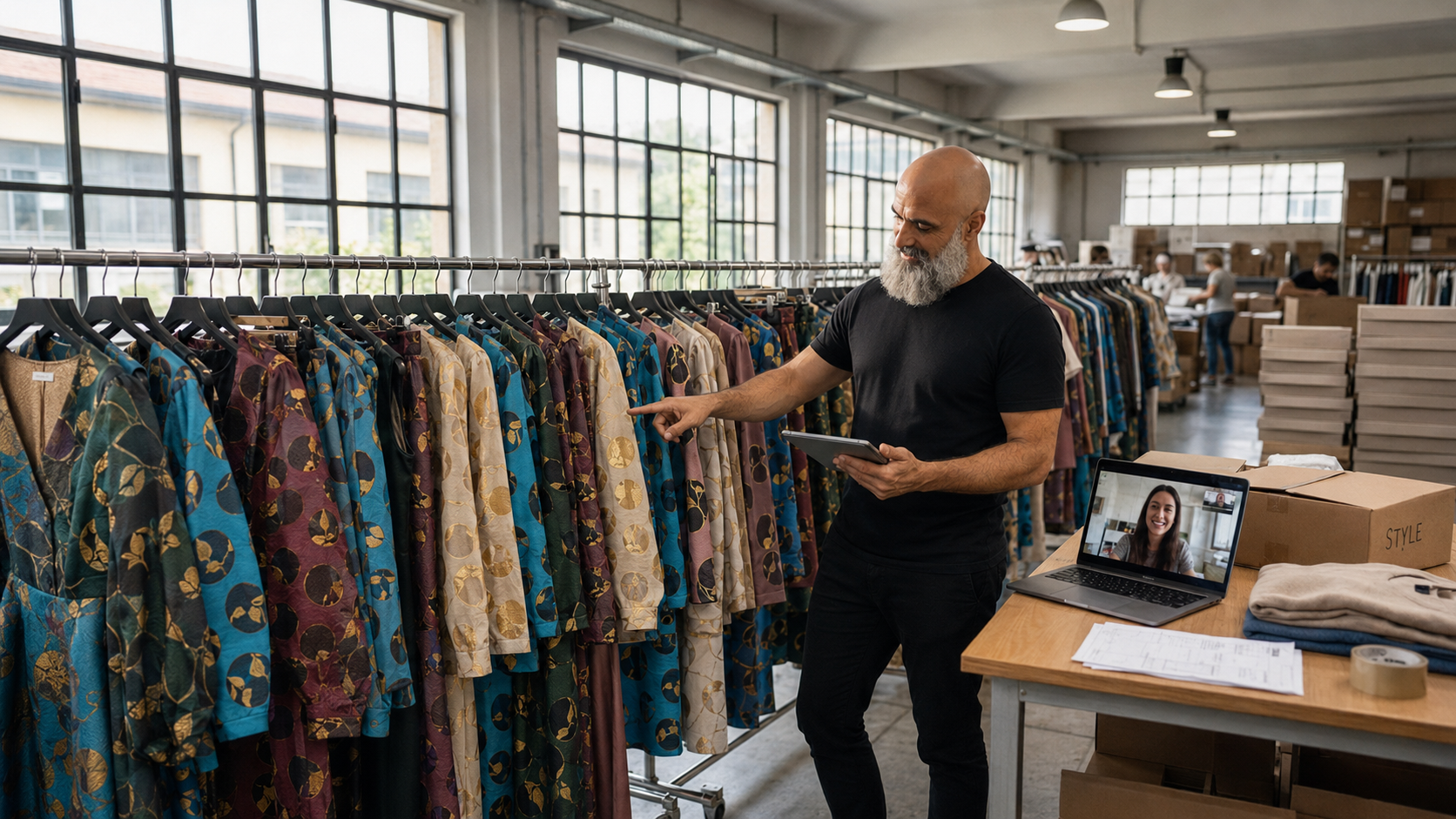
Italian textile converter coordinating mills, printers and finishers in the Lombardy Textile District
Final Takeaway
An Italian textile converter is not simply a company that knows several suppliers.
It is a company that turns a creative brief into a controlled textile route.
A mill provides direct manufacturing competence.
A specialist provides depth in one process.
A sourcing agent provides access and representation.
A converter provides integration.
The value of the Italian textile converter becomes especially clear inside the Lombardy Textile District, where industrial and artisanal expertise is distributed across weaving, preparation, dyeing, printing, finishing, embroidery, garment development and quality control.
The converter does not replace these specialists.
It creates continuity between them.
For ARNIA TEXTILE FASHION, this role also includes:
- fair and responsible commercial relationships;
- punctual payment practices;
- Code of Ethics and Values Charter alignment;
- supply-chain due diligence;
- workplace-safety awareness;
- social inclusion;
- project-specific traceability;
- early quality control;
- prevention of waste, remakes and unnecessary deadstock;
- protection of the client’s brand reputation.
The most sustainable metre of fabric is not simply the one with the strongest label.
It is the metre that has been correctly designed, responsibly produced, accurately documented, approved before bulk and delivered in a form the client can actually use.
Explore ARNIA TEXTILE FASHION’s textile and production services and submit your project brief to identify whether your development requires a mill, a specialist process, a stock-supported base or a coordinated Italian textile converter route.
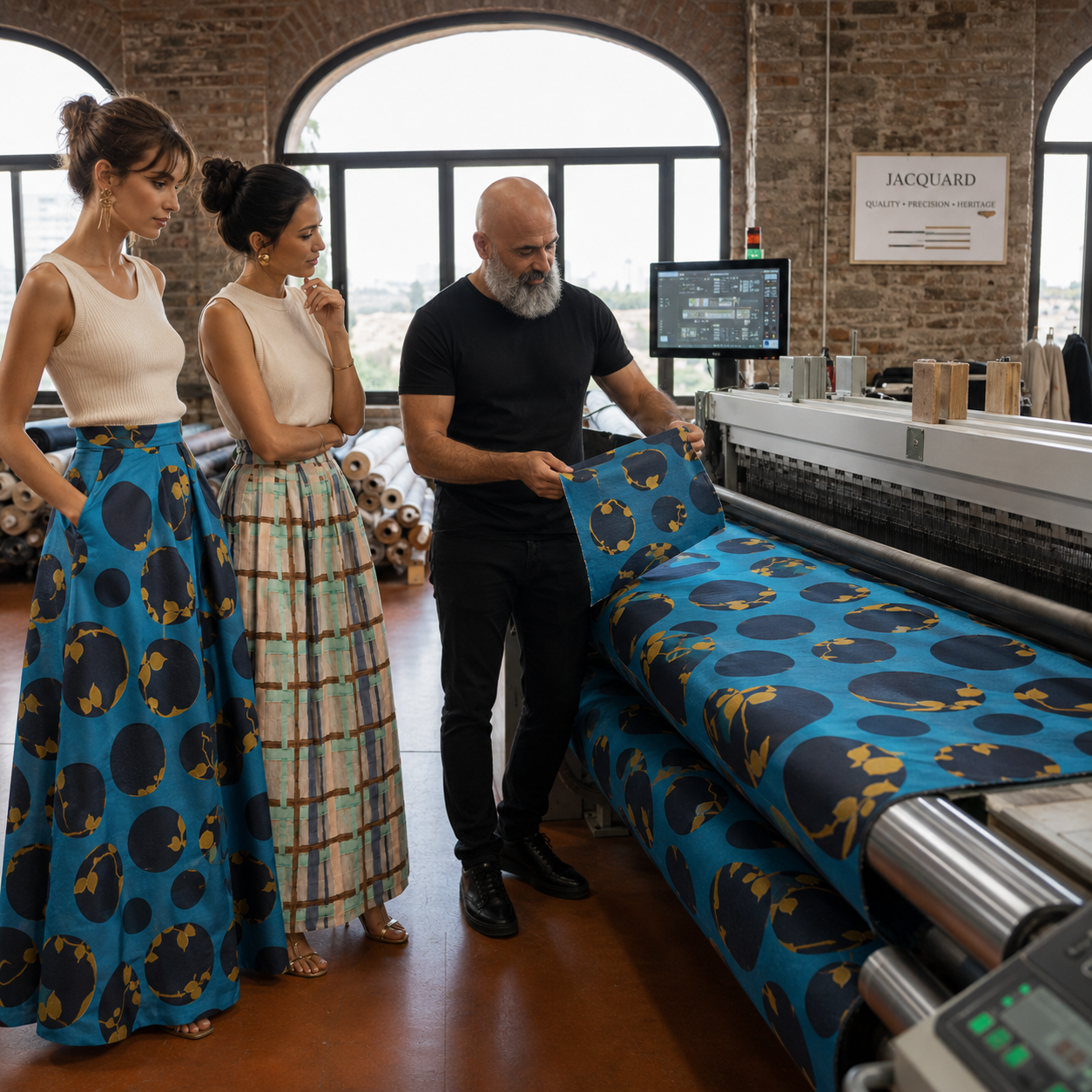
Italian textile converter coordinating mills, printers and finishers in the Lombardy Textile District
FAQ – Italian Textile Converter vs Mill or Sourcing Agent
What is an Italian textile converter?
An Italian textile converter is a company that develops and coordinates the transformation of yarns, greige fabrics or creative concepts into finished textile articles. Its work may include sourcing, weaving, dyeing, printing, finishing, quality control, documentation and delivery.
Is a textile converter the same as a textile mill?
No. A textile mill physically manufactures yarn or fabric or performs another defined industrial process using its own machinery. A converter integrates several materials, processes and suppliers into a finished product route. Some converters may also own production departments.
Does a textile converter own machinery?
Not necessarily. A classic converter may coordinate external mills, dye-houses, printers and finishers. A verticalised converter may own some production departments. The defining function is product and supply-chain integration, not machine ownership.
What is the difference between a converter and a sourcing agent?
A sourcing agent normally searches for suppliers and acts on behalf of the buyer, often for a fee or commission. A converter may develop the product, purchase materials, place processing orders, take ownership of the goods and sell the finished fabric. The exact role depends on the contract.
Is a textile converter just a broker?
A serious textile converter is not merely a broker. It should understand the textile product, select the production route, coordinate specialists, control approvals, manage quality and connect documentation with the physical goods.
What is greige fabric?
Greige fabric is woven or knitted fabric before the full preparation, dyeing, printing and finishing processes have been completed. A traditional converter transforms or commissions the transformation of greige fabric into a market-ready textile.
Why are Italian textile converters important?
Italian textile converters connect specialized industrial and artisanal companies that may each perform one part of the textile process. They help fashion brands access this know-how through one coordinated development and production route.
Why is the Lombardy Textile District important?
The Lombardy Textile District combines complementary expertise across Varese, Como and Milan, including cotton, silk, jacquard, printing, dyeing, embroidery, finishing, design, prototyping and garment development.
What is the main advantage of a textile converter?
The main advantage is integration. The converter helps ensure that material, process, quality, timing, price, documentation and final use are considered together instead of being managed as disconnected transactions.
What are the limitations of a converter?
A converter adds coordination cost and may depend on external partner capacity. Its effectiveness depends on technical competence, supplier relationships, specifications, quality controls, transparency and contractual clarity.
When is it better to work directly with a mill?
Direct mill sourcing may be more efficient for a well-defined, repeatable fabric at sufficient volume when the buyer already has internal technical, quality and supply-chain management capabilities.
When is a specialist supplier the better option?
A specialist may be the best choice when the buyer already controls the upstream and downstream stages and needs one defined process, such as printing, dyeing, embroidery or finishing.
Why can a printer not always control the final printed fabric?
A printer may not control the yarn, weaving, greige quality, fabric preparation or final finishing. Problems in those stages can affect absorbency, color, registration, hand, dimensional stability and final quality.
How does a converter reduce textile waste?
A converter can reduce preventable waste by checking feasibility, approving trials, controlling intermediate stages, identifying defects early and preventing non-conforming bulk production that would otherwise require remakes or become unsaleable stock.
Is quality control part of sustainability?
Yes. Preventing defects and remakes reduces unnecessary use of materials, chemicals, energy, labour, transport and time. Quality control is therefore both an operational and an environmental risk-management activity.
What is the role of a Code of Ethics in a textile supply chain?
A Code of Ethics defines minimum conduct rules relating to legality, labour, workplace safety, dignity, anti-exploitation, contractual correctness, transparency and truthful sustainability claims.
What is a Values Charter?
A Values Charter defines the principles that guide daily relationships and decisions, including human dignity, inclusion, respect, kindness, transparency, responsibility and continuous improvement.
Can a converter guarantee that every supplier complies with labour law?
No private converter can provide an absolute legal guarantee about every action of an independent supplier. A responsible converter can require compliance, conduct due diligence, request evidence, monitor operations, manage corrective actions and stop working with suppliers that do not meet the required standards.
Why do payment terms matter for sustainability?
Unrealistic prices and delayed payments can transfer financial pressure to suppliers and weaken their ability to plan capacity, maintain machinery, train employees and support safe working conditions. Responsible purchasing practices are therefore part of supply-chain sustainability.
Does working with a textile converter make a product certified?
No. Certification depends on the specific material, article, production lot, certified organisations, technical MOQ, Chain of Custody, Transaction Certificates and applicable claim rules.
How does ARNIA differ from a conventional sourcing agent?
ARNIA does not only introduce suppliers. It coordinates selected production partners while retaining responsibility for product development, quality oversight, documentation, traceability, client communication and ethical supply-chain supervision.


