
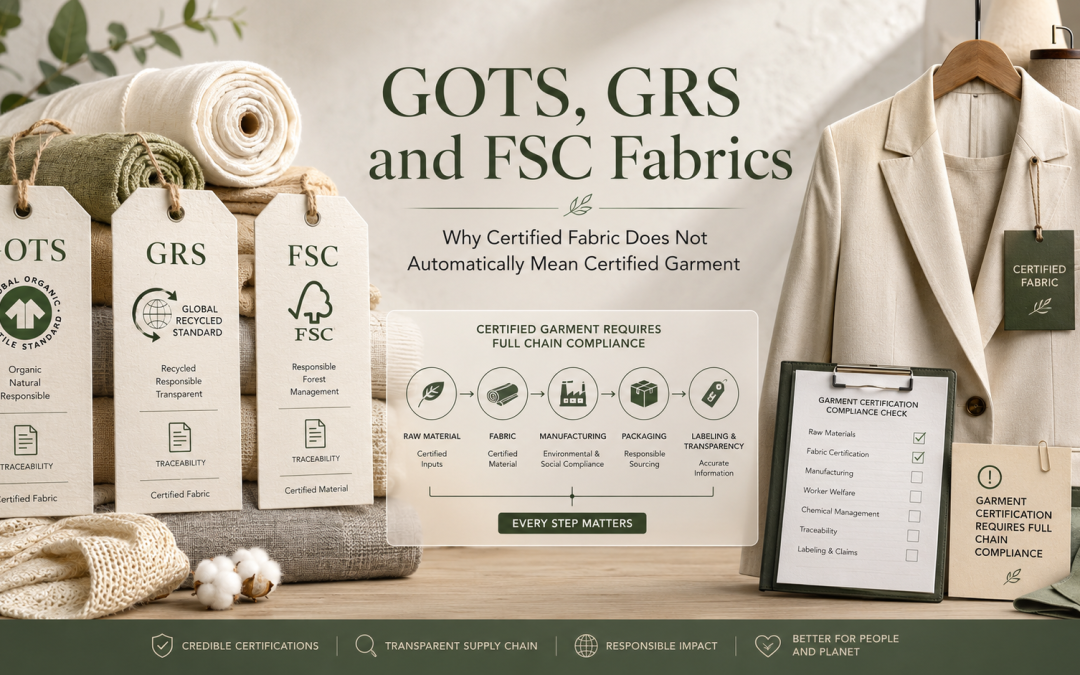
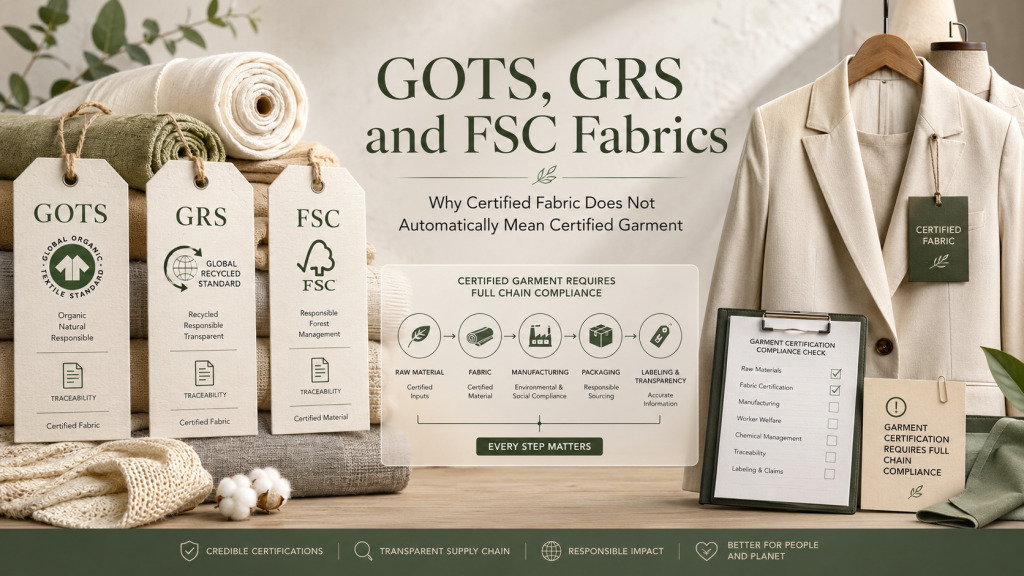
A GOTS, GRS or FSC(R) certified fabric is an important starting point for a responsible fashion collection. But it does not automatically make the final certified garment.
This distinction is essential for emerging brands, premium fashion labels, sustainability managers and buyers who want to communicate responsibly without exposing the brand to greenwashing risk.
A certified fabric is usually connected to a specific material, lot, supplier and transaction. A certified garment, instead, may require a verified Chain of Custody across all relevant stages: fiber, yarn, fabric, dyeing, printing, finishing, cutting, sewing, labeling, documentation and final claim approval.
At ARNIA TEXTILE FASHION, we support fashion brands with Sustainable Textiles, Fabric Sourcing, Cut & Sew Services and supply-chain coordination from the Lombardy Textile District. Our approach is built on a simple principle:
Sustainability is not a label. It is a documented, traceable and ethically governed process.
sustainable fashion
Quick Answer: Certified Fabric vs Certified Garment
A certified fabric is not the same as a certified garment.
A certified fabric means that a specific textile material, lot or transaction may be covered by a recognized standard such as GOTS, GRS or FSC, subject to scope, quantity, documentation and Chain of Custody requirements.
A certified garment means that the final product claim is supported by the correct certification pathway, documentation, eligible production stages, certified operators where required, and approved wording or labeling rules.
In practical terms:
| Question | Certified fabric | Certified garment |
|---|---|---|
| What is certified? | A fabric, yarn, fiber, lot or material transaction | The final garment or product claim |
| What is usually required? | Scope Certificate, Transaction Certificate, technical documentation | Chain of Custody across relevant stages and compliant claim approval |
| Can the brand use the certification logo automatically? | No | Only if the applicable standard and approval process allow it |
| Is it enough for a sustainability claim? | Not always | Only if the claim is specific, documented and not misleading |
| Can small lots always be certified? | No | Usually even more difficult |
| Main risk | Overstating material certification | Greenwashing, buyer rejection, legal and reputational damage |
The safest rule is this: do not claim that a garment is GOTS, GRS or FSC certified unless the full certification pathway and claim wording have been validated.
GOTS, GRS and FSC Fabrics: Why Certified Fabric Does Not Automatically Mean Certified Garment
1. Why This Topic Matters for Fashion Brands
Many fashion founders start with a good intention:
“I want to use certified sustainable fabrics.”
This is the right starting point. But the risk begins when that intention becomes an unsupported claim:
“Our collection is certified sustainable.”
Between these two sentences there is a supply-chain reality that must be verified.
The fashion industry is entering a stricter era of environmental communication. Generic claims such as “eco-friendly”, “green”, “sustainable” or “responsible” are increasingly challenged when they are not specific, documented and verifiable. In the European Union, Directive 2024/825 strengthens consumer protection against misleading environmental claims, generic environmental statements and unverified sustainability labels.
For a brand, the issue is not only legal. It is reputational.
A sustainability claim that cannot be proven does not create brand value. It creates brand risk.
This is why ARNIA’s approach combines certification awareness with sustainability due diligence, anti-greenwashing education, Code of Ethics, Values Charter and practical documentation.
2. What GOTS, GRS and FSC Actually Cover
GOTS, GRS and FSC are not marketing adjectives. They are structured systems with rules, audits, documentation and claim boundaries.
GOTS: Global Organic Textile Standard
GOTS applies to textiles made with certified organic fibers and covers environmental, chemical and social criteria across textile processing. GOTS explains that certification applies across processing stages, from certified organic fiber to finished product, and that companies involved must meet the relevant requirements. GOTS also requires independent third-party certification and uses Transaction Certificates to confirm movement of goods through certified supply chains.
For fashion brands, this means that a GOTS-certified fabric can be a powerful material choice, but it does not automatically authorize the brand to claim the final garment as GOTS certified.
To make a final product claim, the relevant chain must be eligible and documented.
GRS: Global Recycled Standard
GRS is managed by Textile Exchange and is focused on recycled materials. Textile Exchange explains that GRS includes third-party certification of recycled material and Chain of Custody, with additional social, environmental and chemical requirements. GRS also requires a minimum recycled content threshold for the finished certified product.
The key point is Chain of Custody.
Textile Exchange explains that product claims such as recycled or organic require certification through the supply chain and documentation such as Scope Certificates and Transaction Certificates. These documents help verify who is certified and which specific products or lots are covered.
A recycled fabric may be GRS certified at material level, but the final garment claim still depends on the full certification route and documentation.
FSC: Forest Stewardship Council
FSC applies to forest-based materials. In fashion, FSC is often relevant for cellulosic fibers and materials connected to wood-based sources, such as certain viscose or acetate pathways.
FSC Chain of Custody verifies that forest-based materials are credibly used from the forest to finished goods. FSC explains that Chain of Custody certification can enable organizations to use FSC labels and trademarks when requirements are met, with product/material tracking, records and audits.
For fashion brands, this means that using an FSC-related material route does not automatically make the garment FSC certified or logo-eligible. The claim depends on the certified material, the chain, the documentation and trademark rules.
3. Why Certified Fabric Does Not Automatically Mean Certified Garment
The misunderstanding usually comes from one sentence:
“The fabric is certified, so the garment is certified.”
This is not necessarily true.
Here are the most common reasons.
1. The brand may not be certified
If the final brand is not part of the relevant Chain of Custody, it may not be allowed to claim the finished product as certified, even if the fabric supplier has certified materials.
This is one of the most important points for emerging brands. Buying a certified fabric is not the same as becoming a certified brand.
2. The garment-making stage may not be covered
Cutting, sewing, printing, finishing, labeling or packing can be relevant stages depending on the standard and claim. If these stages are outside the certified chain, the final product claim may not be allowed.
A certified roll of fabric can lose claim eligibility if it moves into a non-controlled production route.
3. The specific lot may not have a Transaction Certificate
A supplier may have a Scope Certificate, but that does not automatically prove that every fabric sold is certified.
A Scope Certificate confirms that a company is certified for certain activities and materials. A Transaction Certificate usually confirms that a specific transaction or lot is covered.
For brand communication, the lot matters.
4. The MOQ may be too small
Certified production often requires segregation, dedicated handling, volume reconciliation, paperwork, certified operators and administrative work.
This is why very small lots, prototypes and sample-only projects are often not suitable for Transaction Certificates or final certified-product claims.
ARNIA’s Sustainability and Sustainable Textiles pages explain that certified production may require technical minimum quantities and that small orders or samples cannot always be certified while maintaining Chain of Custody and documentation requirements.
5. Trims and components may not be covered
A garment is not only made of main fabric. It may include:
- lining;
- interlining;
- buttons;
- zippers;
- embroidery threads;
- labels;
- care labels;
- hangtags;
- packaging;
- printing;
- finishing;
- coatings;
- special treatments.
If the claim concerns the whole product, every relevant component and process must be checked.
6. The claim wording may be wrong
A claim can be technically based on real materials but still be misleading if the wording is too broad.
For example:
| Risky wording | Safer wording |
|---|---|
| “This garment is GOTS certified” | “Made with a GOTS-certified fabric lot, where documentation applies” |
| “100% sustainable collection” | “Developed with selected lower-impact materials and documented sourcing steps” |
| “GRS certified garment” | “Contains GRS-certified recycled material, subject to applicable Chain of Custody documentation” |
| “FSC garment” | “Developed with FSC-based cellulosic material options, confirmed project by project” |
| “Fully traceable” | “Traceability documentation can be defined per SKU, lot and production route” |
Good sustainability communication is not about using bigger words. It is about using accurate words.
4. ARNIA’s Practical MOQ Reference for Certified Textile Routes
At ARNIA, certified or certification-ready textile routes are evaluated project by project according to material, process, lot, partner availability, documentation and applicable standard.
Indicative operational thresholds may include:
| Certification / route | Indicative technical planning reference |
|---|---|
| GRS woven jacquard yarn-dyed route | around 300 m |
| GRS printed or piece-dyed route | around 500 m |
| FSC-based viscose / acetate route | around 500 m |
| ECOVERO™ plain piece-dyed route | around 800 m |
| GOTS route | around 1,000 m |
These figures are not automatic guarantees. They are planning references.
Final feasibility must be confirmed according to:
- article;
- fiber composition;
- process route;
- color or print;
- quantity;
- supplier scope;
- segregation possibility;
- Transaction Certificate availability;
- brand certification status;
- intended claim;
- final market and buyer requirements.
For small capsules, prototypes and first test runs, ARNIA may still support responsible sourcing, traceability documents, composition data, chemical safety checks, Code of Ethics alignment and clear claim wording. But a final certified-garment claim may not be realistic.
That is not a weakness. It is a protection against greenwashing.
5. Certification Is Important, But It Is Not the Whole Meaning of Sustainability
Certifications are valuable. They provide independent verification, structured requirements and more credible documentation.
But certification alone does not cover every ethical question in a fashion supply chain.
A fabric can be certified and still be part of a weak business model if the brand:
- forces unrealistic lead times;
- pushes suppliers below fair production cost;
- ignores subcontracting risks;
- uses vague green claims;
- fails to check labor conditions;
- does not document the production route;
- treats sustainability as a marketing label rather than a management system.
This is why ARNIA combines certification pathways with governance tools such as a Code of Ethics and a Values Charter.
For many emerging brands, adopting and applying a Code of Ethics and a Values Charter can be the first concrete step toward real, measurable sustainability. It may be more practical, more honest and more immediately actionable than chasing prestigious standards that the brand cannot yet implement in a serious, transparent and measurable way.
This does not mean that standards such as GOTS, GRS or FSC are less important.
It means that sustainability maturity should be built in the right order:
- understand the supply chain;
- define values and non-negotiable rules;
- select suppliers consistently;
- document materials and processes;
- apply due diligence;
- communicate only what can be proven;
- pursue certifications when the project scale and Chain of Custody make them technically possible.
6. What Is a Code of Ethics in a Fashion Supply Chain?
A Code of Ethics is a formal document that defines the minimum conduct rules expected from a company and its stakeholders.
In a fashion supply chain, the Code of Ethics should apply to:
- the brand;
- employees;
- collaborators;
- suppliers;
- subcontractors;
- consultants;
- logistics partners;
- production partners;
- commercial partners;
- any stakeholder involved in product development and communication.
A Code of Ethics should answer a practical question:
“What behaviors are not acceptable in our supply chain, even if they are cheaper or faster?”
A serious Code of Ethics should cover at least:
Legal compliance
Suppliers and partners must comply with applicable labor, tax, safety, environmental and business laws.
Regular work
The supply chain must reject undeclared work, false subcontracting, illegal labor intermediation, wage abuse and hidden production routes.
Human dignity
Workers must be treated with respect. Forced labor, child labor, harassment, discrimination and unsafe working conditions must be excluded.
Health and safety
Production partners must maintain safe working environments, training, protective measures and responsible process management.
Fair commercial behavior
Payment terms, deadlines, workload, quality expectations and changes must be managed in a way that does not push suppliers into irregular practices.
Anti-corruption
Business decisions should be based on competence, reliability and compliance, not improper benefits.
Confidentiality and know-how protection
Transparency does not mean exposing suppliers, trade secrets or technical know-how without control. Sensitive information should be shared under NDA and only for legitimate purposes.
Sustainability claims
No supplier, collaborator or brand team should make environmental or social claims without evidence.
Right to audit and corrective action
The Code of Ethics should allow checks, documentation requests and corrective action plans when risks appear.
Whistleblowing and grievance channels
Stakeholders should have a safe way to report concerns.
In short, a Code of Ethics turns sustainability from a slogan into an operating rule.
7. What Is a Values Charter?
A Values Charter is different from a Code of Ethics.
The Code of Ethics defines minimum rules and prohibited behaviors.
The Values Charter defines the principles that guide decisions, relationships and long-term direction.
A Values Charter answers a deeper question:
“What kind of company do we want to be, and what kind of supply chain do we want to build?”
For a fashion brand, a Values Charter may include:
Human dignity
People are not production units. They are skilled individuals whose work must be respected.
Transparency
The brand commits to clear information, documented claims and honest communication with clients, suppliers and customers.
Measurability
Sustainability must be connected to evidence: documents, KPIs, audits, traceability datasets, supplier records, material data and continuous improvement.
Responsibility
The brand accepts that its decisions influence suppliers, workers, costs, timing, product quality and environmental impact.
Long-term partnership
Responsible fashion is not built through one-off opportunistic sourcing. It needs stable relationships with selected partners.
Local competence
Made in Italy should not be reduced to a marketing label. It should reflect real competence, craftsmanship, quality control and responsible production choices.
Inclusion
A responsible company should create conditions for people to work, grow, contribute and be valued according to their abilities.
Anti-greenwashing
The brand commits to communicate only what it can prove.
Continuous improvement
A Values Charter does not require perfection on day one. It requires direction, honesty, discipline and measurable progress.
For ARNIA, the Values Charter is not a decorative document. It is part of how stakeholders are selected and aligned.
ARNIA’s supply-chain model is built around selected partners, monitored relationships, ethical alignment and traceability. Its Sustainability page explains that suppliers are expected to comply with ARNIA’s Code of Ethics and Values Charter, including the rejection of labor exploitation, unsafe conditions and greenwashing.
8. Code of Ethics and Values Charter: Why They Matter More Than Many Brands Think
Some emerging brands believe that sustainability starts with a certificate.
In reality, sustainability often starts earlier.
It starts when a brand writes down what it will not accept.
A Code of Ethics and a Values Charter create a practical foundation for responsible growth because they help the brand decide:
- which suppliers to work with;
- which claims to avoid;
- which documents to request;
- which risks to monitor;
- which behaviors to prohibit;
- which values to share with collaborators;
- which compromises are unacceptable.
This is especially important for emerging brands that cannot yet activate full certified garment programs because of MOQ, cost, Chain of Custody or timing constraints.
An emerging brand may not be ready to certify a full collection. But it can immediately:
- map its suppliers;
- adopt a Code of Ethics;
- share a Values Charter;
- require basic compliance declarations;
- collect composition and origin documents;
- avoid misleading claims;
- define an approval process for sustainability communication;
- choose stock-supported or documented fabrics;
- prepare for certification step by step.
This is a concrete sustainability action.
It is not less serious than certification. It is the groundwork that makes future certification credible.
9. Due Diligence: The Bridge Between Values and Evidence
A Code of Ethics without due diligence is only a document.
Due diligence is the process that turns values into checks, records, decisions and corrective actions.
The OECD Due Diligence Guidance for Responsible Supply Chains in the Garment and Footwear Sector explains that due diligence helps companies identify, prevent, mitigate and address negative impacts in the garment and footwear supply chain.
In fashion, due diligence should not be treated as a corporate burden reserved for large groups. It is also a practical tool for emerging brands.
A simple due diligence process can start with twelve steps.
Step 1 — Map the product
Define the product clearly:
- category;
- materials;
- trims;
- processes;
- origin;
- production stages;
- finishing;
- packaging;
- labeling;
- intended markets.
Step 2 — Map the claim
Before making any sustainability statement, define the exact claim.
Ask:
- Are we claiming certified material?
- Certified garment?
- Recycled content?
- Organic content?
- FSC-based material?
- Made in Italy?
- Traceability?
- Low impact?
- Social impact?
- Ethical production?
Each claim requires different evidence.
Step 3 — Map the suppliers
Identify who is involved in:
- sourcing;
- spinning;
- weaving or knitting;
- dyeing;
- printing;
- finishing;
- cutting;
- sewing;
- embroidery;
- washing;
- packing;
- logistics.
Even when supplier names are protected for confidentiality, the brand should know that a controlled route exists.
Step 4 — Collect basic documentation
A responsible document file may include:
- technical datasheet;
- composition sheet;
- Scope Certificate;
- Transaction Certificate where applicable;
- test reports;
- REACH declaration;
- RSL/MRSL alignment where required;
- invoices and lot references;
- care label information;
- production flow;
- supplier declarations;
- Code of Ethics acceptance;
- Values Charter acceptance.
Step 5 — Check certification boundaries
Confirm what the certification covers and what it does not cover.
Does it cover the fiber?
The yarn?
The fabric?
The dyeing?
The printing?
The garment-making?
The final product claim?
The logo use?
If the answer is unclear, the claim is not ready.
Step 6 — Assess labor and subcontracting risk
High-risk areas may include:
- outsourced manual work;
- urgent production peaks;
- subcontracting;
- finishing;
- home-based work;
- low-cost production pressure;
- unclear labor documentation;
- temporary labor intermediaries.
The brand should not only ask “How much does it cost?”
It should also ask “How is this price possible?”
Step 7 — Insert ethical clauses in agreements
The Code of Ethics and Values Charter should be connected to purchase orders, supplier onboarding or framework agreements.
This can include:
- compliance commitment;
- no unauthorized subcontracting;
- right to request documents;
- right to audit where appropriate;
- corrective action process;
- termination rights for serious breaches;
- no false sustainability claims;
- confidentiality and non-circumvention.
Step 8 — Create a claim approval workflow
No sustainability claim should be published on:
- website;
- social media;
- product page;
- hangtag;
- lookbook;
- wholesale line sheet;
- press release;
- investor deck;
- care label;
- packaging;
until it has been checked against documentation.
Step 9 — Train the team
Designers, marketers, founders, sales teams and external agencies must understand the difference between:
- material certified;
- product certified;
- certification-ready;
- traceable;
- documented;
- lower-impact;
- responsible;
- compliant.
Most greenwashing starts from language confusion.
Step 10 — Monitor suppliers
Due diligence is not a one-time questionnaire. It requires monitoring, updates and escalation.
This can include:
- annual document updates;
- supplier risk scoring;
- corrective action plans;
- follow-up after issues;
- audit requests where appropriate;
- updated certification checks;
- production-stage review.
Step 11 — Keep an evidence archive
If a claim is challenged, the brand must be able to retrieve the evidence.
A responsible archive should connect:
- product;
- SKU;
- season;
- lot;
- supplier;
- material;
- claim;
- document;
- approval date;
- responsible person.
Step 12 — Improve year by year
A small brand does not need to pretend perfection.
A credible brand should show continuous improvement:
- clearer supplier selection;
- better materials;
- fewer vague claims;
- stronger documentation;
- more realistic production planning;
- better stakeholder alignment;
- stronger Code of Ethics implementation;
- measurable progress.
This is the difference between sustainability as storytelling and sustainability as management.
10. Legal Aspects: Why Sustainability Claims Must Be Treated as Risk Statements
Sustainability claims are not just marketing language.
They can influence consumer decisions, buyer decisions, wholesale contracts, retail approvals, investor expectations and brand reputation.
A claim can create legal risk when it is:
- vague;
- exaggerated;
- unsupported;
- not comparable;
- based on partial information;
- not representative of the whole product;
- inconsistent with certification rules;
- impossible to verify;
- disconnected from Chain of Custody;
- contradicted by supplier documentation.
Examples of risky statements include:
- “100% sustainable”;
- “fully ethical”;
- “certified collection”;
- “GOTS garment” when only the fabric is certified;
- “recycled product” without verified recycled content and Chain of Custody;
- “FSC product” without proper Chain of Custody and trademark approval;
- “traceable supply chain” without SKU or lot documentation.
A safer approach is to make claims that are specific, limited and documentable.
For example:
- “This style is made with a fabric lot supported by GOTS documentation, where applicable.”
- “Selected GRS-certified recycled material options are available subject to MOQ and Transaction Certificate requirements.”
- “FSC-based cellulosic material routes can be evaluated project by project.”
- “Our suppliers are expected to comply with our Code of Ethics and Values Charter.”
- “We use documented sourcing and continuous improvement to reduce greenwashing risk.”
This approach protects both the brand and the supplier.
11. Ethical Aspects: Why Correct Claims Are a Matter of Respect
The legal side is important. But the ethical side is deeper.
A sustainability claim is a promise.
It is a promise to the buyer, the consumer, the workers, the supplier, the community and the market.
When a brand overclaims, even unintentionally, it creates several ethical problems:
- it misleads customers;
- it disadvantages competitors that communicate honestly;
- it turns supplier work into marketing without proper evidence;
- it hides the complexity of real production;
- it weakens public trust in sustainability;
- it may pressure suppliers into unsafe or irregular shortcuts.
Ethical communication requires humility.
A young brand can say:
“We are not fully certified yet, but we are building our supply chain with documented materials, selected partners, a Code of Ethics, a Values Charter and a continuous improvement roadmap.”
That sentence may be more credible than an exaggerated certification claim.
It is honest.
It is measurable.
It is defensible.
It is a real starting point.
12. Brand Reputation: The Hidden Cost of Unsupported Claims
Brand reputation is built slowly and can be damaged quickly.
For emerging brands, one unsupported sustainability claim can create consequences that are disproportionate to the size of the business.
Possible consequences include:
- buyer rejection;
- wholesale cancellation;
- retailer compliance issues;
- customer complaints;
- social media criticism;
- press scrutiny;
- certification body complaints;
- legal disputes;
- investor concerns;
- loss of supplier trust;
- internal team confusion;
- long-term credibility damage.
For established brands, the risk is even larger because sustainability claims are often reviewed by:
- legal departments;
- ESG teams;
- procurement teams;
- auditors;
- retailers;
- NGOs;
- journalists;
- consumers;
- public authorities.
This is why ARNIA positions sustainability as brand reputation protection.
The goal is not to make the loudest claim.
The goal is to make the strongest claim that the brand can prove.
13. How ARNIA Supports Responsible Certification and Claim Strategy
ARNIA TEXTILE FASHION is an Italian textile converter and social cooperative based in the Lombardy Textile District. ARNIA works with premium and luxury fashion brands through textile sourcing, sustainable fabrics, stock-supported materials, Cut & Sew coordination and supply-chain due diligence.
ARNIA’s support may include:
- Sustainable Textiles with GOTS, GRS, FSC and ECOVERO™ pathways where feasible;
- Fabric Sourcing for documented material selection;
- Stock-Supported Fabrics for faster sampling and capsule development, with certification availability confirmed project by project;
- Cut & Sew Services for small-batch Made in Italy production routes;
- Sustainability guidance on certification limits, MOQ and responsible claims;
- Transparency documentation and governance references;
- Textile Converter support for supply-chain coordination and risk control.
ARNIA does not treat sustainability as a decorative label. It treats sustainability as a working system made of materials, people, documents, checks, values and responsibility.
14. A Practical Roadmap for Emerging Brands
For emerging brands, the most responsible roadmap is often progressive.
Phase 1 — Ethical foundation
Adopt:
- Code of Ethics;
- Values Charter;
- supplier onboarding questionnaire;
- claim approval workflow;
- document archive;
- basic traceability file.
Phase 2 — Responsible sourcing
Select:
- documented fabrics;
- stock-supported options where appropriate;
- certified or certification-ready routes when feasible;
- suppliers aligned with the Code of Ethics and Values Charter.
Phase 3 — Product feasibility
Check:
- MOQ;
- fabric availability;
- trims;
- labelling;
- testing;
- production route;
- lead time;
- certification applicability;
- claim wording.
Phase 4 — Documentation
Collect:
- technical sheets;
- composition data;
- certification references;
- Transaction Certificates where applicable;
- test reports if required;
- supplier declarations;
- production route information;
- SKU or lot traceability.
Phase 5 — Communication
Publish only claims that are:
- specific;
- supported;
- limited to the correct scope;
- understandable;
- not exaggerated;
- approved internally;
- consistent across website, labels, line sheets and social media.
Phase 6 — Certification scale-up
When quantity, budget and supply chain maturity allow, move toward more formal certified product pathways.
This roadmap is realistic.
It helps the brand grow without pretending to be more certified than it is.
15. Claim Checklist Before Publishing
Before publishing any sustainability claim, ask these questions:
| Question | Why it matters |
|---|---|
| What exactly are we claiming? | Prevents vague communication |
| Is the claim about fabric or final garment? | Avoids certified fabric vs certified garment confusion |
| Which standard applies? | GOTS, GRS and FSC have different rules |
| Do we have a Scope Certificate? | Confirms supplier certification scope |
| Do we have a Transaction Certificate? | Confirms lot or transaction coverage |
| Is the brand certified where required? | Determines final product claim eligibility |
| Are garment-making stages covered? | Prevents broken Chain of Custody |
| Are trims and finishes relevant? | Avoids incomplete product claims |
| Is the MOQ sufficient? | Certification may not be feasible for small lots |
| Is the wording legally safe? | Reduces greenwashing risk |
| Is the claim archived with evidence? | Protects brand reputation |
If the answer to any question is unclear, do not publish the claim yet.
16. Safer Claim Language for Brands
Here are examples of safer language for emerging brands.
If using certified fabric but not a certified final garment
“This garment is made with a certified fabric lot, where documentation applies. Final product certification and claim eligibility depend on the complete Chain of Custody.”
If working toward certification
“We are developing this collection through selected documented materials and a responsible sourcing pathway. Certification applicability is confirmed project by project.”
If using a Code of Ethics and Values Charter
“Our supply-chain relationships are guided by a Code of Ethics and Values Charter covering responsible work, transparency, anti-greenwashing and respect for people.”
If using stock-supported fabrics
“Stock-supported fabrics can support faster sampling and capsule development. Certification documents and Transaction Certificates, where required, must be confirmed for the specific lot and quantity.”
If communicating continuous improvement
“We are building a measurable sustainability roadmap based on documented sourcing, supplier due diligence, responsible claims and continuous improvement.”
This language may look less spectacular than “100% sustainable”.
But it is stronger because it is more defensible.
17. Final Takeaway
A certified fabric is a valuable material choice.
A certified garment is a verified product claim.
A sustainable brand is a responsible management system.
GOTS, GRS and FSC can play an essential role in responsible fashion, but they must be used correctly. A certificate is not a shortcut. It is part of a chain.
For emerging brands, the first concrete step may not be a full certified garment program. It may be the adoption of a Code of Ethics, a Values Charter, supplier due diligence, documented sourcing and honest claim governance.
This is not a lower standard.
It is the beginning of a serious sustainability culture.
At ARNIA TEXTILE FASHION, we believe responsible Made in Italy should protect not only product quality, but also people, suppliers, clients, communities and brand reputation.
Explore ARNIA’s Sustainable Textiles, Sustainability and Fashion Startup Lab to build a documented and realistic sustainability pathway for your next collection.
sustainable fashion made with passion and kindness
FAQ
What is the difference between certified fabric and certified garment?
A certified fabric usually refers to a specific textile material, lot or transaction covered by a standard such as GOTS, GRS or FSC. A certified garment requires the final product claim to be supported by the correct Chain of Custody, documentation, production stages and claim approval.
Can I say my garment is GOTS certified if the fabric is GOTS certified?
Not automatically. A GOTS-certified fabric does not automatically make the final garment GOTS certified. The final claim depends on Chain of Custody, certified operators, documentation, Transaction Certificates and applicable GOTS claim rules.
What is a Transaction Certificate in fashion?
A Transaction Certificate is a document used in certified textile supply chains to confirm that a specific transaction or lot is covered by a certification system. It is different from a Scope Certificate, which confirms that a company is certified for certain activities or materials.
Why are small lots difficult to certify?
Small lots can be difficult to certify because certification may require segregation, dedicated handling, documentation, volume reconciliation, certified operators and administrative controls. For prototypes, samples and very small runs, these requirements may be technically or economically unrealistic.
What are ARNIA’s indicative MOQ references for certified textile routes?
Indicative planning references may include around 300 m for certain GRS yarn-dyed woven routes, around 500 m for GRS printed or piece-dyed routes, around 500 m for FSC-based routes, around 800 m for ECOVERO™ plain piece-dyed routes and around 1,000 m for GOTS routes. Final feasibility is always confirmed project by project.
Can stock-supported fabrics be certified?
Stock-supported fabrics can be useful for sampling, capsule collections and faster development. However, stock availability does not automatically mean that every lot is covered by a Transaction Certificate or eligible for a final product claim. Certification documents must be confirmed for the specific lot and quantity.
What is a Code of Ethics in a fashion supply chain?
A Code of Ethics is a formal document that defines minimum rules of conduct for the brand, suppliers, collaborators and stakeholders. It should address legal compliance, regular work, health and safety, anti-corruption, no labor exploitation, confidentiality, right-to-audit, anti-greenwashing and corrective action.
What is a Values Charter?
A Values Charter defines the principles that guide the brand’s decisions and relationships. It may include human dignity, transparency, measurable sustainability, inclusion, responsible Made in Italy, long-term partnership, evidence-based claims and continuous improvement.
Are a Code of Ethics and Values Charter substitutes for GOTS, GRS or FSC certification?
No. They are not substitutes for product or material certification. They are governance tools that help a brand build a responsible supply chain, select stakeholders, manage risks, avoid greenwashing and prepare for certification when technically feasible.
How does due diligence protect brand reputation?
Due diligence helps a brand identify supply-chain risks, collect documents, verify claims, monitor suppliers and correct issues before they become legal, commercial or reputational problems. It turns sustainability from a statement into a controlled process.


