
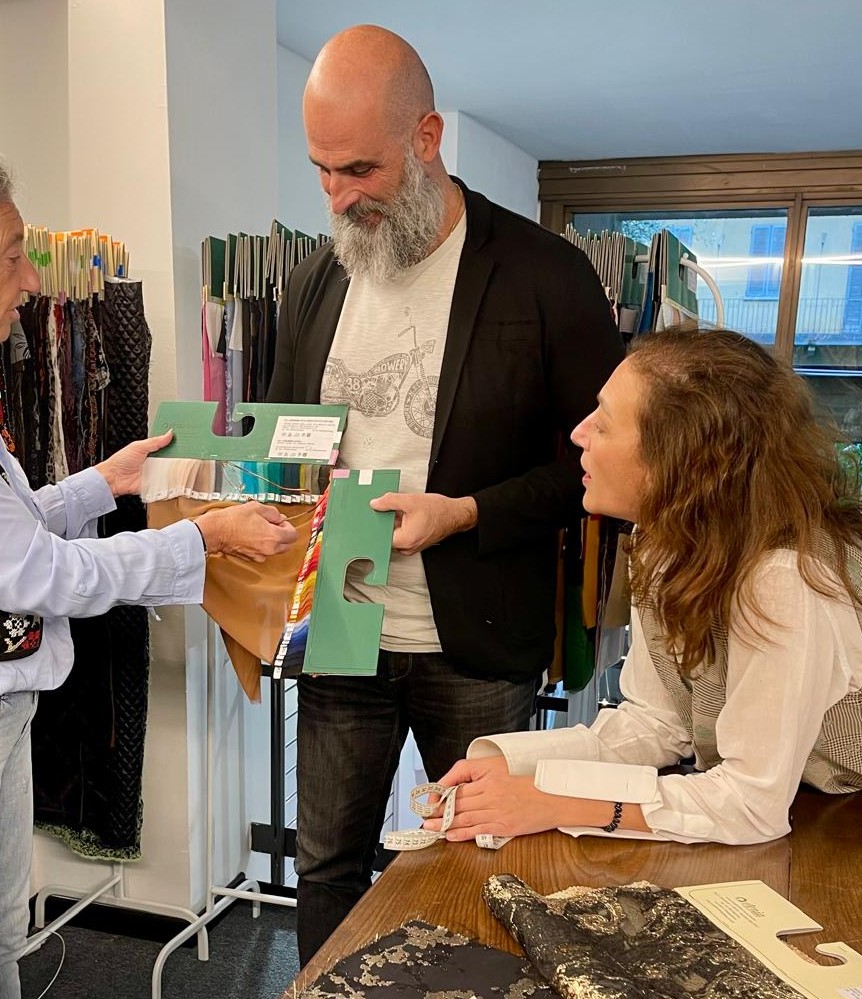
A reference swatch can communicate colour, texture, pattern, weight and creative direction. It cannot, by itself, provide everything required for reliable production.
It may not reveal the exact fibre percentages, yarn specifications, weave construction, finishing route, dimensional behaviour, colourfastness, available width, production tolerances or continuity of the original raw materials.
This is why custom fabric development in Italy should not begin with the promise of an exact copy.
It should begin with a more responsible question:
Which measurable aesthetic, technical and commercial characteristics must be preserved, and which production route can reproduce them consistently?
At ARNIA TEXTILE FASHION, custom fabric development connects the creative reference with technical feasibility, fabric sourcing, sampling, garment application, quality control and sample-to-bulk repeatability.
The objective is not simply to produce one attractive swatch.
The objective is to create a production-ready fabric that can be specified, approved, documented and reproduced within agreed parameters.
Quick Answer
Custom fabric development in Italy normally moves through the following stages:
- project brief and reference review;
- legal and intellectual-property alignment;
- technical analysis of the reference swatch;
- selection of the most realistic sourcing or development route;
- yarn, construction, colour and finishing trials;
- swatch, lab dip, strike-off or loom-trial approval;
- performance testing;
- garment or application validation;
- definition of the approved master and tolerances;
- bulk-production planning, quality control and documentation.
The exact sequence depends on the fabric family, intended garment, quantity, target price, timing, certification requirements and degree of customisation.
Key Takeaways
- A physical reference swatch is valuable, but it is not a complete technical specification.
- Visual similarity does not guarantee equivalent composition, performance or production cost.
- Fabric sourcing, adapted development and fully custom fabric development are different routes.
- The intended garment must be defined before the final fabric is approved.
- A successful sample is not automatically a repeatable bulk article.
- Weight, width, composition, colour, construction, finishing and performance must be specified.
- Certification and traceability must be evaluated before production, not added as marketing claims afterwards.
- The safest result is not necessarily an exact copy, but a technically controlled and commercially realistic textile solution.
Why a Reference Swatch Is Only the Starting Point
A reference swatch can provide valuable evidence.
A skilled textile team may observe:
- the apparent fibre family;
- woven or knitted construction;
- surface texture;
- weight category;
- drape;
- yarn contrast;
- pattern scale;
- transparency;
- elasticity;
- lustre;
- colour relationship;
- finishing effect.
However, observation alone cannot always establish:
- exact fibre percentages;
- yarn count and twist;
- warp and weft densities;
- elastomer percentage;
- loom setup;
- print chemistry;
- dye class;
- finishing auxiliaries;
- residual shrinkage;
- dimensional stability;
- rubbing or washing fastness;
- formal certification status;
- long-term raw-material availability.
A small reference swatch can also produce misleading measurements. ASTM’s fabric-weight methodology distinguishes between complete pieces, full-width samples and small swatches, noting that a result obtained from a small swatch applies to that sample and may not represent the entire production lot.
The reference should therefore be treated as:
evidence of the desired result, not proof of the original production recipe.
Visual Similarity Is Not Technical Equivalence
Two textiles may look almost identical in a photograph and still perform very differently.
They may differ in:
| Variable | Why It Matters |
|---|---|
| Fibre composition | Affects hand, moisture response, care, labelling, price and certification |
| Yarn structure | Influences surface, strength, bulk, lustre and abrasion |
| Weave or knit construction | Determines stability, drape, stretch and appearance |
| Fabric density | Affects coverage, weight, opacity and durability |
| Finished width | Changes marker efficiency and garment consumption |
| Mass per unit area | Influences silhouette, comfort, sewing and shipping |
| Finishing | Can change softness, shrinkage, texture, sheen and dimensional behaviour |
| Colour process | Influences shade reproducibility and colourfastness |
| Surface treatment | May alter pressing, care and abrasion resistance |
| Production scale | Determines setup cost, MOQ and repeatability |
Mass per unit area and fabric width are not merely descriptive numbers. They are measurable production parameters addressed by recognised ISO and ASTM methods. ISO 3801 covers mass per unit length and area for woven fabrics, while ASTM D3774 and D3776 address fabric width and mass per unit area.
A fabric can therefore be visually close to the reference and still be unsuitable for the intended garment.
The First Decision: Source, Adapt or Develop?
Not every project requires a fully custom textile.
A professional fabric-development process should first identify the lowest-risk route capable of achieving the required result.
| Development Route | What It Means | Best Used When | Main Limitation |
|---|---|---|---|
| Source an existing article | Find a current fabric with compatible aesthetics and performance | Timing is important and a close technical alternative is acceptable | Exact colour, composition or surface may not be available |
| Adapt an existing construction | Modify colour, yarn, weight, design scale or finish | A proven base exists but needs brand-specific adjustment | Changes may affect MOQ, cost and performance |
| Develop a new fabric | Engineer a new construction, design or process route | The textile is central to product identity and alternatives are insufficient | Higher setup, longer validation and greater production dependency |
| Use a stock-supported base | Start from a running greige or colour-card article | Sampling and smaller projects require lower development risk | Customisation options remain process-dependent |
ARNIA supports all three routes through its Fabric Sourcing and Custom Textile Development service.
Selected running bases may also be evaluated through ARNIA’s Stock-Supported Fabrics route, subject to current availability and technical suitability.
What Must Be Defined Before Custom Fabric Development Begins
The fabric cannot be developed intelligently without understanding the product and commercial context.
The development brief should define:
Intended Product
The same fabric may perform differently in:
- a fitted dress;
- a structured skirt;
- a fluid blouse;
- an unlined jacket;
- an embroidered panel;
- a pleated garment;
- a capsule accessory.
Expected Quantity
Quantity influences:
- loom or print setup;
- yarn purchasing;
- dye-bath scale;
- finishing route;
- colour continuity;
- certification feasibility;
- unit cost.
Target Price Architecture
A development target should be compatible with:
- intended retail price;
- wholesale model;
- fabric consumption;
- garment-making cost;
- trims;
- logistics;
- duties;
- target margin.
A “beautiful fabric at the lowest possible price” is not a measurable brief.
Target Timing
The calendar should include:
- technical analysis;
- material sourcing;
- setup;
- first development;
- corrections;
- testing;
- garment validation;
- bulk planning.
Intended Markets
Target markets affect:
- fibre-composition terminology;
- labelling;
- chemical restrictions;
- buyer test protocols;
- care requirements;
- permitted marketing claims.
For products placed on the EU market, Regulation (EU) No 1007/2011 establishes requirements for textile-fibre names and composition labelling.
Certification and Traceability Objectives
These should be defined before choosing the raw material and production route.
They cannot be reliably added after the fabric has already been developed.
Italian textile converter coordinating mills, printers and finishers in the Lombardy Textile District
Intellectual Property: A Reference Is Not Automatically Permission to Copy
A reference swatch may originate from:
- the client’s archive;
- an old garment;
- a vintage textile;
- a supplier collection;
- another fashion brand;
- an original client design;
- a publicly available image.
Before exact reproduction is attempted, the project should clarify whether the client:
- owns the original design;
- has obtained permission to use it;
- is commissioning a lawful technical adaptation;
- requires a new design inspired by selected characteristics rather than a copy.
EU design protection may cover features including lines, contours, colours, shape, texture and materials. Original design works may also qualify for copyright protection where the relevant legal requirements are met.
For this reason, ARNIA can work under confidentiality and NDA, but a physical swatch should not automatically be interpreted as authorisation to reproduce third-party intellectual property.
The safest brief distinguishes between:
- technical benchmark;
- aesthetic direction;
- client-owned design;
- new development requirement.
The Custom Fabric Development Process
Stage 1 — Brief, Reference and Project Qualification
The first stage is not weaving, printing or dyeing.
It is clarification.
The development team should receive:
- the physical swatch, where available;
- clear photographs of face and reverse;
- intended garment;
- required metres;
- commercial target;
- preferred composition;
- target weight;
- timing;
- desired origin;
- certification requirements;
- expected continuity.
The physical reference should be labelled and registered so that every party is discussing the same source.
A photographic reference alone may support initial evaluation, but it rarely provides enough information for a reliable quotation or development commitment.
Stage 2 — Technical Analysis of the Reference Swatch
The appropriate depth of analysis depends on the project.
Visual and Tactile Review
The team evaluates:
- colour;
- motif;
- surface;
- lustre;
- transparency;
- hand;
- drape;
- body;
- apparent stretch;
- face and reverse.
Physical Measurement
Useful parameters may include:
- fabric width;
- weight per square metre;
- repeat dimensions;
- warp and weft density;
- stretch and recovery;
- thickness;
- shrinkage;
- usable width.
Fibre and Yarn Analysis
Where required, fibre analysis can help determine whether the material contains:
- cotton;
- silk;
- wool;
- linen;
- viscose;
- acetate;
- polyester;
- polyamide;
- elastomer;
- blends.
The degree of certainty depends on the available testing and the complexity of the material.
Construction Analysis
For a woven reference, the team may examine:
- basic weave;
- jacquard structure;
- supplementary yarns;
- double-cloth areas;
- floats;
- binder points;
- fil coupé effects;
- pile;
- cloqué or matelassé effects.
For knitted materials, analysis may include:
- knit family;
- gauge;
- yarn feed;
- loop structure;
- elastomer integration;
- compactness.
Stage 3 — Define the Characteristics That Must Be Preserved
Not every characteristic has equal importance.
A useful development brief classifies requirements into three groups.
Non-Negotiable
Examples:
- intended garment performance;
- minimum opacity;
- composition requirement;
- certification pathway;
- maximum weight;
- required colour family;
- motif ownership;
- required width.
Preferred
Examples:
- exact surface depth;
- specific sheen;
- fibre blend preference;
- hand-feel direction;
- reverse-side appearance.
Adaptable
Examples:
- minor motif-scale adjustment;
- yarn substitution;
- small weight variance;
- alternative finish;
- adjusted width.
This hierarchy prevents the development from becoming technically impossible or commercially incoherent.
Stage 4 — Feasibility and Development Route
At this stage, the converter determines whether the reference is best approached through:
- existing collection research;
- swatch matching;
- stock-supported base;
- weave development;
- print development;
- embroidery development;
- finishing trial;
- combination of processes.
This is also where the team should identify critical risks:
- obsolete yarn;
- unavailable machine;
- protected design;
- unrealistic MOQ;
- excessive setup cost;
- unstable finish;
- insufficient colourfastness;
- low sample-to-bulk repeatability;
- incompatible garment application.
ARNIA’s guide to the Difference Between an Italian Textile Converter, a Mill and a Sourcing Agent explains why complex developments may require coordination across several specialised processes rather than one isolated supplier.
Stage 5 — Select Raw Materials and Production Partners
The development team must identify materials and processes capable of delivering the required result.
This can involve:
- fibre selection;
- yarn count;
- yarn twist;
- filament or spun yarn;
- dyed or undyed yarn;
- conventional or recycled material;
- greige base selection;
- weave or knit partner;
- dyehouse;
- printer;
- embroiderer;
- finisher.
The lowest initial price is not necessarily the lowest-risk route.
Partner selection should consider:
- technical specialisation;
- quality consistency;
- available machinery;
- current capacity;
- documentation;
- geographic proximity;
- production continuity;
- labour and compliance controls;
- confidentiality.
ARNIA coordinates selected external mills, workshops and production partners while retaining responsibility for development direction, documentation, quality oversight, traceability and client communication.
Stage 6 — Translate the Reference into a Technical Development
The required development tool depends on the textile category.
| extile Route | Typical First Development | Key Approval Question |
|---|---|---|
| Piece-dyed fabric | Lab dip on approved base | Is the shade correct on the intended substrate? |
| Yarn-dyed woven | Yarn colour approval and loom trial | Do colour and construction work together? |
| Jacquard | CAD simulation, handloom or loom trial | Are motif, scale, structure and reverse acceptable? |
| Printed fabric | Print strike-off | Are colour, scale, registration and ground correct? |
| Embroidery | Embroidery swatch or panel | Are density, yarn, ground and stability compatible? |
| Devoré or burnout | Chemical/process trial | Is the transparent effect controlled and repeatable? |
| Pleating | Pleating trial | Does the base retain the required structure? |
| Coating or lamination | Finish trial | Are adhesion, hand and durability acceptable? |
| Special washing or finishing | Pilot finish | Does the process create the desired hand without instability? |
Lab Dips
A lab dip is a small dyeing trial used to evaluate colour before production.
A professional lab-dip process includes:
- physical or digital colour standard;
- substrate confirmation;
- dye selection;
- controlled laboratory application;
- colour evaluation;
- precise approval comments.
CottonWorks identifies colour standards, dyestuff selection, lab equipment, finishing equipment and evaluation procedures as core elements of the lab-dip process.
Loom Trials and Head Ends
For woven developments, the first fabric produced after changing warp, construction or pattern may be used to inspect weaving and pattern accuracy before continuation. CottonWorks describes this first woven piece as a head end or strike-off.
Because terminology varies between weaving and printing, development documents should distinguish clearly between:
- woven head-end or loom trial;
- print strike-off;
- colour lab dip;
- embroidery sample;
- finishing trial.
Stage 7 — Evaluate Finishing as Part of the Construction
Finishing is not simply the final cosmetic stage.
It can transform:
- width;
- weight;
- shrinkage;
- surface;
- softness;
- lustre;
- dimensional stability;
- stretch;
- recovery;
- volume.
The same greige construction can produce very different finished articles.
For example, finishing may:
- relax a compact weave;
- raise the surface;
- create a washed hand;
- stabilise a stretch construction;
- activate differential shrinkage;
- change light reflection;
- reduce or increase apparent volume.
Therefore, a greige or loom sample should not be treated as the final production standard when the essential result depends on finishing.
The article must be approved in its intended finished condition.
Stage 8 — Testing Against the Intended End Use
There is no single universal testing package for every fashion fabric.
The test plan should reflect:
- fibre composition;
- colour process;
- fabric structure;
- garment category;
- care method;
- intended market;
- brand requirements;
- child or adult use;
- direct skin contact;
- special finishing.
Possible checks include:
- fibre composition;
- mass per unit area;
- width;
- dimensional change;
- washing fastness;
- rubbing fastness;
- perspiration fastness;
- light fastness;
- hot-pressing resistance;
- pilling;
- abrasion;
- seam performance;
- stretch and recovery;
- chemical conformity.
ISO 3759 provides procedures for preparing and measuring textile specimens for dimensional-change testing. ISO 105-X12 addresses colour transfer by rubbing, while ISO 105-X11 covers resistance to hot pressing. ISO 105-J03 provides a method for calculating colour differences between specimens.
AATCC also maintains recognised methods across colour evaluation, fibre analysis, appearance, physical properties and colourfastness.
Testing should confirm suitability for the intended application. It should not be added as an arbitrary checklist disconnected from the product.
Stage 9 — Validate the Fabric in the Garment
A textile can pass laboratory tests and still be unsuitable for the intended design.
A garment prototype may reveal issues that a fabric swatch cannot show:
- unexpected volume;
- seam bulk;
- transparency;
- motif placement;
- pressing sensitivity;
- distortion around curves;
- excessive consumption;
- lining requirements;
- interaction with trims;
- incompatibility with the pattern.
This is especially important for:
- dimensional jacquards;
- cloqué;
- fil coupé;
- devoré;
- embroidery;
- pleated fabrics;
- large-scale prints;
- fabrics with directional surfaces.
ARNIA’s technical guide to Jacquard Cloqué Fabric explains why surface effect, pressing, motif scale and garment construction must be evaluated together.
The Jacquard Fil Coupé Guide provides another example of how woven structure and garment use affect the final result.
Where textile and garment development must be coordinated, ARNIA can connect fabric sourcing with Cut & Sew Sampling and Production.
Stage 10 — Create the Approved Master Standard
Approval should produce more than an email saying:
“The sample looks good.”
A production-ready approval should identify:
- article code;
- version or revision;
- approved composition;
- approved colour;
- approved physical sample;
- finished width;
- finished weight;
- motif repeat;
- face and reverse;
- finishing;
- target performance;
- permitted tolerances;
- testing requirements;
- intended application;
- documentation requirements.
The approved physical sample should be:
- signed or otherwise identifiable;
- dated;
- protected from contamination and light;
- linked to the technical specification;
- duplicated where necessary for supplier and client records.
For colour-sensitive projects, production approval may also require:
- approved colour standard;
- lab-dip reference;
- shade band;
- agreed instrumental tolerance;
- defined viewing conditions.
Colour communication becomes more reliable when the physical standard, measurement conditions and approval comments are all controlled.
Stage 11 — Confirm Sample-to-Bulk Repeatability
Repeatability means more than producing the same pattern twice.
A repeatable fabric requires control across several dimensions.
| Repeatability Area | What Must Be Controlled |
|---|---|
| Raw material | Fibre, yarn source, count, twist, colour and availability |
| Construction | Density, repeat, weave or knit structure and machine setup |
| Colour | Standard, recipe, substrate and approved tolerance |
| Finishing | Process sequence, temperature, chemistry and mechanical treatment |
| Dimensions | Finished width, weight and shrinkage |
| Surface | Texture, relief, pile, lustre or wash effect |
| Performance | Applicable test requirements |
| Documentation | Article code, lot, supplier and process records |
| Continuity | Ability to repeat the route in future production |
A visually acceptable sample may still fail as a repeatable fabric when:
- the yarn was a one-off remainder;
- the greige base is no longer running;
- the finish depends on uncontrolled manual variation;
- the production equipment differs from sampling;
- the approved colour cannot be reproduced on the final substrate;
- no tolerance was defined;
- the first sample was too small to reveal variation.
The purpose of sample-to-bulk validation is to expose these risks before the main production commitment.
Stage 12 — Bulk Production, Inspection and Documentation
Once the development route has been approved, production planning should define:
- raw-material reservation;
- production quantity;
- lot structure;
- colour batches;
- inspection responsibilities;
- testing plan;
- approval gates;
- delivery format;
- traceability data;
- certification documents, where applicable.
Quality control should compare the bulk material against:
- approved master;
- technical specification;
- colour standard;
- tolerance limits;
- performance requirements.
This does not mean that every metre will be microscopically identical.
Textiles contain controlled variation.
The objective is to distinguish between:
- acceptable production tolerance;
- normal lot variation;
- correctable deviation;
- material non-conformity.
What Makes a Fabric Production-Ready?
A production-ready fabric should answer five questions clearly.
1. What Is It?
- article code;
- composition;
- construction;
- weight;
- width;
- colour;
- finish.
2. What Is It For?
- garment category;
- intended market;
- performance expectations;
- care route.
3. What Has Been Approved?
- physical standard;
- technical specification;
- colour;
- repeat;
- surface;
- testing.
4. What Variation Is Acceptable?
- shade tolerance;
- weight tolerance;
- width tolerance;
- pattern tolerance;
- appearance tolerance.
5. Can It Be Reproduced?
- raw materials available;
- production route confirmed;
- relevant partner capacity identified;
- MOQ understood;
- documentation route defined.
If these questions are unanswered, the project may have an attractive sample but not yet a reliable production fabric.
Common Reasons Custom Fabric Developments Fail
The Brief Is Purely Visual
A moodboard is useful for creative direction, but it does not define measurable performance.
The Garment Has Not Been Defined
Fabric approved without knowing its final application may later prove too heavy, transparent, unstable or structured.
Quantity Is Discussed Too Late
A technically possible fabric may be commercially impossible at the intended volume.
Target Price Is Missing
The team may develop a premium route for a product architecture that cannot support it.
Every Characteristic Is Treated as Non-Negotiable
Exact composition, exact hand, exact colour, exact weight, exact surface, very low MOQ and very low price may not be compatible.
The Reference Uses Obsolete Materials
Archive textiles may depend on yarns, dyes, machines or finishes that are no longer available.
Only the Face Is Evaluated
The reverse may determine lining, comfort, abrasion or garment construction.
The Swatch Is Approved Without Testing the Garment
A small textile sample cannot reveal every problem in pattern placement, seams, pressing or consumption.
No Bulk Tolerance Is Defined
Without agreed tolerances, every normal production variation may become a dispute.
Certification Is Requested After Development
A conventional development route cannot automatically be converted into a certified route after sampling.
Why Develop Custom Fabrics in Italy?
Italy does not offer one standardised fabric-development model.
Its value comes from the concentration of specialised expertise.
Within the Lombardy Textile District, different capabilities are historically concentrated across complementary areas:
- Como: silk, jacquard, printing and finishing;
- Varese: cotton weaving, dyeing and industrial embroidery;
- Milan: design, pattern development, prototyping and garment coordination.
The advantage is not that every operation takes place inside one factory.
The advantage is that specialised processes can be coordinated within a concentrated ecosystem.
This can support:
- faster technical communication;
- physical sample exchange;
- problem solving;
- process visibility;
- access to specialised equipment;
- connection between textile and garment development.
ARNIA TEXTILE FASHION acts as an Italian textile converter and production partner, connecting creative direction with technical feasibility, specialised production, quality oversight and documentation.
Explore the Lombardy Textile District and ARNIA’s broader Textile and Garment Development Services.
How Development Costs and MOQ Are Created
Custom fabric pricing is not based only on the cost of fibre.
Development can require:
- technical analysis;
- CAD or artwork preparation;
- yarn sourcing;
- loom setup;
- screens or cylinders;
- embroidery programming;
- lab dips;
- strike-offs;
- finishing trials;
- testing;
- corrections;
- minimum dye or process batches.
Some costs are fixed.
Others depend on metres produced.
This creates an important commercial principle:
The lower the production quantity, the greater the setup cost allocated to each metre.
MOQ may be driven by:
- raw-material packaging;
- loom efficiency;
- print repeat;
- dye-bath capacity;
- finishing machinery;
- segregation requirements;
- laboratory and administrative costs;
- certified-production rules.
Small-lot development may still be possible through:
- stock-supported bases;
- existing constructions;
- limited colour changes;
- digital printing;
- selected sampling routes;
- higher per-metre cost.
The correct route depends on the product, not on a universal MOQ.
Certification, Traceability and Custom Fabric Development
A custom fabric is not automatically certified because one component is certified.
Certification and claim eligibility depend on:
- selected fibre;
- certified supplier scope;
- processing route;
- production facilities;
- order quantity;
- segregation;
- documentation;
- Chain of Custody;
- specific production lot;
- Transaction Certificate availability;
- intended final claim.
Textile Exchange explains that a Transaction Certificate identifies the certified products and shipment details covered by a specific transaction. When the buyer is not certified, the chain may be considered broken for subsequent product claims.
ARNIA therefore evaluates certification pathways at the beginning of the project and confirms their applicability article by article and lot by lot.
Read:
- Certified Fabric vs Certified Garment
- Transaction Certificates, MOQ and Chain of Custody
- How to Choose a Sustainable Textile Supplier in Italy
For prototypes, very small lots and early sampling, it may be possible to provide technical, composition, traceability or chemical-conformity information without being able to issue a Transaction Certificate or support a final certified-product claim.
Transparent limits protect the brand from greenwashing and unsupported communication.
Information a Buyer Should Provide
A complete custom fabric development brief should include:
| Information | Buyer Input |
|---|---|
| Product category | Dress, jacket, skirt, blouse, accessory or other application |
| Reference material | Physical swatch, garment, archive textile, image or artwork |
| Ownership status | Client-owned, authorised, archive or inspiration reference |
| Expected metres | Initial sampling and estimated bulk quantity |
| Target composition | Required or preferred fibres |
| Target weight | Approximate range or garment objective |
| Required width | Where known |
| Surface and hand | Soft, crisp, compact, fluid, dry, lustrous, structured |
| Colour direction | Physical standard, Pantone or approved reference |
| Design scale | Motif dimensions and placement requirements |
| Target price architecture | Realistic fabric or finished-product target |
| Timing | Sampling and bulk requirements |
| Intended markets | EU, UK, US or other territories |
| Certification objectives | Material or product claim requirements |
| Continuity | One capsule, seasonal repeat or long-term programme |
How ARNIA Manages Custom Fabric Development
ARNIA supports premium and luxury fashion brands through a structured development process.
1. Project Brief
We identify:
- intended product;
- quantity;
- target price architecture;
- timing;
- development stage;
- certification and traceability requirements.
2. Route Definition
We assess whether the most realistic solution is:
- an existing collection article;
- a stock-supported base;
- fabric sourcing;
- adapted development;
- fully custom development;
- fabric plus garment feasibility.
3. Sampling and Technical Validation
According to the process, this may include:
- reference comparison;
- lab dips;
- yarn trials;
- print strike-offs;
- jacquard trials;
- embroidery samples;
- finishing tests;
- garment prototypes.
4. Specification and Approval
We connect the physical approval with:
- article information;
- technical parameters;
- client comments;
- documented responsibilities;
- agreed next steps.
5. Production Oversight
ARNIA coordinates the selected Lombardy production route and monitors progress according to the validated project scope.
Availability, feasibility, timing, pricing, origin, certification and documentation are confirmed project by project after technical review.
Where the project requires broader coordination, explore ARNIA’s Textile Project Management service.
When ARNIA Is the Right Custom Fabric Development Partner
ARNIA is particularly suited to projects requiring:
- premium or luxury positioning;
- jacquard or woven novelties;
- distinctive surfaces;
- print, embroidery or special finishing;
- technical interpretation of a reference;
- fabric and garment coordination;
- realistic sampling;
- selected Made in Italy production routes;
- repeatability;
- traceability and compliance awareness;
- one accountable project coordinator.
ARNIA is not positioned for:
- retail fabric purchases;
- anonymous online sourcing;
- commodity price competition;
- quotation based only on an image;
- projects without defined quantities;
- exact third-party copying without verified rights;
- guaranteed certification for prototypes or micro-lots;
- developments that exclude technical validation.
Start a Custom Fabric Development Project
To assess a project correctly, prepare:
- intended garment;
- reference swatch or images;
- estimated metres or units;
- preferred composition;
- target weight and hand;
- target timing;
- target price architecture;
- intended markets;
- certification and traceability requirements.
Submit the information through the ARNIA Textile and Garment Project Brief.
ARNIA will review the brief and identify the most realistic route between collection sourcing, stock-supported fabric, adapted development, fully custom textile development and fabric-plus-garment coordination.
Related ARNIA Technical Guides
- Fabric Sourcing and Custom Textile Development
- Italian Textile Converter vs Mill vs Sourcing Agent
- Jacquard Cloqué Fabric Development
- Jacquard Fil Coupé
- Textile Printing Techniques
- Italian Jacquard Fabrics
- Italian Cut & Sew Services
- Certified Fabric vs Certified Garment
- Transaction Certificates and Chain of Custody
- Lombardy Textile District
FAQ — Custom Fabric Development in Italy
What is custom fabric development?
Custom fabric development is the process of creating or adapting a textile for a defined aesthetic, technical and commercial purpose. It may involve yarn selection, weave or knit construction, colour, printing, embroidery, finishing, testing and production validation.
Can a fabric be reproduced exactly from a reference swatch?
Sometimes a very close result is technically possible, but exact reproduction cannot be assumed. The original yarns, machinery, finish, colour recipe or production parameters may be unknown or unavailable. Intellectual-property rights must also be clarified.
Is a physical swatch better than a photograph?
Yes. A physical swatch allows evaluation of the face, reverse, weight, hand, drape, thickness and construction. A photograph can communicate visual direction but cannot provide complete technical information.
Can ARNIA develop a fabric from an image?
ARNIA can use an image as an initial creative reference, but technical feasibility, composition, weight, construction, surface and production route must be defined through further analysis and sampling.
What is swatch matching?
Swatch matching is the process of identifying an existing or developable textile that corresponds to the most important characteristics of a reference sample. The objective may be visual similarity, technical equivalence or a balanced combination of both.
What is the difference between fabric sourcing and custom fabric development?
Fabric sourcing identifies an existing suitable article or base. Custom fabric development modifies or creates the textile through changes to colour, yarn, construction, artwork, finishing or performance.
What is an adapted fabric development?
An adapted development starts from a proven existing construction and changes selected elements such as colour, yarn, composition, design scale or finishing. It generally involves less risk than creating a completely new article.
What is a lab dip?
A lab dip is a small dyeing trial used to assess colour on a confirmed substrate before production. It should be evaluated against an approved physical or digital colour standard.
What is a print strike-off?
A print strike-off is a development sample used to check print colour, scale, registration, ground and visual result before bulk printing.
What is a loom trial or head end?
It is an initial section of fabric produced after setting up or changing the warp, pattern or construction. It is reviewed for weaving, pattern and structural accuracy before production continues.
What is a production-ready fabric?
A production-ready fabric has an approved physical standard, documented specification, confirmed production route, defined tolerances, identified raw materials and agreed quality requirements.
Why is the intended garment required before fabric approval?
The garment determines the necessary drape, weight, stability, stretch, opacity, consumption, seam performance, pressing and motif placement. A textile cannot be fully evaluated without knowing its end use.
Why can a beautiful swatch fail during garment development?
The fabric may prove too heavy, unstable, transparent, bulky or difficult to press. The motif may not fit the pattern pieces, or the construction may create excessive waste or seam problems.
What does sample-to-bulk repeatability mean?
It means that the approved result can be reproduced in production within agreed parameters for colour, construction, width, weight, surface, finishing and performance.
What affects the MOQ of a custom fabric?
MOQ may depend on yarn purchasing, loom setup, dye-bath capacity, print screens or cylinders, finishing machinery, production efficiency, segregation and certification requirements.
Can custom fabric development support small collections?
Yes, depending on the construction. Existing articles, stock-supported bases, limited adaptations and selected digital processes may support smaller projects more effectively than fully custom developments.
Can a custom fabric be GOTS, GRS or FSC certified?
Potentially, if the selected materials, suppliers, processes, quantities, documentation and Chain of Custody meet the applicable requirements. Certification cannot be guaranteed from the design brief alone.
Does using certified fabric make the final garment certified?
Not automatically. Final-product claims depend on the applicable standard, production stages, Chain of Custody, documentation, brand status and claim approval.
What information is needed to start?
The buyer should provide the reference, intended garment, quantity, composition preference, weight and hand direction, timing, target price architecture, intended market and certification requirements.
How long does custom fabric development take?
Timing depends on the construction, material availability, number of trials, testing, corrections and finishing route. A reliable schedule can only be confirmed after technical review.
Can the original fabric supplier be identified from a swatch?
Sometimes construction or production-family clues can be identified, but a swatch does not reliably prove its original mill or supply chain. ARNIA focuses on identifying a technically realistic development route rather than making unsupported supplier attributions.
Why work with an Italian textile converter?
A textile converter can coordinate several specialised processes—such as yarn sourcing, weaving, dyeing, printing, embroidery and finishing—while maintaining one project framework for specifications, approvals, quality and communication.
How can a brand start a custom fabric project with ARNIA?
Complete the ARNIA Textile and Garment Project Brief with the project category, reference material, expected quantity, timing, price architecture and any certification or traceability requirements.


