
In the world of sustainability, we talk a lot about the environment—and much less about what truly keeps a business standing: Sustainable Relationships.
- Relationships inside a company.
- Relationships across a supply chain.
- Relationships with clients, partners, institutions, local communities, and the territory that makes “Made in Italy” possible.
And yet, this is exactly where ESG becomes real—especially in the Social and Governance dimensions. It’s where we discover whether a sustainability report is the consequence of consistent choices… or just a polished image exercise.
At ARNIA TEXTILE FASHION, we often repeat a simple line: We don’t just weave fabric. We weave impact.
And impact is never a solo act. It’s built through structured, accountable relationships—designed into the supply chain from day one.
If you want a product that can honestly be called sustainable, you must be able to answer one question:
What kind of relationships are behind it?
#iSustainability takes shape in relationships: governance, trust, and traceability by design.
From ESG ratings to the human numbers behind sustainability reporting and sustainable relationships
Across Europe, sustainability is no longer an optional extra. Between reporting requirements, ESG assessments, and the rising expectations of brands, buyers, and investors, more companies are asked to prove their social and governance impact for real.
This means it’s no longer enough to list values, “nice” initiatives, or a couple of community projects.
A credible ESG story requires two things at the same time:
-
Measurable evidence (data, controls, traceability, risk management, corrective actions)
-
Relational consistency (how people actually work together under pressure—internally and externally)
In other words: a sustainability report truly adds up only when governance can carry the weight of the story.
Social and Governance: two sides of the same pact
We often think of the “S” in ESG as everything to do with people (welfare, rights, community), and the “G” as rules, corporate bodies, and controls.
In reality, in companies that work well, Social and Governance are two sides of the same pact:
-
Governance defines how decisions are made: which criteria we use, whom we listen to, which risks we consider (including human and reputational ones), and how we manage supply-chain accountability.
-
Social shows what those decisions produce in practice: trust, retention, fewer conflicts, stable supplier relationships, and healthier ties with local communities.
When governance ignores the human side, the sustainability report fills up with disconnected “initiatives.”
When governance integrates care for people and stakeholders, the report becomes the natural snapshot of a different way of doing business.
“Cor gentile”: an Italian archetype for sustainabile relationships
In the Italian tradition, there is a powerful concept: cor gentile—the gentle heart (Guido Guinizzelli 1225 – 1276 / Dolce Stil Novo – literary movement in 13th and 14th century Italy)
Gentleness is not a polite façade. It is a structural quality: the ability to create authentic relationships based on respect, responsibility, and meaning—without losing discipline or standards.
A single idea says it best (in modern words):
Love and value take root where gentleness lives.
Applied to business, “cor gentile” becomes:
-
a leadership criterion for Boards and top management
-
a relational code for managers
-
a daily practice for everyone working with clients, suppliers, and local stakeholders
For supply chains, this matters more than ever: because ESG today is increasingly about the human proof behind the numbers.
Sustainability isn’t a label. It’s a system of agreements.
A product does not become sustainable because someone declares it so.
It becomes sustainable when the system behind it can prove:
-
who did what (and where)
-
under which rules
-
with which controls
-
with which data
-
and with which accountability when something goes wrong
That system is made of people, decisions, and long-term collaboration.
This is why the most fragile sustainability claims usually break in the same places:
-
unclear responsibilities
-
rushed subcontracting
-
weak traceability
-
certification misunderstandings
-
supplier conflict hidden behind “fast delivery”
-
reporting that looks perfect on paper but doesn’t match daily reality
What must be behind a product that wants to be SUSTAINABLE (a practical checklist)
Below is a relationship-based checklist you can apply to any textile or fashion project—from fabric sourcing to finished garment.
1) Clear accountability and a real escalation process
Sustainable supply chains don’t run on goodwill. They run on clarity.
A credible model includes:
-
defined responsibilities (internally and across partners)
-
documented approval steps (sampling, lab dips, bulk, changes)
-
a clear escalation process for defects, delays, or non-compliances
-
corrective actions that solve root causes—not just symptoms
Relationship principle: transparency without blame.
2) Traceability by design (not by storytelling)
Traceability is not a marketing paragraph. It’s structured information.
If traceability depends on memory, informal messages, or “trust me,” it will break—especially when a brand needs evidence for compliance, audits, or claims.
At ARNIA, traceability is designed into the workflow as early as sourcing and development.
Learn more: Textile Converter and Fabric Sourcing
3) Compliance that protects the brand (chemical safety + standards)
Sustainability is also chemical responsibility and legal protection.
A credible product path includes:
-
alignment with applicable regulations (e.g., REACH where relevant)
-
alignment with brand RSL/MRSL expectations (when provided)
-
testing pathways when needed (planned—not improvised at the end)
Relationship principle: compliance is a shared language between brand, supplier, and production partners.
4) Certifications—and the discipline of honest claims
Certifications matter. But a lot of “greenwashing risk” starts from misunderstanding what certifications do (and do not) allow a brand to claim.
Two points are essential:
-
Minimum production thresholds exist for certified production (because of segregation protocols, dedicated machinery, and chain-of-custody requirements).
-
Chain of Custody rules apply: if the final brand is not certified to a given standard, the final product often cannot be claimed as “certified” even if the fabric upstream is certified.
If you want a clear, brand-safe explanation, read:
Sustainability Practical Guide
And for a direct anti-greenwashing approach:
Sustainable Textiles ECO GRS GOTS
5) Fair commercial relationships (pricing, payments, timelines) / sustainable relationships
This is one of the most ignored sustainability topics—and one of the most decisive.
Unrealistic targets create:
-
rushed timelines
-
hidden subcontracting
-
quality collapse
-
labor risk and reputational exposure
Sustainable relationships include:
-
realistic planning
-
fair negotiation
-
payment terms that don’t push risk downstream
-
shared problem-solving instead of punitive supplier management
Relationship principle: sustainability cannot be extracted—only built.
6) Grievance channels and remediation pathways
If you can’t listen, you can’t improve.
A credible governance model includes:
-
channels for reporting issues (internally and across stakeholders)
-
protection from retaliation
-
a remediation process with timelines and accountability
This is not bureaucracy. It is risk management—and dignity.
See our approach to transparency here:
Transparency and Corporate Commitments
7) Inclusion, skills, and dignity—inside production, not next to it
Sustainability is also the dignity of work.
ARNIA is a non-profit social cooperative: inclusion is built into the industrial model, not added as a side project. The goal is excellence with measurable social impact.
If you want to understand how the local ecosystem supports quality and control, explore:
Lombardy Textile District of Excellence
8) Measurement that reflects reality: the “Sustainable Relationships dashboard”
If relationships are central to ESG, they must become measurable.
A practical relationship dashboard can include:
-
internal indicators: turnover, absenteeism, training hours, safety, psychological safety
-
supplier indicators: stability, disputes, audit outcomes, corrective action closure
-
client indicators: quality claims, rework, on-time delivery, communication quality
-
community indicators: partnerships, long-term projects, local value creation
The goal is not to add KPIs.
The goal is to measure what truly drives sustainability outcomes: how people work together.
Explore our ESG measurement approach here:
ESG Assessment
A governance + stakeholder matrix that makes ESG practical
To make “relational sustainability” actionable, use a simple matrix:
Vertical axis: governance levels
-
Ownership / Board
-
Top management
-
Middle management
-
Operational teams
Horizontal axis: key stakeholders
-
Internal people
-
Clients and partners
-
Suppliers and subcontractors
-
Communities and local territory
-
Institutions, banks, investors
At every intersection, ask:
-
What does responsible decision-making look like here?
-
What data proves it?
-
What behavior makes it credible?
-
What happens when something goes wrong?
That’s where ESG stops being theory—and becomes design.
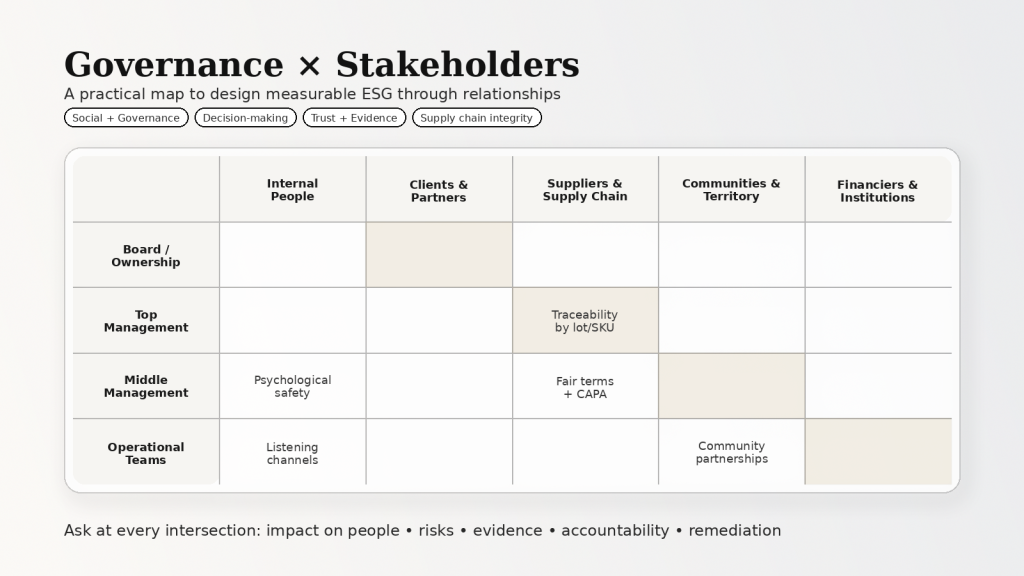
#Ask at every intersection: impact, risk, evidence, accountability, remediation.
Why this is strategic for Made in Italy (and for your brand)
For brands working internationally, sustainability is now inseparable from:
-
compliance
-
credibility
-
investor and buyer expectations
-
long-term market access
For Made in Italy, relational sustainability is also a competitive advantage: the ability to build trust over time, coordinate specialized supply chains, preserve local skills, and remain rooted in the territory—without sacrificing reliability.
That’s what sustainable luxury really means: not only what you produce, but how you produce it.
If you’re a brand: 10 questions to ask before calling a product “sustainable”
Use this checklist in your next sourcing or production conversation:
-
Can you provide traceability by lot / SKU (not just generic statements)?
-
Which sustainability claims are admissible for the final product (Chain of Custody)?
-
What are the minimums required for certified production—and why?
-
What is your approach to chemical compliance and testing (if needed)?
-
How do you select and monitor suppliers and high-risk processes?
-
Do you have a grievance/whistleblowing channel and a remediation workflow?
-
How do you prevent hidden subcontracting and manage corrective actions?
-
How do you protect know-how while staying transparent enough for audits and legality?
-
Which indicators prove Social + Governance performance (not only Environment)?
-
If a problem emerges, who owns it—and how fast do you act?
If a supplier can answer these calmly and clearly, you are not just buying fabric.
You are buying risk reduction, reputation protection, and future-proof sourcing.
How ARNIA supports brands (in practice)
If you want to build a product you can defend—technically, commercially, and reputationally—start from the areas where relationships become operational:
-
Textile Converter (our role in coordinating and protecting the supply chain)
-
Fabric Sourcing (traceable scouting + vendor management)
-
Cut & Sew Services (from prototypes to production, minimums from 20 pcs/style)
-
The Textile Project Manager (why project governance is the hidden lever of quality + sustainability)
-
48Hour Fabric Shortlist & Sampling Plan (a safe way to start—fast, but controlled)
-
Textile deadstock vs Just-in-Time (how “cheap solutions” create sustainability and compliance risk)
-
Protecting Know-How and Fashion Legality (balanced transparency that protects virtuous SMEs)
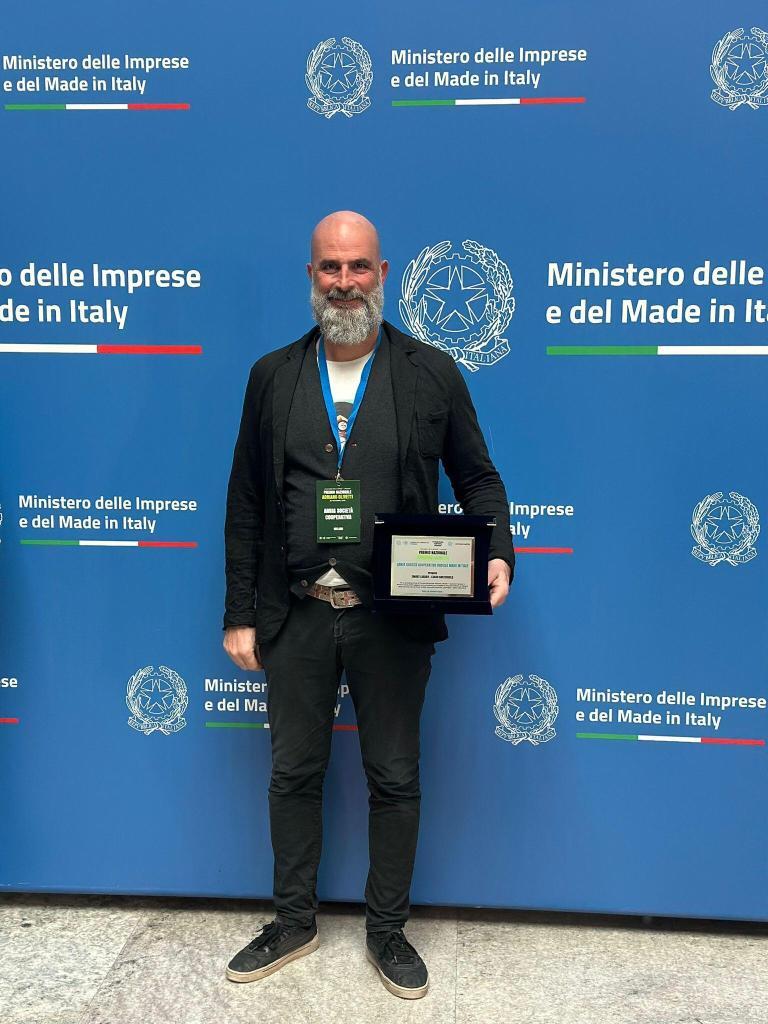
Closing: where ESG really takes shape
If your sustainability story feels stronger than your evidence—or if your evidence doesn’t reflect daily reality—your next step is not a new campaign.
Your next step is governance and relationships:
how decisions are made, how partners are treated, how data is managed, how issues are handled.
That’s where ESG truly takes shape.
Contact ARNIA here: Contact ARNIA MADE IN ITALY
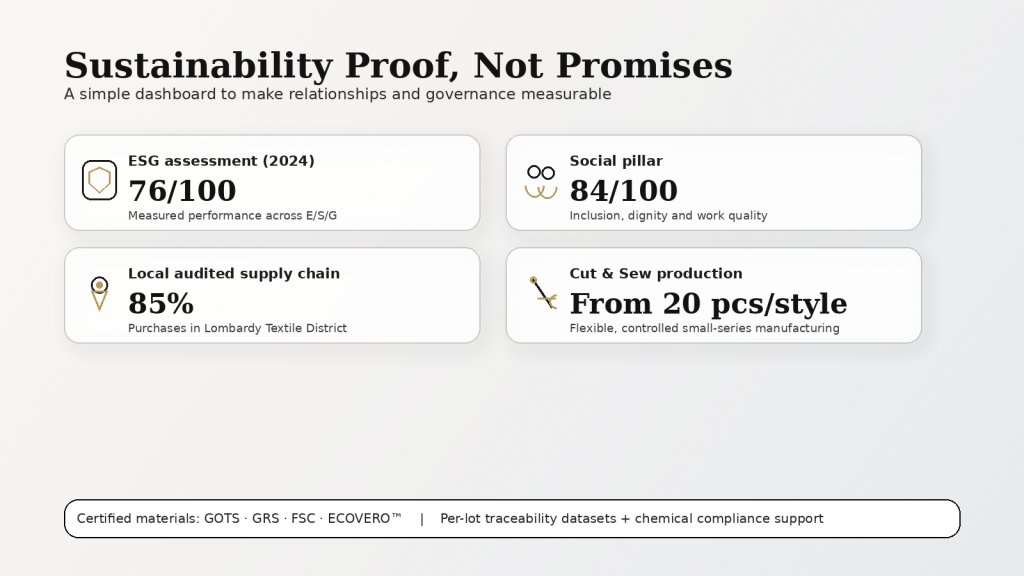
#Proof, not promises: measurable ESG and traceability that protects brand reputation.


