

Why “Sustainable”, “Organic” and “Eco” Claims Need Certification Chains, Traceability and Proof
Greenwashing in fashion and textiles, starts from words that have become very powerful.
“Sustainable.”
“Organic.”
“Eco-friendly.”
“Conscious.”
“Responsible.”
“Low impact.”
“Climate neutral.”
For years, these words were used as marketing language. Today, in Italy, the European Union and many international markets, they are increasingly treated as legal statements. If they influence a customer’s purchasing decision, they must be specific, verifiable and supported by evidence.
This is the real turning point: greenwashing is no longer only a reputational risk. It is becoming a compliance risk, a consumer protection risk and a supply-chain governance risk.
For fashion brands, especially emerging labels and small-batch producers, the issue is not simply whether they “care about sustainability”. The issue is whether they can prove what they say — through certification chains, traceability data, technical documentation, measurable KPIs and responsible claim governance.
At ARNIA TEXTILE FASHION, this is why we insist on a clear distinction: sustainability is not a slogan. It is a controlled process of continuous improvement, documented step by step, without overstating what a product, a fabric or a brand can legitimately claim. ARNIA’s own practical guide already frames this point clearly: sustainability is not a sticker; it is a roadmap, and certified fabric alone does not automatically make an entire collection certified or legally claimable as such.
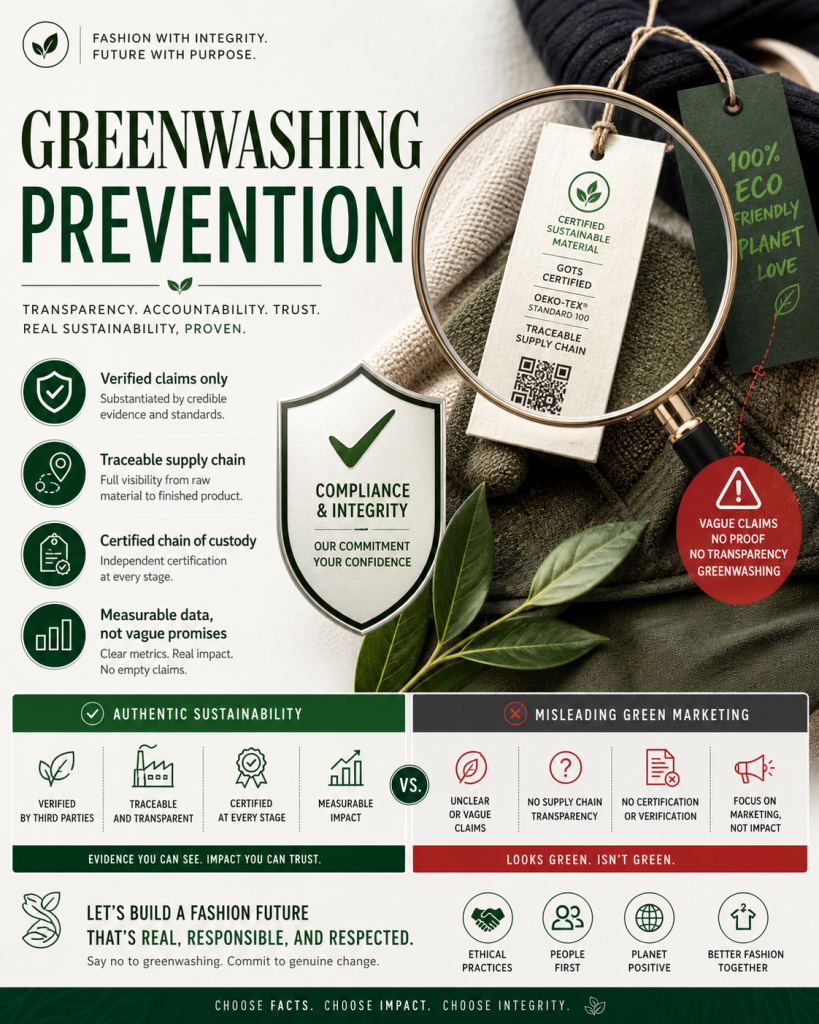
GREENWASHING IN FASHION
1. Greenwashing in fashion: when a claim becomes a risk
Greenwashing happens when environmental or social communication creates a misleading impression about the real impact, qualities, certification status or sustainability performance of a product, collection, process or company.
In fashion, greenwashing can arise from obvious exaggeration, but also from good-faith confusion. A brand may believe that buying a certified fabric is enough to call the finished garment “certified”. A designer may use deadstock fabric and assume that the whole product is automatically sustainable. A marketing team may write “eco-friendly” because the collection uses one lower-impact component, while the rest of the supply chain is undocumented.
The problem is not only the word. The problem is the gap between the word and the evidence.
A sustainable fashion claim must answer at least three questions:
- What exactly is being claimed?
The whole product, one component, one production phase, one material, one collection, or the company? - What proof supports the claim?
Certification, transaction certificate, laboratory test, traceability dataset, supplier documentation, lifecycle data, audit, KPI or governance record? - Who controls the claim before publication?
Marketing, legal, compliance, sustainability, production, or all of them together?
If these questions cannot be answered and archived, the claim is not ready for the market.
2. Elisabetta Cicigoi’s “Greenwashing”: from green language to legal accountability
Elisabetta Cicigoi’s book “Greenwashing – Fondamenti giuridici, pratiche commerciali sleali e Direttiva 2024/825”, published by Pacini Giuridica, starts from a fundamental question: what does it legally mean to be “green”?
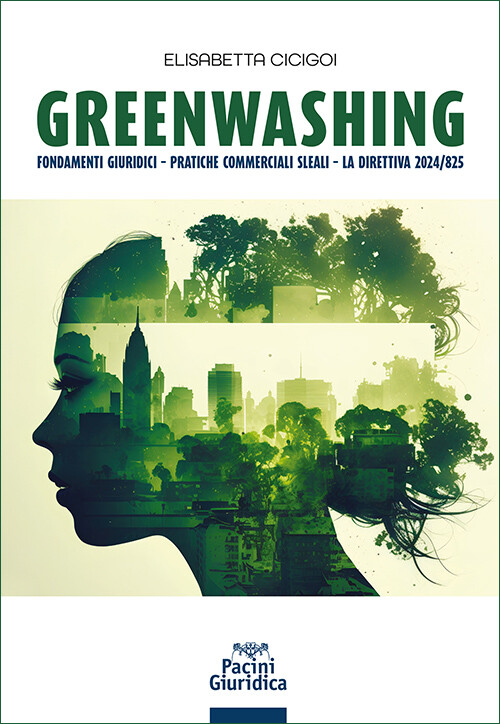
Greenwashing-Elisabetta Cicigoi
This is not a purely academic issue. Cicigoi’s analysis highlights that environmental communication is no longer just brand storytelling. Words, images, colours, sustainability labels and marketing narratives can become unfair commercial practices when they exploit environmental sensitivity without adequate legal and factual basis. The book presents Directive (EU) 2024/825 as a decisive step in protecting consumers from misleading green claims and forcing companies to reconsider how they use sustainability language.
One of the book’s central theses is that companies must move from emotional green communication to legally controlled environmental communication. Expressions such as “environmentally friendly”, “zero impact”, “green”, “nature-friendly” and similar generic wording become dangerous when they are not linked to real, measurable and verifiable environmental performance. Cicigoi’s public commentary stresses that businesses must communicate real environmental performance clearly and transparently, not merely use sustainability as a commercial attraction.
For the fashion and textile sector, this thesis is especially relevant. A garment is not a single act of production. It is a chain: fibre, spinning, weaving or knitting, dyeing, finishing, printing, cutting, sewing, labelling, packaging, logistics and retail communication. A green claim that ignores this chain is structurally weak.
In other words: in fashion, a sustainability claim is only as strong as the weakest undocumented link in the supply chain.
3. Italy and the EU: the legal framework is moving from intention to evidence
Italy has implemented Directive (EU) 2024/825 through Legislative Decree No. 30 of 20 February 2026, published in the Italian Official Journal on 9 March 2026 and in force from 24 March 2026. The decree amends the Italian Consumer Code and strengthens the framework against misleading environmental claims.
The European timetable is clear: Member States had to transpose the Directive by 27 March 2026, and the new requirements enter into application from 27 September 2026. The European Commission describes this reform as part of the broader effort to empower consumers for the green transition through more reliable sustainability information.
The Italian implementation defines and regulates key concepts such as environmental claims, generic environmental claims, sustainability labels, certification schemes and recognised excellent environmental performance. It also introduces stricter rules for future environmental performance claims, which must be supported by clear, objective, publicly available and verifiable commitments, realistic implementation plans, measurable targets and independent verification.
The most operational part is the extension of the list of practices considered unfair in all circumstances. For fashion brands, four prohibitions are particularly important:
- displaying sustainability labels not based on a certification scheme or not established by public authorities;
- making generic environmental claims without recognised excellent environmental performance;
- claiming benefits for the whole product or business when they relate only to one aspect;
- claiming that a product has neutral, reduced or positive greenhouse gas impact when the claim is based on offsetting.
The Italian Ministry of Enterprises and Made in Italy has explicitly referred to sectors such as fashion and textiles as particularly exposed to misleading environmental communication. It also underlined that environmental claims must be reliable, comparable and verifiable, including claims such as “neutral” or “zero impact”.
This means that in fashion, “sustainable” is no longer a mood. It is a statement that must be backed by evidence.
4. Enforcement in Italy: green claims already have a cost
The legal risk is not theoretical.
In 2025, the Italian Competition Authority sanctioned SHEIN with a fine of €1 million for misleading and/or deceptive environmental claims used in the promotion and online sale of clothing products. The Authority considered certain claims vague, generic, emphatic, misleading or omissive, including statements around green fibres, circularity, recyclability and emissions reduction. It also stressed the higher duty of care expected from companies operating in highly polluting sectors such as fast and super-fast fashion.
The same Authority imposed an €8 million fine on GLS for its “Climate Protect” programme, considering that the environmental communication lacked transparency, rigour and diligence. The case is important beyond logistics: it shows that environmental programmes used to build a green image must be communicated with clarity, specificity, accuracy and verifiability.
Under the Italian Consumer Code framework, unfair commercial practices may lead to significant administrative sanctions, reaching up to €10 million in serious cases.
For fashion companies, the conclusion is simple: if sustainability is part of brand positioning, it is also part of legal risk management.
5. The global direction: EU rules are not isolated
The European Union is not alone. Around the world, regulators are moving in the same direction: environmental claims must be clear, substantiated and not misleading.
In the United Kingdom, the Competition and Markets Authority investigated environmental claims by fashion retailers including ASOS, Boohoo and Asda. The resulting undertakings required green claims to be accurate, clear, prominent and supported by evidence. The CMA also warned against ambiguous language such as “eco”, “responsible” or “sustainable” when not properly explained, and insisted that fabric claims such as “organic” or “recycled” must be specific.
In the United States, the Federal Trade Commission’s Green Guides are designed to help marketers avoid misleading environmental claims. They require appropriate qualification and substantiation, including competent and reliable scientific evidence where needed. The FTC has also addressed textile-specific issues, including misleading fibre claims.
In Australia, the ACCC’s guidance on environmental and sustainability claims identifies eight practical principles: make accurate claims, have evidence, do not hide important information, explain qualifications, avoid broad unqualified claims, use clear language, ensure visual elements do not mislead, and be open about sustainability transition.
France has adopted specific rules around carbon neutrality claims, requiring companies using expressions such as “carbon neutral” or “zero carbon” to provide lifecycle-based greenhouse gas reporting and transparency around offsetting.
At international level, the OECD has also analysed misleading green claims as a consumer policy issue, highlighting the prevalence and harm of false, misleading or unsubstantiated environmental communication.
The direction is consistent: green claims are becoming evidence claims.
6. Why fashion and textiles are structurally exposed to greenwashing
Fashion is vulnerable to greenwashing because textile products are complex.
A simple garment may involve:
- fibre origin;
- spinning;
- weaving or knitting;
- dyeing;
- finishing;
- printing or embroidery;
- cutting and sewing;
- care labelling;
- packaging;
- transport;
- retail communication.
Each stage may affect the validity of a sustainability claim. If the brand cannot document the chain, the claim becomes fragile.
This is why generic claims are dangerous. “Eco-friendly dress” says too much and proves too little. “Sustainable capsule” often suggests that the entire collection has been assessed, when in reality only one fabric or one supplier may have been checked. “Organic garment” can be misleading if only the raw material is certified but the chain of custody is not intact through the final product.
A responsible claim must be narrower, clearer and more documentable.
For example:
- “Made with certified organic cotton fabric” is more precise than “organic dress”.
- “Main fabric contains recycled polyester certified at fabric level” is safer than “sustainable jacket”.
- “Produced through a monitored short supply chain in Lombardy” is more meaningful than “ethical fashion”, if it is supported by supplier controls.
- “Garment not certified; certified fabric documentation available for the production lot” is more transparent than overstating certification.
The goal is not to weaken sustainability communication. The goal is to make it credible.
7. Chain of Custody: where good-faith greenwashing often starts
One of the most common mistakes in fashion is confusing certified material with certified finished product.
A fabric may be certified. A supplier may be certified. A transaction certificate may exist for a specific lot. But this does not automatically mean that the final garment can be marketed as certified.
Product-level certification usually depends on Chain of Custody: the controlled, documented and certified flow of material through all relevant stages, up to the party making the claim. If the brand itself is not certified under the relevant scheme, it generally cannot claim the final garment as certified, even if an upstream fabric is certified.
ARNIA’s Sustainability Practical Guide explains this point clearly: if the brand is not certified, it may often communicate a truthful component claim, such as “made with certified fabric”, but it should not label the garment as GOTS, GRS or FSC certified when the chain of custody does not support that claim.
This distinction is critical for start-ups and emerging designers. Many small brands buy certified fabrics in good faith and then unintentionally overclaim. The intention may be honest, but the market message may still be misleading.
In modern sustainability law, good faith is not enough. Claims need governance.
8. The small-batch dilemma: real sustainability without impossible certification
A serious sustainability conversation must also be honest about production scale.
Many emerging brands produce capsules, prototypes or small batches. They may want certified production, but product-level certification can require technical minimums, segregation procedures, dedicated machinery, documentation flows and administrative controls that are not realistic for very small lots.
ARNIA’s guide explains this practical reality and lists operational minimums for certified runs. For example, ARNIA indicates minimums such as GRS Printed: 500 metres, GRS Woven Jacquard Yarn Dyed: 300 metres, GRS Plain Piece Dyed: 500 metres, FSC: 500 metres, ECOVERO™ Plain Piece Dyed: 800 metres, ECOVERO™ Printed: 500 metres, and GOTS: 1,000 metres. These are ARNIA operational minimums for maintaining traceability, segregation and technical feasibility; they are not presented as universal rules of the standards.
This point matters because sustainability should not become a privilege reserved only for large corporations. A start-up may not be able to issue a product-level certified claim for a small capsule, but it can still communicate responsibly.
A small brand can build credibility through:
- certified or better-controlled input materials where available;
- precise component claims;
- documented supplier selection;
- traceable production lots;
- chemical safety declarations or tests where relevant;
- transparent limitations;
- a measurable sustainability roadmap;
- annual reporting of progress.
This is the philosophy ARNIA promotes: continuous improvement that is transparent, measurable and reportable, even when full product certification is not technically or economically possible at small scale.
The honest sentence “we are building a documented sustainability roadmap” is stronger than the exaggerated sentence “we are 100% sustainable”.
9. “Organic”, “sustainable” and “eco”: how to use these words correctly
“Organic”
In textiles, “organic” is one of the highest-risk words. It should not be used loosely.
A fibre may be organically grown. A fabric may be certified under a recognised textile standard. A finished product may or may not be certifiable depending on the chain of custody and the brand’s certification status.
A safe approach is to specify the level:
- “fabric made with certified organic cotton”;
- “certified organic cotton fabric used as main material”;
- “finished garment not certified” when applicable.
Avoid saying “organic garment” unless the full certification and chain of custody support that exact claim.
“Sustainable”
“Sustainable” is broad and therefore risky. It can refer to environmental impact, social conditions, durability, circularity, resource use, governance or all of them together. Without explanation, it can create an impression that is wider than the evidence.
A better approach is to replace “sustainable” with a specific claim:
- lower-impact dyeing process, if documented;
- recycled content, if certified and quantified;
- short audited supply chain, if traceable;
- social cooperative production model, if documented;
- reduced waste through made-to-order or just-in-time planning, if measurable.
“Eco-friendly”
“Eco-friendly” is generally too vague unless supported by recognised excellent environmental performance relevant to the claim. Under the EU framework, generic environmental claims are specifically targeted when the trader cannot demonstrate recognised excellence.
A better approach is to avoid the expression and communicate the measurable fact behind it.
Do not say: “eco-friendly fabric”.
Say: “fabric developed with documented recycled content and traceable production lot”, if that is true and evidenced.
10. Deadstock: why “using what already exists” is not automatically sustainable
Deadstock is often presented as a quick solution to sustainability. The argument sounds simple: if fabric already exists, using it must be better than producing new fabric.
Sometimes that may be true. But in compliance terms, the picture is more complex.
ARNIA has already addressed this in its article on textile deadstock vs just-in-time production. The key point is that deadstock often lacks official composition, provenance, chemical documentation, traceability and chain-of-custody records. Without these documents, it may be difficult to support claims about sustainability, certification, fibre content, chemical safety or labelling compliance.
This does not mean that deadstock is always wrong. It means that deadstock is not automatically sustainable.
Before using deadstock as part of an environmental claim, a brand should ask:
- Is the fibre composition officially documented?
- Is the origin known?
- Are chemical safety declarations available?
- Are test reports available?
- Is there a transaction certificate or chain-of-custody documentation?
- Can the fabric be reordered?
- Can the final product be labelled correctly?
- Can the claim be proved if challenged?
If the answer is no, “deadstock sustainable fashion” becomes a greenwashing risk.
For structured brands, ARNIA generally recommends a more controlled route: produce less, produce better, produce closer to real demand, and document the lot. This is where just-in-time textile production can be more credible than opportunistic deadstock sourcing.
11. ARNIA’s method: sustainability as governed evidence, not marketing atmosphere
ARNIA TEXTILE FASHION is a non-profit social cooperative rooted in the Lombardy textile district, operating as a textile converter and industrial-strategic partner for fashion brands. Its model combines Italian textile know-how, short local supply chains, certified materials where applicable, traceability, social inclusion and measurable ESG governance.
ARNIA’s company profile identifies key pillars such as high-end jacquards, embroidery and prints, a short audited supply chain, social inclusion and an ESG 2024 score of 76/100. It also describes ARNIA’s role in developing high-end fabrics and capsule collections for emerging and established brands in the Varese–Como–Milan textile district.
The technical approach is based on documentation. ARNIA can provide, on request and where applicable to the order, certified materials, per-lot traceability datasets, chemical safety conformity, laboratory testing and governance documentation. Its per-SKU or per-lot traceability dataset can include article code, composition, fibre origin, production stages, process facilities, chemical auxiliaries, REACH/RSL information, admissible claims and logistics information.
This is the opposite of greenwashing. It is not about saying more. It is about saying only what the evidence can support.
ARNIA’s sustainability philosophy can be summarised in five principles:
- Define the claim before publishing it.
A claim must have a clear scope: material, process, product, collection or company. - Connect the claim to evidence.
Evidence may include certifications, transaction certificates, supplier documentation, traceability data, test reports or governance records. - Respect Chain of Custody limits.
Certified fabric does not automatically mean certified garment. - Protect transparency and know-how together.
Transparency means controlled disclosure of compliance, traceability and governance data. It does not mean exposing supplier identities, trade secrets or other clients’ projects without legal safeguards. - Communicate continuous improvement honestly.
A brand can be credible even without full product certification, if it reports its limits, data, targets and progress.
This last point is essential for start-ups. Sustainability should be accessible, but it must be truthful.
12. Transparency does not mean uncontrolled disclosure
A common misunderstanding in fashion compliance is that transparency means publishing every supplier name, every process detail and every commercial relationship.
That is not accurate.
In a professional textile supply chain, transparency must be balanced with confidentiality, safety, client privacy and protection of industrial know-how. ARNIA’s NDA and supply-chain protection framework is designed to protect confidential information, supplier relationships, project deliverables, prototypes, production methods and trade secrets while enabling the controlled exchange of information required for development and compliance.
This distinction is important: responsible transparency is not uncontrolled exposure.
A serious supplier can provide documentation, certificates, traceability datasets, audit evidence and compliance declarations under appropriate conditions. But it should not be expected to disclose sensitive supplier identities or process know-how at an early exploratory stage without NDA, non-circumvention protections and a clear project purpose.
This protects both parties: the brand’s reputation and the supplier’s industrial ecosystem.
13. Anti-greenwashing checklist for fashion brands
Before publishing any sustainability claim, a fashion brand should create an internal evidence pack answering these questions:
Claim scope
- What exactly are we saying?
- Is the claim about the whole product, one component, one process, one collection or the company?
- Could a consumer understand the claim more broadly than intended?
Evidence
- What document supports the claim?
- Is there a certificate?
- Is there a transaction certificate?
- Is there a test report?
- Is there a traceability dataset?
- Is there supplier documentation?
- Is the evidence specific to the lot or only generic?
Certification and Chain of Custody
- Is the relevant standard applicable to the material, fabric or finished product?
- Is the brand certified where product-level claims require it?
- Are we using a logo or sustainability label correctly?
- Are we confusing certified fabric with certified finished garment?
Quantification
- Are percentages clear?
- Are recycled or organic contents measured and documented?
- Are claims such as “low impact” supported by data?
Visual communication
- Do images, colours, leaves, icons or badges create a stronger impression than the evidence supports?
- Are we using proprietary labels that could be mistaken for independent certification?
Climate claims
- Are we saying “carbon neutral”, “zero impact” or “climate positive”?
- Is the claim based on offsetting?
- Do we have lifecycle data and a compliant communication basis?
Governance
- Who approved the claim?
- When was it approved?
- Where is the evidence archived?
- Is the claim reviewed when suppliers, materials or processes change?
If the evidence cannot be archived, the claim should not be published.
14. Examples: risky claims and safer alternatives
Risky claim
“This is a sustainable dress.”
Safer alternative
“This dress is made with a documented lower-impact material selected through ARNIA’s traceability-based sourcing process. Product-level certification is not claimed.”
Risky claim
“Organic garment.”
Safer alternative
“Main fabric made with certified organic cotton. The finished garment is not certified unless specifically confirmed through an applicable Chain of Custody process.”
Risky claim
“Eco-friendly capsule collection.”
Safer alternative
“This capsule uses selected traceable fabrics and a small-batch production approach designed to reduce overproduction. Documentation is managed per production lot.”
Risky claim
“Made from sustainable deadstock.”
Safer alternative
“Made from available archive fabric. Composition and compliance documentation have been reviewed for this production lot.”
Risky claim
“Climate neutral product.”
Safer alternative
“Emission reduction and impact data are under review. No product-level climate neutrality claim is made.”
15. What start-ups can say when full certification is not technically possible
Start-ups should not be pushed into silence simply because they cannot afford or technically manage full certification for every small lot. But they must avoid exaggerated claims.
A responsible start-up can say:
- “We are working with documented materials and controlled suppliers.”
- “We use certified fabrics where technically and commercially feasible.”
- “The finished garment is not certified unless explicitly stated.”
- “We prioritise traceability, responsible sourcing and reduction of overproduction.”
- “We report progress and limits transparently.”
- “Our sustainability roadmap is based on measurable steps, not generic claims.”
This is not weaker communication. It is stronger because it is credible.
ARNIA’s Sustainability Practical Guide is designed exactly for this purpose: helping emerging brands understand certifications, Chain of Custody, small-run limits, claims hygiene, data rooms, KPIs and responsible storytelling.
16. The future: from green storytelling to claim governance
The future of sustainability communication in fashion will not be built on louder claims. It will be built on better governance.
Brands will need:
- material policies;
- supplier onboarding rules;
- evidence archives;
- traceability by SKU or lot;
- claim approval workflows;
- staff training;
- compliance checks before product launches;
- transparent consumer-facing language;
- periodic reporting;
- remediation where gaps are found.
This approach is already part of ARNIA’s positioning. ARNIA promotes sustainability as measurable action, not marketing, and links environmental responsibility with social inclusion, supply-chain ethics, traceability and third-party audits.
In this context, a sustainable fashion brand is not the brand that claims perfection. It is the brand that knows what it can prove, what it cannot yet prove, and what it is improving.
That is the difference between greenwashing and responsible sustainability.
17. How ARNIA helps brands reduce greenwashing risk
ARNIA supports fashion brands through a practical anti-greenwashing approach built around supply-chain control and documentation.
Depending on the project, ARNIA can support:
- responsible fabric sourcing;
- certified materials where technically feasible;
- small-batch and capsule collection development;
- traceability by production lot;
- chemical safety documentation and testing where required;
- Chain of Custody clarification;
- claim wording support;
- technical feasibility review;
- controlled supplier disclosure under NDA;
- continuous improvement roadmaps for emerging brands.
Useful pages:
- Sustainability
- Transparency
- Sustainability Practical Guide
- Fabric Sourcing
- Cut & Sew Services
- Textile Deadstock vs Just-in-Time
- Protecting Know-How and Fashion Legality
ARNIA’s role is not to help brands say more than they can prove. Its role is to help them build the evidence needed to communicate responsibly.
Conclusion: the safest sustainability claim is the one you can prove
Fashion does not need more vague green language.
It needs better evidence.
The words “sustainable”, “organic” and “eco” are not forbidden by nature. But they are dangerous when used without scope, certification chain, measurable data and internal governance.
The strongest claim is not the broadest one.
It is the one that can survive a buyer’s due diligence, a regulator’s question and a consumer’s reasonable interpretation.
At ARNIA TEXTILE FASHION, we believe that responsible Made in Italy must be beautiful, traceable and accountable. Sustainability is not a final label. It is a disciplined process of improvement — documented, measurable and honestly communicated.
FAQ — Greenwashing in Fashion and Textile Supply Chains
What is greenwashing in fashion?
Greenwashing in fashion is the use of environmental or social claims that mislead consumers about the real sustainability performance of a garment, fabric, collection, process or company. It may arise from exaggeration, omission, vague language or unsupported claims.
Are words like “sustainable”, “organic” and “eco-friendly” risky?
Yes. They are risky when they are broad, generic or unsupported. Under the EU framework, generic environmental claims are specifically targeted when they are not backed by recognised excellent environmental performance relevant to the claim.
Can a brand say a garment is certified if only the fabric is certified?
Generally, no. Certified fabric does not automatically make the finished garment certified. Product-level certification depends on Chain of Custody, transaction documentation and the certification status of the party making the claim.
Can a small fashion start-up communicate sustainability without full certification?
Yes, but it must be precise. A start-up can communicate certified fabrics, traceable suppliers, small-batch production, reduction of overproduction and measurable improvement targets, provided the claims are truthful and documented.
Why are small certified lots difficult?
Certified production may require minimum quantities, segregation, dedicated machinery, transaction documentation and administrative controls. Very small lots or prototypes may not be technically or economically compatible with product-level certification.
Is deadstock automatically sustainable?
No. Deadstock can reduce waste in some cases, but it often lacks composition, origin, chemical safety, traceability and Chain of Custody documentation. Without evidence, “deadstock sustainable fashion” can become a greenwashing risk.
What evidence is needed for a sustainable fashion claim?
Evidence may include certification, transaction certificates, supplier declarations, traceability datasets, chemical tests, laboratory reports, lifecycle data, audit records, ESG KPIs and internal claim approval documentation.
Can a brand say “climate neutral” if it uses offsets?
In the EU, claims that a product has neutral, reduced or positive greenhouse gas impact based on offsetting are specifically targeted by the new framework. Climate claims require particular caution, data and legal review.
Who enforces greenwashing rules in Italy?
The Italian Competition Authority supervises unfair commercial practices and may impose significant sanctions under the Consumer Code framework. Italy has implemented Directive (EU) 2024/825 through Legislative Decree No. 30/2026.
How can ARNIA help reduce greenwashing risk?
ARNIA supports brands with responsible fabric sourcing, certified materials where feasible, traceability by lot, compliance documentation, Chain of Custody clarification, technical review, small-batch production strategy and responsible sustainability communication.


