
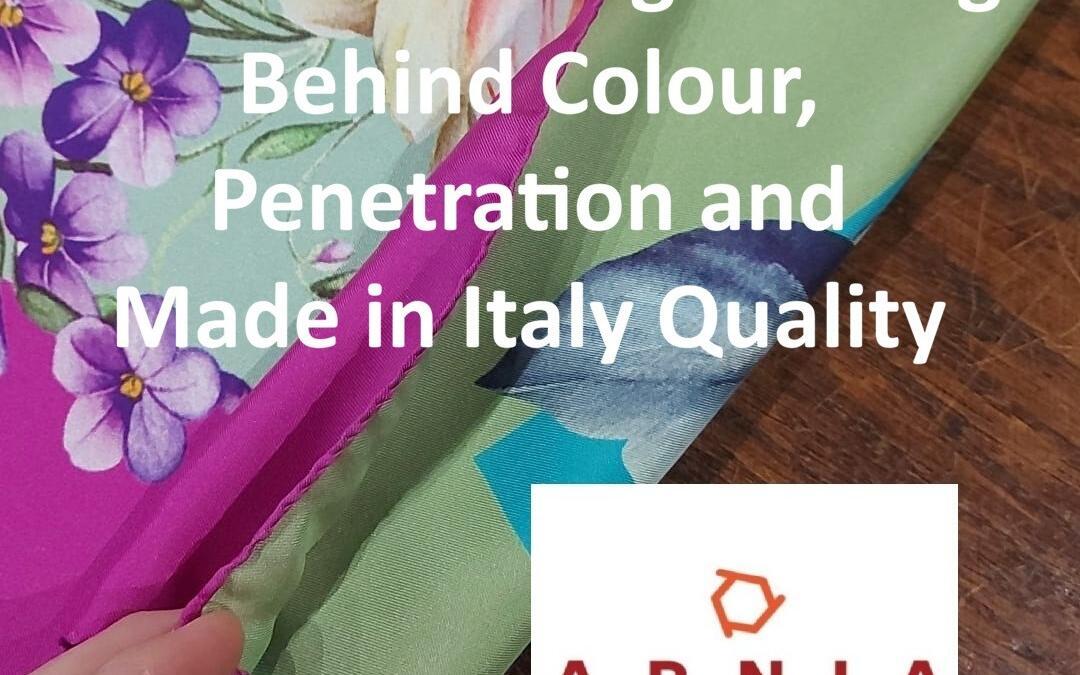
Textile printing is often described as decoration. In reality, it is much more than that. It is a controlled combination of chemistry, fabric preparation, colour management, mechanical precision and finishing know-how. A successful printed fabric is not simply a fabric with a motif on top: it is a textile article where fibre, yarn, construction, surface, dyestuff, fixation and final handle all work together.
Technically, textile printing is a form of localised colouration: colour is applied only to specific areas of the fabric, instead of immersing the whole cloth in a dye bath. The aim is to obtain sharp motifs, stable colours and a printed surface that resists washing, rubbing and use. Research on textile printing describes it as the application of colour to textile surfaces through specialised processes and machines, with the objective of creating patterns with defined borders and good resistance to washing and crocking.
At ARNIA TEXTILE FASHION, printing is part of a broader textile development culture rooted in the Lombardy Textile District — Varese, Como and Milan — where yarn, weaving, printing, finishing, prototyping and garment development can be coordinated within a short, specialised and audited supply chain. ARNIA’s company profile identifies digital and screen printing among its textile development activities on silk, cotton, viscose, linen, recycled polyester and conventional polyester, within a model based on craftsmanship, industrial reliability and measurable ESG performance.
For fashion brands, the key question is therefore not only: “Which printing technique should we use?” The better question is: “Which combination of fabric preparation, fibre chemistry, print technology, colour penetration and finishing will produce the correct visual result, hand feel, durability and sustainability profile?”
1. Fabric Preparation: The Quality of the Print Starts Before TEXTILE Printing
A print can only be as good as the fabric prepared to receive it. Before any printing process — rotary, flat screen, digital or transfer — the fabric must be clean, stable, absorbent in the right way and free from surface impurities that may block the colour.
General textile preparation removes natural and process-related impurities to make the fabric suitable for subsequent dyeing, printing and finishing. Depending on the fibre, common preparation steps may include desizing, scouring, bleaching, mercerising, heat-setting or degumming.
Desizing — “sbozzima”
Desizing is especially relevant for woven fabrics. During weaving, warp yarns are often treated with sizing agents to improve resistance and reduce breakage. These size residues are useful during weaving but harmful during printing if they remain on the fabric.
If sizing is not properly removed, the print paste or ink may not penetrate evenly. The result can be uneven colour, weak areas, stains, white marks or irregular motif definition. A fabric that looks visually acceptable before printing may reveal preparation problems only after colour application.
Scouring — “purga”
Scouring removes oils, waxes, pectins, spinning lubricants, dirt and other impurities. On cotton and linen, it helps improve absorbency. On viscose and other cellulosics, it helps create a more uniform substrate. On silk, preparation must be more delicate because the fibre’s hand, sheen and structure must be preserved.
A well-scoured fabric accepts colour more uniformly. A poorly scoured fabric may produce dull shades, halos, uneven grounds or weak penetration.
Linen and the importance of double washing
Linen requires particular attention. It is a beautiful, natural fibre, but its surface can contain loose fibres, neps, small woody particles and mobile impurities. During printing, these particles may temporarily cover the fabric surface and act like small “resists”. If they detach later, they may leave tiny unprinted or lighter marks.
This is one reason why, for linen or linen-rich fabrics, a double washing route can be technically useful before printing. The aim is not to “over-process” the cloth, but to reduce unstable surface elements before colour is applied. Technical literature on dyed fabrics identifies white specks as undyed spots commonly caused by neps, which can prevent the fibre mass from accepting dye properly.
For premium printed linen, preparation is therefore a strategic quality step: it reduces reserve effects, improves surface regularity and helps obtain cleaner motifs.
Why preparation determines brilliance
Brilliant, deep and luminous colours are not achieved only by choosing strong dyes. They depend on the full preparation sequence. If the fabric is not correctly prepared, colour may remain superficial, appear greyed, lose depth or vary from lot to lot.
This is especially true for luxury printing, where clients often expect three things at the same time: intense colour on the face, pleasant handle and acceptable colour visibility on the reverse side. These three targets are not automatic. They must be engineered.
2. Fibre Chemistry: Acid, Reactive and Disperse Textile Printing Systems
There is no universal printing chemistry. The dyestuff must match the fibre.
A useful technical rule is simple:
- Silk is commonly printed with acid dyes.
- Cotton, linen and viscose are commonly printed with reactive dyes.
- Polyester is printed with disperse dyes or through sublimation/transfer printing.
Technical suppliers describe the same fibre logic: reactive printing pastes are used for cellulosic fibres; acid printing pastes are suitable for silk, wool and polyamide; polyester is generally printed with disperse dyes. After printing, many dye-based systems require drying, steaming and washing to remove unfixed dye and thickener.
Acid printing for silk
Silk is a protein fibre. Acid dye printing works in an acidic environment, where the dye has affinity for the fibre. This route can give exceptional luminosity, brilliance and elegance — qualities that are central to luxury scarves, foulards, dresses, linings and accessories.
However, brilliance and fastness do not always move in the same direction. Acid dyes can offer a wide colour range, but the final fastness depends on the selected dye class, shade depth, finishing, washing and intended use. CottonWorks notes that acid dyes are used for silk, wool and nylon and that their colourfastness properties vary widely.
For silk, the technical decision is therefore not only “acid print yes or no”. It is: which acid dye class, which steaming profile, which wash-off, which final hand, and which fastness level is required for the product?
Reactive printing for cotton, linen and viscose
Reactive dyes are used for cellulosic fibres such as cotton, linen, viscose and other cellulose-based fibres. They form a chemical bond with cellulose and can provide bright colours with strong wash performance when correctly fixed and washed. CottonWorks describes reactive dyes as widely used for cotton blends, forming a covalent bond with cellulose and giving good to excellent washfastness, with a broad and bright shade range.
Reactive printing is particularly relevant for shirts, dresses, linings, summer fabrics, scarves in cotton/viscose blends and many fashion articles where brightness and durability must be balanced.
The limitation is environmental and process-related: reactive systems require careful fixation and washing-off. If unfixed dye and auxiliaries are not properly removed, the fabric may suffer from bleeding, poor rubbing fastness, harsh handle or wastewater impact. This is why sustainability in printing must be discussed honestly: the chemistry, water use and afterwashing requirements matter.
Disperse printing and transfer printing for polyester
Polyester is hydrophobic and cannot be printed like cotton or silk. It normally requires disperse dyes, which diffuse into the polyester structure under heat. CottonWorks explains that disperse dyes are used for thermoplastic synthetic fibres, primarily polyester, and that some disperse dyes can sublime, enabling sublimation printing.
For polyester, there are two main routes:
- Direct disperse printing
The fabric is printed directly, then fixed by heat or steaming and usually washed to remove unfixed dye. - Transfer / sublimation printing
The design is first printed onto paper, then transferred to polyester through heat and pressure. In sublimation, the dye changes from solid to gas and migrates into the polyester fibre. Technical guides describe sublimation transfer printing as a process where patterns printed on paper are transferred to fabrics using dry heat and pressure; the dyes pass from solid to gaseous state without becoming liquid.
Transfer printing can be highly relevant for polyester scarves, linings, sportswear, accessories and some recycled polyester fabrics. It can reduce water use because it avoids some wet post-treatment stages. Sappi describes dye sublimation as water-free compared with conventional screen printing, while noting that it is typically used on synthetic fibres such as polyester.
3. Rotary Screen textile Printing: Industrial Depth, Penetration and Consistency
Rotary screen printing is one of the most important industrial textile printing techniques. It uses engraved cylindrical screens, one for each colour. The fabric moves continuously under the rotating screens, while print paste is pushed through the open areas of each cylinder onto the textile.
ARNIA’s own print page describes rotary screen printing as a method using engraved cylindrical screens to apply designs at high speed, particularly suitable for large-scale production, repeating patterns, colour penetration and wash durability.
Strengths of rotary printing
Rotary printing is especially strong when the project requires:
- continuous yardage;
- repeat motifs;
- strong colour depth;
- good reverse-side penetration;
- industrial reproducibility;
- competitive cost on medium/large runs;
- stable colour recipes once approved.
Because rotary uses print paste and mechanical pressure, it can often push colour deeper into the yarn and fabric structure than digital printing. This is one of the reasons rotary is frequently preferred for scarves, accessories, linings and articles where the reverse side matters.
Limits of rotary textile printing
Rotary is not the best solution for every project. Each colour normally requires a screen, which means set-up time, engraving cost and a technical commitment before production. It is less flexible than digital printing for sampling, photographic artwork, very complex gradients or small experimental drops.
Rotary also requires careful control of paste viscosity, screen engraving, pressure, speed, drying and fixation. If the paste is too fluid, the print may bleed. If it is too dense, penetration may be insufficient. If pressure or fabric tension is wrong, registration may suffer.
Best use cases
Rotary printing is ideal for:
- production yardage;
- accessories and scarves requiring stronger reverse visibility;
- repeating all-over patterns;
- premium linings;
- home textiles;
- stable seasonal prints;
- projects where colour solidity and penetration are more important than unlimited colour freedom.
4. Flat Screen Textile Printing — “Stampa a Quadro”
Flat screen printing, often called stampa a quadro in Italian textile practice, uses flat screens instead of rotating cylinders. The screen is positioned over the fabric, and print paste is pushed through the open areas of the mesh. Each colour normally requires a separate screen and a separate passage.
Flat and rotary screen printing are both described in technical literature as highly adaptable and capable of high production rates, while screen systems remain central to many direct textile printing techniques.
Strengths of flat screen printing
Flat screen printing offers excellent control on:
- special effects;
- larger motifs;
- engineered placements;
- high paste deposits;
- luxury hand-crafted effects;
- devoré, discharge, metallic, pigment, lacquer or special surface applications;
- designs where the visual result benefits from a slower, more controlled process.
Compared with rotary, flat screen printing can be more flexible for certain artistic designs, panel placements or luxury effects that do not require continuous high-speed production.
Limits of flat screen textile printing
The process is slower than rotary and usually less efficient for long industrial runs. Registration must be carefully controlled, especially on unstable fabrics. Labour, set-up and handling can be more demanding. Fine detail is possible, but the result depends on mesh, paste, fabric surface and operator skill.
Best use cases
Flat screen printing is often suitable for:
- luxury silk panels;
- special effects;
- limited editions;
- placement prints;
- complex surface treatments;
- prints requiring a thicker deposit;
- designs where hand-feel and visual depth are more important than speed.
5. Digital Textile Printing: Freedom, Detail and Responsiveness
Digital textile printing changed the logic of textile design. It allows patterns to be printed directly from a digital file onto fabric using inkjet technology. ARNIA’s print page describes digital printing as a high-precision inkjet method that allows unlimited colours, fine detail, photo-quality imagery, gradients, no screen set-up and fast response for short runs, sampling and complex motifs.
Strengths of digital printing
Digital printing is ideal when a brand needs:
- high-resolution artwork;
- many colours;
- photographic images;
- gradients and watercolour effects;
- fast sampling;
- lower set-up compared with screen methods;
- frequent design changes;
- capsule collections;
- personalised prints;
- smaller production lots.
Digital printing also reduces some forms of waste because there are no screens to engrave and no large paste kitchens for every colourway. Educational sources on digital textile printing highlight its flexibility, fast colour/design changes and reduced waste and pollutants compared with traditional screen printing.
Limits of digital textile printing
Digital printing is not magic. It has technical limits:
- penetration is often more superficial than rotary;
- the reverse side can remain pale or white;
- textured fabrics may reduce sharpness;
- absorbency must be controlled through pretreatment;
- dark, saturated colours require careful profiling;
- nozzle performance and fabric flatness are critical;
- some ink systems need steaming and washing;
- unit cost can be higher on large production runs.
The main challenge is often reverse-side visibility. Digital ink droplets are deposited in precise quantities. This gives detail and colour control, but not always deep penetration. On compact, heavy or tightly woven fabrics, the print may remain mainly on the face. On scarves, accessories or garments where both sides are visible, this may be a limitation unless additional technical solutions are used.
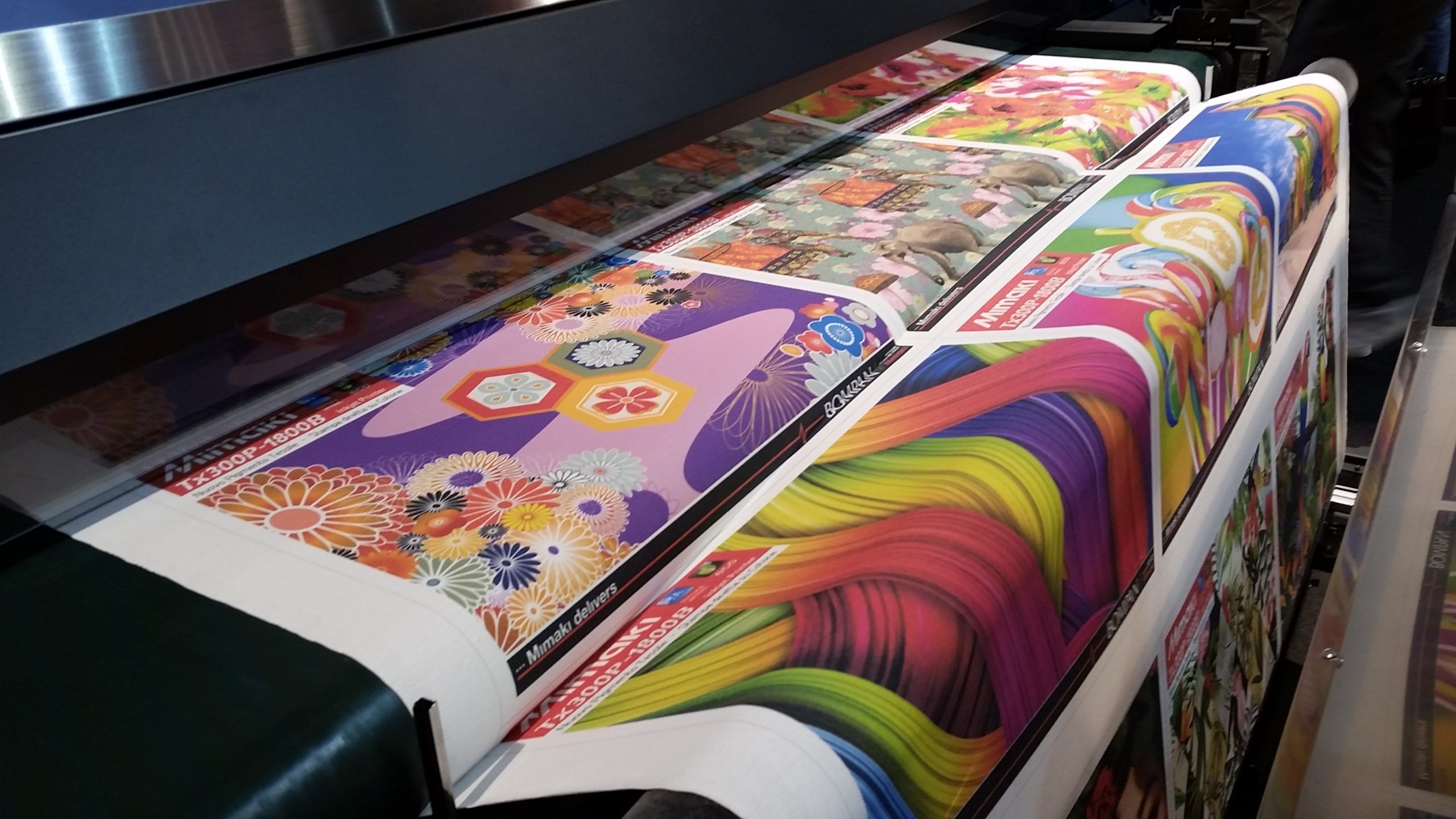
textile printing digital
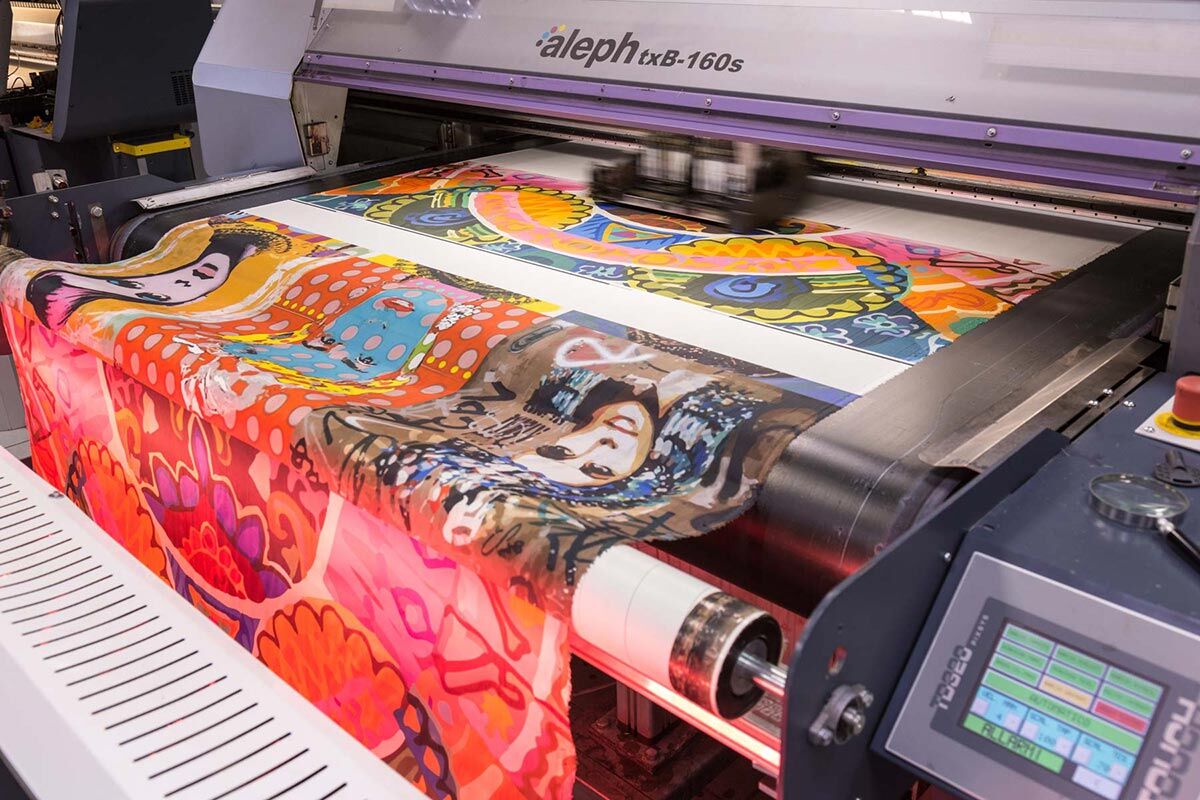
Industrial fabric printer producing a vivid, multicolor textile on a wide roll.
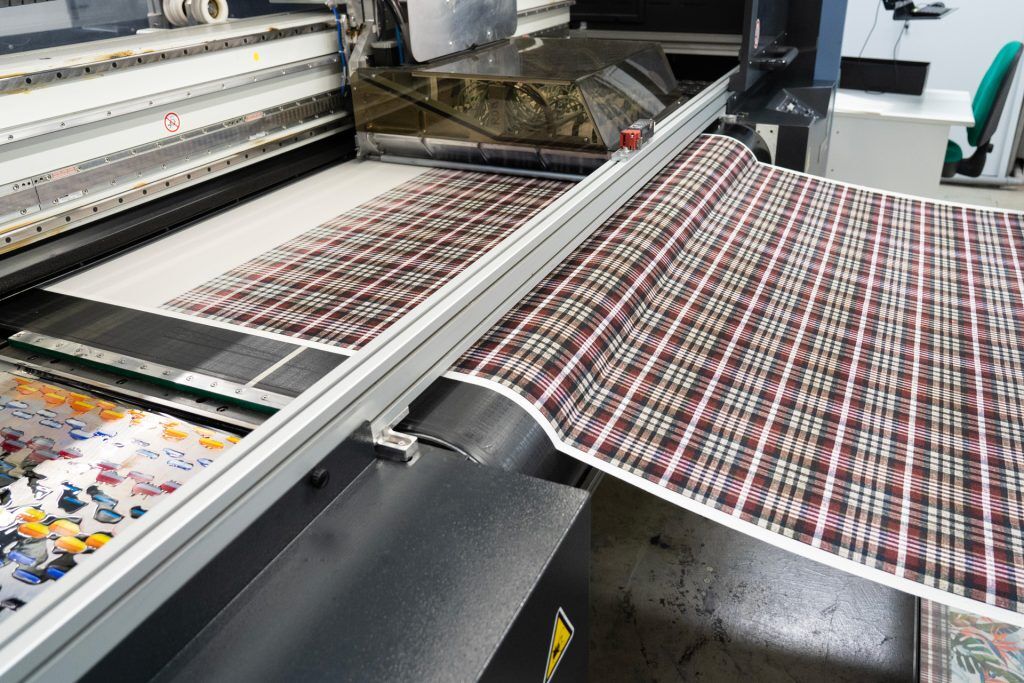
Industrial fabric printer feeding
6. Transfer Printing: How It Works and Why It Can Reduce Water Use
Transfer printing is an indirect process. The design is printed onto transfer paper, usually in mirror image. The paper is then placed against the fabric and passed through a heat press or calender. Under heat and pressure, sublimation dyes change into gas and migrate into polyester fibres.
Sihl describes sublimation printing as an indirect process where the image is printed on special transfer paper and transferred to fabric by heat; the dye passes from solid to gaseous state without an intermediate liquid state.
Why transfer printing is mainly linked to polyester
The dye must have affinity for the fibre. Polyester opens under heat and allows the gaseous dye to diffuse into the fibre. Sihl explains that, in sublimation transfer, the process is applied to polyester or polyester-mix fabrics and that the gaseous colour pigment diffuses into the synthetic fibres, creating a durable image.
This is why transfer printing is not normally the first choice for pure cotton, linen, viscose or silk. Those fibres require different dye chemistry.
Sustainability advantages
The main sustainability advantage of sublimation transfer is the reduced use of water. The image is fixed through heat rather than through a wet fixation and washing-off route. Some transfer technologies highlight no water consumption, no water pollution and no harmful emissions as part of their process claims.
This does not mean transfer printing is “impact free”. It still requires paper, energy, heat, inks and a polyester substrate. For a responsible brand, the correct question is not “Is transfer sustainable?” but “Is transfer the lower-impact and technically coherent option for this specific polyester article, compared with direct disperse printing or another route?”
Limits of transfer printing
Transfer printing can have limitations:
- it is mainly suitable for polyester or polyester-coated substrates;
- it is generally more effective on light or white grounds;
- thick fabrics can produce a one-sided image;
- paper use must be considered;
- colour penetration may not equal direct disperse printing in all cases;
- registration and ghosting must be controlled.
SPGPrints notes that paper sublimation does not deliver the same through-print and fastness levels as direct disperse printing, and that the print may be visible mainly on one side of the fabric.
7. Colour Penetration: Face, Reverse Side and the Real Quality of a Print
One of the most important differences between printing techniques is colour penetration.
In textile printing, colour is not simply placed on a flat surface. It interacts with yarns, fibre swelling, capillarity, fabric density and surface finish. Technical literature underlines that the print paste must colour the visible surface fibres and penetrate considerably into the yarn structure.
Rotary versus digital penetration
In general terms:
- Rotary printing can give stronger penetration because it uses paste volume, screen pressure and continuous mechanical action.
- Flat screen printing can also give strong penetration, especially with high paste deposit and controlled pressure.
- Digital printing gives precision and detail but often remains more superficial, especially on compact fabrics.
- Transfer printing on polyester can fuse colour into the synthetic fibre, but the visual effect can still be one-sided depending on fabric thickness and transparency.
This distinction matters enormously for scarves, foulards, accessories, linings, lightweight dresses and any product where the reverse side is visible.
Penetrants and the use of “Penetril”-type auxiliaries
When digital printing needs improved reverse-side visibility, a penetration enhancer may be tested. In production language, this may be discussed as using a penetrant such as “Penetril” or equivalent auxiliaries, depending on the mill and process.
The principle is to help the colour move deeper into the fibre/yarn structure by modifying wetting and surface tension. However, deeper penetration is never free of trade-offs. It may:
- reduce edge sharpness;
- increase bleeding risk;
- reduce face brilliance;
- change the colour balance;
- require a new colour profile;
- alter hand feel;
- increase the need for pre-production testing.
In some cases, the colour recipe or separation must be reduced or rebalanced. If too much colour is pushed into the structure, the face may lose clarity. For accessories and foulards, the technical target is not simply “maximum penetration”, but the right balance between face brilliance, reverse-side visibility, sharpness and handle.
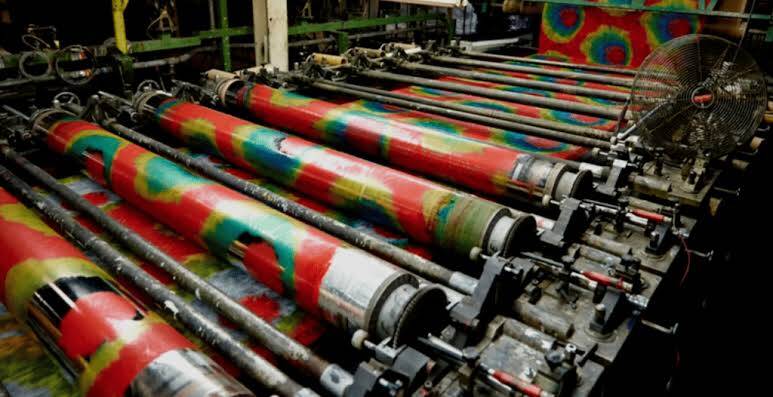
Industrial textile printing rotary machine
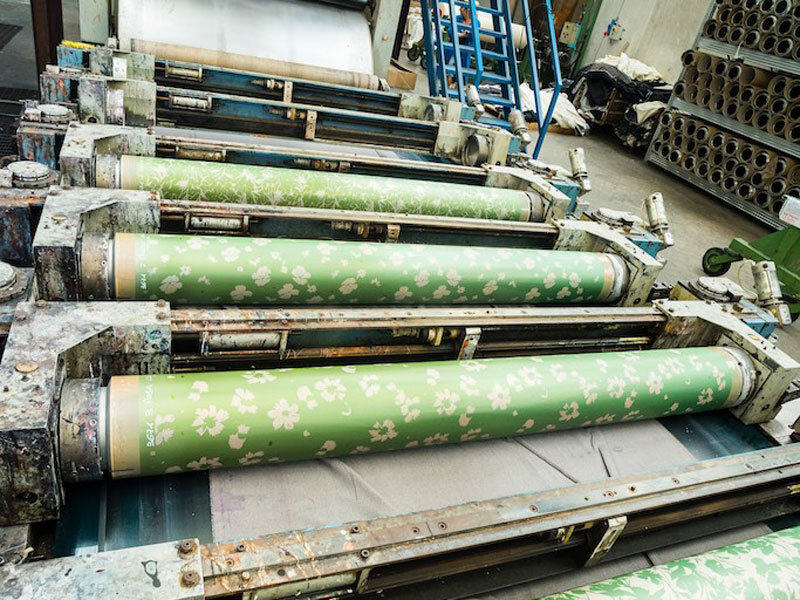
Industrial textile printing rotary machine
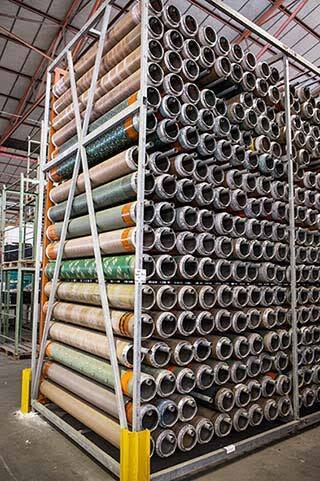
textile printing rotary – the cylinders
8. Digital Front-and-Back Registered Printing: A New Creative and Technical Opportunity
One of the most advanced solutions ARNIA can offer clients is digital front-and-back registered printing.
This technique allows printing both sides of the fabric in controlled registration. The front and reverse can carry:
- the same design in alignment;
- the same design with different colourways;
- a coordinated front/back visual system;
- a more intense front with a softer reverse;
- a reversible effect for scarves, accessories, shirts, lightweight jackets or special garments.
The creative potential is significant. A brand can propose the same motif on both sides, but with completely different colours: for example, a deep navy and emerald front with a beige and tobacco reverse, or a bright floral face with a muted monochrome back.
Technically, this is not a standard “print twice” operation. It requires control of:
- fabric shrinkage;
- fabric skew and bow;
- feeding tension;
- registration marks;
- drying between sides;
- ink migration;
- colour interaction;
- opacity;
- hand feel;
- final dimensional stability.
The lighter and more transparent the fabric, the more the two sides visually interact. The heavier and more opaque the fabric, the more registration and reverse-side coverage become separate engineering problems.
This technology is particularly interesting for luxury accessories because it addresses one of the traditional weaknesses of digital printing: the pale or white reverse side.
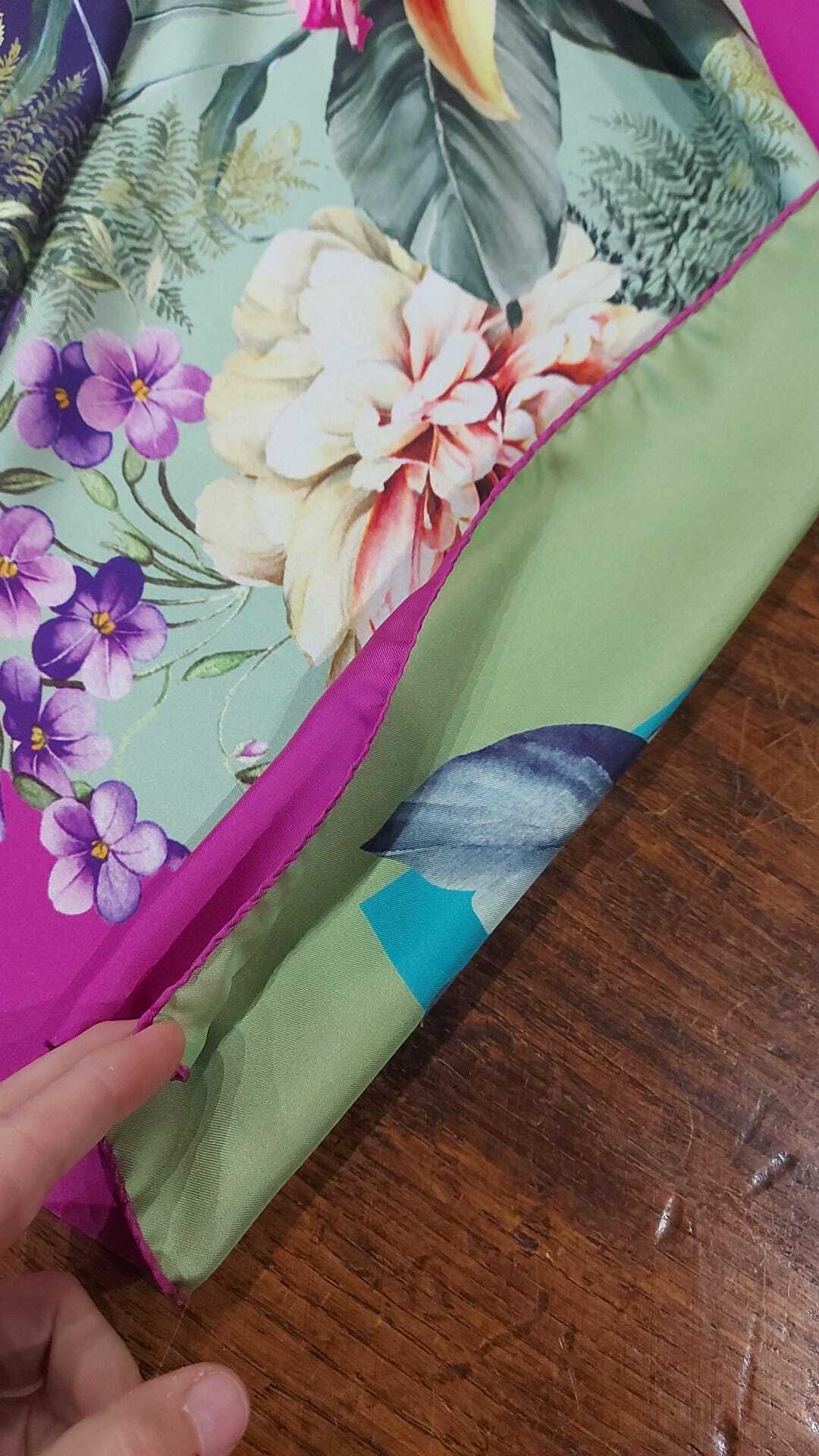
DOUBLE FACE DIGITAL PRINT
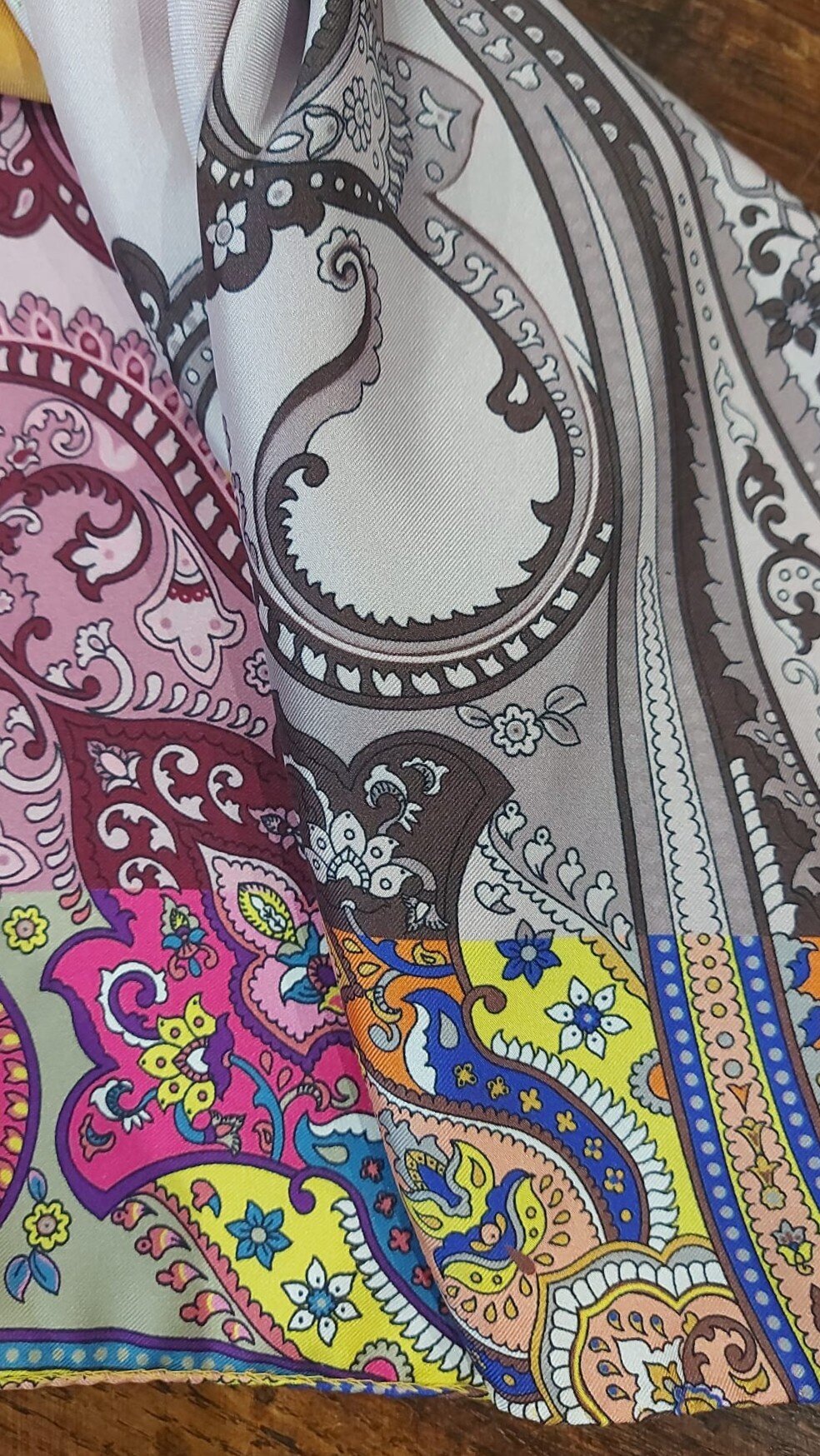
DOUBLE FACE DIGITAL PRINT
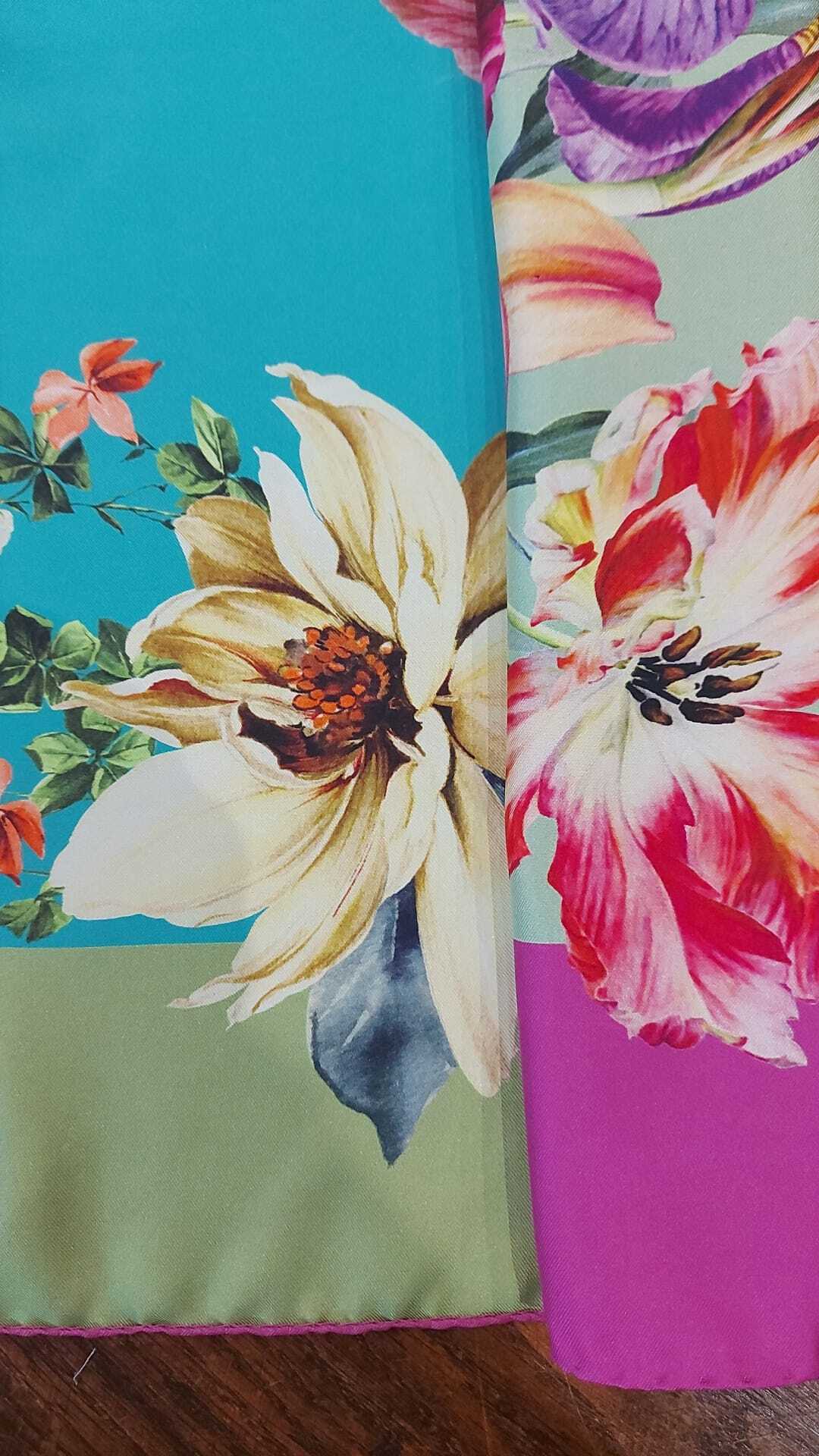
DOUBLE FACE DIGITAL PRINT
9. Light Back Tinting and Stenter “Raclatura”: Avoiding the White Reverse
Digital printing can create a common issue: the face looks rich, but the reverse remains white. This is especially visible when the fabric moves, folds or is stretched. In Italian production language, this is often close to the effect sometimes described as the fabric “smiling” — the white base appears through the structure when the cloth opens under tension.
For this reason, ARNIA can evaluate a light back tint or controlled stenter application — a very light raclatura or padding/tinting treatment — before or after the digital printing route, depending on the substrate and process.
The aim is not to create a second design. It is to neutralise the white base.
Common solutions include:
- light grey undertones;
- warm beige undertones;
- soft neutral grounds;
- tone-on-tone pre-tints.
Grey can reduce the visual aggression of a white reverse on cooler designs. Beige can soften natural, warm, floral or earthy palettes. The choice depends on the artwork and the final product.
The critical warning: back tint changes the front
A back tint is never neutral from a colour management point of view. Even a very light grey or beige can influence the perceived colour on the printed face, especially on lightweight or semi-transparent fabrics.
It may warm, cool, mute or slightly darken the final print. Therefore, the tint must be tested and approved before bulk production. The approved colour target must include the base, the tint, the print, fixation, washing and final finishing. This connects directly with professional colour evaluation under controlled light conditions. ARNIA’s D65 colour management guide explains why fabric colour approval must be assessed under standardised daylight and, where relevant, checked for metamerism.
10. Comparing the Main Textile Printing Techniques
| Technique | Best For | Main Advantages | Main Limits | Penetration / Reverse Side |
|---|---|---|---|---|
| Rotary screen printing | Production yardage, repeat motifs, scarves, linings, home textiles | Industrial speed, consistency, strong colour, good penetration, repeatability | Screen costs, less flexible for many designs or small runs, set-up required | Usually stronger penetration; can often improve reverse-side visibility |
| Flat screen printing | Luxury panels, limited editions, special effects, placement prints | Controlled paste deposit, rich effects, artisanal-industrial quality | Slower than rotary, more handling, set-up per colour | Good penetration possible depending on paste, pressure and fabric |
| Digital printing | Sampling, complex artwork, gradients, photographic prints, capsules | Unlimited colours, no screens, fast design changes, high detail | Surface effect, pale reverse, higher cost on long runs, needs precise pretreatment | Often more superficial; penetration can be improved but must be tested |
| Transfer printing | Polyester, recycled polyester, sportswear, accessories, flags, linings | Lower water use, sharp details, durable on polyester, efficient for certain runs | Mainly polyester, paper use, often one-sided on thick fabrics | Colour bonds with polyester, but visual through-print may be limited |
| Digital front-and-back registered printing | Scarves, reversible accessories, premium lightweight fabrics | Same motif on both sides, different colourways, reduced white reverse | Requires registration control, testing, shrinkage management | Strong solution for double-face visual effect |
11. Sustainability: No Technique Is Automatically Sustainable
A responsible printing strategy must avoid simplistic claims.
Digital printing can reduce waste and screen set-up. Transfer printing can reduce water use on polyester. Rotary printing can be efficient at scale. Flat screen printing can reduce overproduction when used for precise limited editions. But none of these techniques is automatically sustainable in every context.
The environmental profile depends on:
- fibre choice;
- dye chemistry;
- preparation route;
- water and energy use;
- fixation method;
- washing-off;
- fabric waste;
- rejected lots;
- production scale;
- durability;
- claim accuracy;
- supply-chain governance.
ARNIA’s Sustainability Practical Guide warns that buying a certified fabric does not automatically make the whole collection “certified” or “sustainable”; ESG includes materials, processes, energy/water use, waste minimisation, safe work, supplier due diligence, traceability, truthful marketing and responsible claims.
This is particularly important for printed fabrics. A brand should not claim “sustainable print” only because one stage appears lower impact. The correct communication should specify what is actually true: for example, lower water transfer printing on polyester, certified base cloth where applicable, local audited production, reduced sampling waste through digital printing, or documented chemical compliance.
For ARNIA, sustainability is not a label. It is a measurable process that combines textile competence, transparent documentation, anti-greenwashing discipline and supply-chain responsibility. Internal ARNIA materials position sustainability as a process of continuous improvement based on measurable results, traceability, audit and honest communication.
12. Como and the Culture of Textile Printing
Printing has a deep connection with the Como district.
Como is internationally associated with silk, but its real strength is not only the fibre. It is the complete culture of textile transformation: design, colour separation, silk preparation, jacquard weaving, dyeing, printing, washing, finishing and accessory development.
The Fondazione Antonio Ratti notes that silk production in Como began in the fifteenth century and that industrial manufacturing flourished from the mid-nineteenth century, creating a production district of excellence known internationally.
The Como Silk Museum describes itself as able to show the whole production process, from silkworm to coloured yarns, from hand printing to fashion collections, and preserves machines, documents and samples that testify to Como’s textile history.
Today, Como is not simply a heritage district. UNESCO describes Como as located at the heart of the Italian Textile Valley, supported by textile traditions, artistic skills, training centres, artisans and manufacturers. UNESCO also reports that around 70% of European silk is produced in the Como district, with about 1,400 silk companies and more than 15,000 people employed.
Italy’s official tourism portal also connects Como’s global reputation to the quality of fabrics made in its printing works and silk factories, noting that international fashion houses come to the area for garments and accessories such as ties and scarves.
This is the context in which ARNIA operates: not as a generic supplier, but as a textile converter and industrial-strategic partner able to coordinate the right process for the right fabric, within the Lombardy ecosystem.
For more on the territory, read ARNIA’s article on the Lombardy Textile District.
13. How ARNIA Selects the Right Printing Route
At ARNIA, the printing technique is not selected by habit. It is selected by project.
A technical assessment normally considers:
- fibre composition;
- fabric construction;
- weight and transparency;
- artwork complexity;
- required colour depth;
- expected reverse-side visibility;
- target hand feel;
- intended use;
- fastness requirements;
- production quantity;
- sustainability and certification boundaries;
- budget and timing;
- risk of colour deviation;
- final garment or accessory application.
A silk foulard, a viscose dress, a linen resort shirt, a polyester lining and a recycled polyester accessory may all be “printed fabrics”, but they should not be managed with the same technical logic.
Explore ARNIA’s dedicated page for Print Digital / Rotary and the Base Cloths for Customized Print service for printable stock-supported bases.
For brands developing custom artworks, the print discussion should start early — ideally before the artwork is finalised. File preparation, repeat size, colour separation, scale, base cloth, fibre chemistry and reverse-side expectations all influence the final result.
14. Practical Recommendations for Brands
Before starting a printed fabric project, a brand should clarify:
- What is the fibre?
Silk, cotton, viscose, linen and polyester require different chemistry. - Is the reverse side visible?
Scarves, accessories and flowing garments need a different penetration strategy from structured garments. - Is the artwork photographic, graphic or repeat-based?
Digital may be ideal for gradients and complex artworks; rotary may be better for repeat production. - Is the colour expected to be brilliant, deep, muted or vintage?
The colour target influences preparation, dye class and finishing. - Is the product certified or claim-sensitive?
Certification, Chain of Custody and communication must be assessed before the claim is made. - Is the fabric stretch or semi-transparent?
Stretch can reveal the white base. Semi-transparent fabrics may show interaction between face, reverse and ground tint. - Is water reduction a priority?
Transfer printing may be relevant for polyester, but not for every fibre or product category. - Is the project a capsule, sampling exercise or production run?
Digital is often strong for sampling and capsules; rotary becomes more efficient when production scale justifies the set-up.
For colour approval and fewer surprises between screen, fabric and finished product, ARNIA’s Daylight D65 Practical Guide is also recommended.
15. Conclusion: Printing Is Strategy, Not Decoration
The best printed fabrics are not created at the printing machine alone. They are created through preparation, chemistry, colour science, penetration control, finishing and supply-chain experience.
Rotary printing gives depth, speed and consistency. Flat screen printing offers controlled richness and special effects. Digital printing provides freedom, detail and responsiveness. Transfer printing can reduce water use on polyester and deliver sharp, durable images. Front-and-back registered digital printing opens new creative possibilities for reversible and accessory fabrics. Light back tinting can reduce the white reverse and “smiling fabric” effect, provided the colour shift is tested before production.
For fashion brands, the real value is not choosing the most fashionable technique. It is choosing the right technique for the fabric, the design, the product, the claim and the customer experience.
That is where the Made in Italy textile district — and ARNIA’s role within it — becomes strategic.
Discover ARNIA’s Innovative Textile Collections, explore Fabric Sourcing, or contact ARNIA through the official Contact page to assess the most suitable printing route for your next project.
FAQ
Frequently Asked Questions About Textile Printing
1. What is the difference between rotary, flat screen and digital textile printing?
Rotary screen printing uses cylindrical engraved screens to apply each colour continuously onto the fabric. It is particularly effective for repeating patterns, medium-to-large production runs and projects requiring strong colour penetration.
Flat screen printing uses separate horizontal screens, normally one for each colour. It is slower than rotary printing but offers excellent control over paste deposit, placement prints and special surface effects.
Digital textile printing applies ink directly from a digital file. It does not require engraved screens and is therefore particularly suitable for detailed artwork, gradients, multiple colours, sampling and capsule collections.
2. Why is fabric preparation essential before printing?
Fabric preparation removes substances that may prevent the colour from being absorbed evenly. These can include weaving sizes, oils, waxes, loose fibres, natural impurities and residues from previous manufacturing stages.
Correct preparation improves:
- colour brilliance and depth;
- motif sharpness;
- colour uniformity;
- penetration into the fabric structure;
- fixation and fastness;
- consistency between sampling and bulk production.
Even the most advanced printing technology cannot fully compensate for an inadequately prepared base fabric.
3. What are desizing and scouring?
Desizing removes the sizing products applied to warp yarns before weaving. These products help the yarn withstand mechanical stress during weaving but may create barriers to colour absorption if they remain on the finished cloth.
Scouring removes oils, waxes, lubricants, pectins and other natural or process-related impurities. Its purpose is to create a clean and uniformly absorbent textile surface.
The preparation route must always be adapted to the fibre, fabric construction and intended printing chemistry.
4. Why may linen require double washing before printing?
Linen may contain loose fibres, neps and small surface particles that temporarily cover parts of the fabric during printing. These particles can act as microscopic printing reserves. When they detach during later processing, they may reveal lighter or unprinted points.
A controlled double-washing process can reduce unstable surface material and improve the uniformity of the printed result. This is particularly important for premium linen fabrics with detailed motifs or solid, saturated colours.
5. Which printing chemistry is used for silk, cotton, viscose and polyester?
The printing chemistry must be compatible with the fibre:
- Silk: commonly printed with acid dyes.
- Cotton and linen: commonly printed with reactive dyes.
- Viscose and other cellulosic fibres: commonly printed with reactive dyes.
- Polyester: printed with disperse dyes, either directly or through transfer and sublimation processes.
The final route also depends on colour requirements, fabric construction, expected fastness, end use and finishing.
6. Does acid printing produce brighter colours on silk?
Acid printing can produce exceptionally brilliant, luminous and elegant colours on silk. This is one reason why it remains central to luxury scarves, foulards and lightweight silk fabrics.
However, colour fastness depends on the specific dye class, shade depth, fixation, steaming, washing-off and intended use. Some acid dye systems may offer lower wet-fastness performance than carefully selected and correctly fixed reactive systems, but this should not be treated as a universal rule. Each colour range must be technically assessed and tested.
7. Why does rotary printing generally penetrate more deeply than digital printing?
Rotary printing applies a relatively substantial quantity of print paste through a screen, supported by mechanical pressure and controlled paste viscosity. This can help the colour travel further into yarns and through the fabric structure.
Digital printing applies accurately measured droplets to the fabric surface. This gives excellent definition and colour control, but the result may remain more concentrated on the face of the fabric.
Penetration is also affected by:
- fabric weight and density;
- yarn twist;
- fibre absorbency;
- pretreatment;
- ink or paste viscosity;
- printing speed;
- drying and fixation conditions.
8. Can the penetration of digital printing be increased?
Yes, penetration may be improved through pretreatment adjustments and specialised wetting or penetration auxiliaries, sometimes referred to in production as Penetril-type products.
These auxiliaries modify the way the ink wets and enters the textile structure. However, increased penetration may also reduce edge sharpness, alter colour brilliance or increase the risk of bleeding.
The colour separations or ink quantities may therefore need to be reduced and recalibrated. This solution is particularly relevant for scarves and accessories, where the appearance of the reverse side is important, but it must always be validated through physical trials.
9. What is transfer printing and how does it work?
In transfer printing, the design is first printed onto specialised paper. The printed paper and polyester fabric are then passed through a heated press or calender.
Under heat and pressure, the disperse dye sublimates and migrates from the paper into the polyester fibre. The colour becomes part of the synthetic fibre rather than remaining as a conventional surface coating.
Transfer printing is mainly used for polyester and polyester-rich substrates. It is not normally the appropriate route for untreated cotton, linen, viscose or silk.
10. Does transfer printing use less water?
Transfer printing can substantially reduce process-water use because colour transfer and fixation take place through heat rather than through a conventional wet printing, steaming and washing-off sequence.
This can represent an important environmental advantage for suitable polyester articles. However, a complete assessment should also consider:
- energy consumption;
- transfer-paper use;
- ink chemistry;
- substrate composition;
- production efficiency;
- waste management;
- product durability.
It should therefore be described as a lower-water process, not as an impact-free printing method.
11. Why can the reverse side of a digitally printed fabric remain white?
Digital ink is normally applied from one side of the fabric. On compact, heavy or tightly woven materials, the ink may not travel far enough through the structure to colour the reverse.
The contrast becomes particularly visible when the fabric is folded, draped or stretched. On some constructions, the white base appears between the yarns when the textile is placed under tension. This is sometimes informally described as the fabric “smiling”.
The issue is especially important for scarves, foulards, flowing garments and accessories where both sides remain visible during use.
12. How can the white reverse of a digital print be reduced?
Several technical solutions may be assessed:
- optimising fabric pretreatment;
- using a penetration-enhancing auxiliary;
- applying a light neutral base tint;
- lightly tinting or coating the reverse;
- using registered front-and-back digital printing.
ARNIA commonly evaluates soft grey or beige undertones when a neutralised reverse is required. The selected undertone must be tested because it can alter the colours visible on the printed face, particularly on lightweight or semi-transparent fabrics.
13. What is registered front-and-back digital printing?
Registered front-and-back digital printing applies coordinated designs to both sides of the fabric while controlling their relative position.
The two sides may feature:
- the same design and the same colours;
- the same design with completely different colourways;
- coordinated but distinct graphics;
- a full-colour face and a more restrained reverse.
This technique creates new opportunities for reversible scarves, accessories and lightweight garments. It requires precise control of fabric tension, dimensional stability, shrinkage, drying and registration.
14. Can a light grey or beige back tint affect the front colour?
Yes. A reverse or base tint can influence the colour perceived on the face, especially when the fabric is thin, open or semi-transparent.
A grey undertone may cool or mute certain shades. A beige undertone may warm them. Even a subtle tint can influence whites, pastels and transparent colours.
For this reason, the tint, print, fixation, washing and final finishing must be evaluated together. The complete construction should be approved before bulk production rather than assessing the printed face in isolation.
15. Which printing technique is best for scarves and foulards?
There is no single best technique.
Rotary or flat screen printing may be preferred when strong penetration and reverse-side colour visibility are priorities. Digital printing is particularly effective for intricate artwork, numerous colours, photographic detail and smaller developments. Front-and-back registered digital printing can be considered when both sides require intentional design and colour.
The decision should consider:
- fibre composition;
- fabric weight and transparency;
- artwork complexity;
- desired hand feel;
- face-to-reverse colour balance;
- required fastness;
- production quantity;
- intended positioning of the finished accessory.
16. Is digital printing always more sustainable than screen printing?
No printing method is automatically more sustainable in every application.
Digital printing can reduce screen-making, unused print paste and set-up waste. Rotary printing can be highly efficient when used for appropriate production quantities. Transfer printing can reduce water consumption on polyester. Flat screen printing can be effective for controlled limited editions and specialised applications.
The environmental result depends on the complete process, including fibre, preparation, chemistry, energy, water, afterwashing, production quantity, rejection rate and product durability.
17. Does ARNIA offer all the main textile printing techniques?
ARNIA can coordinate rotary screen, flat screen, digital and transfer printing through its specialised network in the Lombardy Textile District. It also evaluates advanced solutions such as registered front-and-back digital printing, penetration optimisation and controlled neutral back tinting.
The appropriate route is selected according to the fibre, fabric construction, artwork, expected penetration, end use and production requirements. ARNIA operates as an industrial-strategic textile partner rather than selecting a printing method solely on the basis of unit price.
18. Why is the Como district internationally associated with textile printing?
The Como district combines a long-established culture of silk, textile design, colour separation, printing, washing and finishing with specialised industrial expertise.
Its value lies not only in individual production companies, but in the concentration of complementary skills within a relatively short geographic area. This makes it possible to coordinate design, base-fabric selection, printing, finishing and quality control through an experienced local ecosystem.
For ARNIA, this territorial expertise forms part of a wider Lombardy network connecting Como’s silk and printing know-how with the textile capabilities of Varese and Milan


