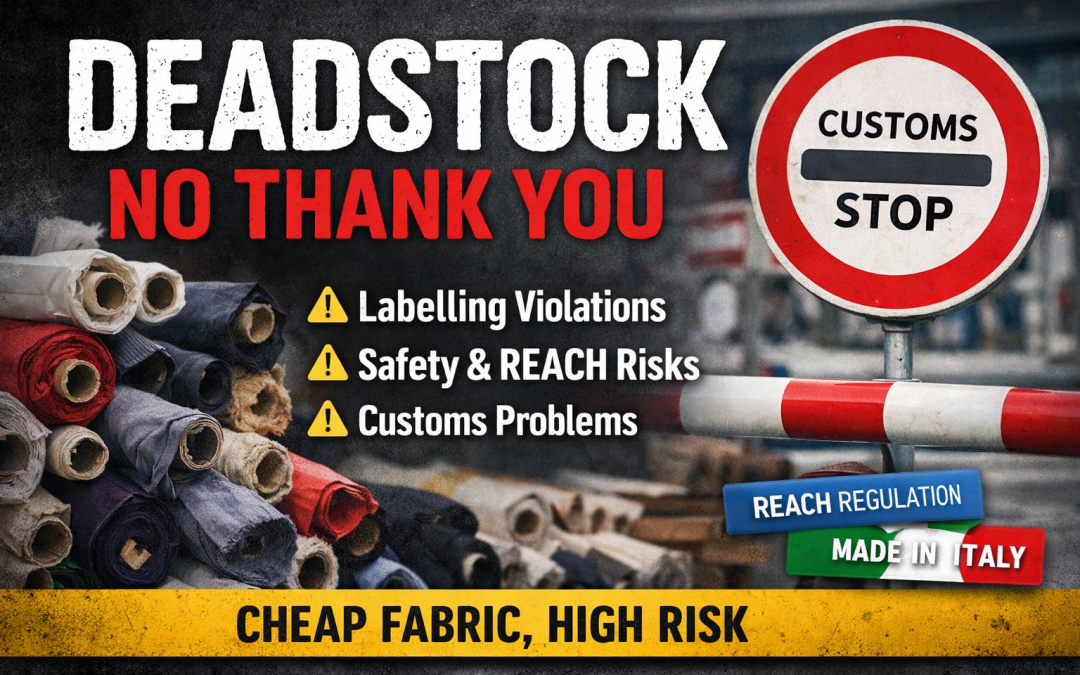
Deadstock can appear to offer an immediate advantage: a lower purchase price and a ready-made “circular” narrative.
However, when deadstock is missing verifiable documentation (fibre composition, chemical compliance, origin, traceability),
the risk profile changes dramatically. At ARNIA we advise brands to approach deadstock with extreme caution:
deadstock no thank you is often the most responsible decision for consumer safety, brand reputation, and customs clearance.
Deadstock No Thank You: The Minimum Legal Information You Must Be Able to Prove
Fibre Composition Labelling (EU Regulation 1007/2011)
In the EU, textile products must be labelled with fibre composition using official fibre names and percentages,
in compliance with Regulation (EU) No 1007/2011.
If you cannot prove fibre composition for deadstock, you cannot label legally and you risk enforcement actions, seizures,
withdrawals, and commercial bans. For deadstock, the most common failure is “assumed composition” without evidence.
(EU Regulation 1007/2011)
Product Safety and Traceability (EU GPSR 2023/988)
From 13 December 2024, the General Product Safety Regulation (EU) 2023/988 strengthens obligations on
product safety, traceability, and the identification of the responsible economic operator for consumer products placed on the EU market.
Deadstock without a reliable technical and compliance dossier increases the probability of safety claims, investigations, and recalls.
(EU GPSR 2023/988)
REACH Chemical Compliance Is Not Optional
Deadstock does not waive chemical compliance obligations. Under REACH Regulation (EC) No 1907/2006,
brands and supply chains must be able to manage chemical risks and communicate SVHC information where applicable
(e.g., Article 33 duties for articles). If deadstock comes without credible REACH evidence, your legal risk rises and your
“sustainability story” may become a consumer health story.
(REACH 1907/2006)
Deadstock No Thank You: EU Fabric vs Non-EU Fabric — How Risk Changes
EU-Supplied Fabric Used for EU Market Garments
This is the least risky deadstock scenario only if documentation exists:
verified fibre composition, supplier declarations, traceability records, and chemical compliance evidence.
Without these, EU-supplied deadstock can still be old, mixed, re-labelled, or incomplete—and the legal risk returns immediately.
Non-EU Fabric Used for EU Market Garments
Non-EU deadstock often carries higher uncertainty around finishes, dyes, prior treatments, and documentation quality.
If finished garments are placed on the EU market, you still face EU labelling and safety expectations (1007/2011 and GPSR),
and you may need stronger testing to support claims.
Deadstock No Thank You: DEU Finished Garment vs Non-EU Finished Garment
Finished Garment Placed on the EU Market
If the garment is placed on the EU market, you must be able to substantiate fibre composition labelling, ensure safety expectations,
and provide traceability information. Deadstock with unknown composition and missing compliance evidence is a high-risk strategy.
Finished Garment Exported Outside the EU
Export does not automatically reduce risk. Destination markets may have different labelling rules, language requirements, origin marking,
and import testing. If composition and origin are uncertain, customs can stop shipments, demand re-labelling, or impose penalties.
In practice: deadstock with weak documentation often fails at the border.
Deadstock No Thank You: Customs and Export Problems — Why Deadstock Gets Stuck at the Border
HS Code and Classification Errors
Garment classification depends on fibre type, construction, and product category. Deadstock uncertainty can lead to wrong HS codes,
changing duty rates and triggering customs audits. A low-cost deadstock decision can become a high-cost border delay.
Valuation Problems
Deadstock often comes with unusual pricing and incomplete commercial documentation. Under-valuation or inconsistent invoices may lead
to customs scrutiny, penalties, and shipment delays—especially when documentation does not match physical reality.
Origin Confusion and Preferential Origin Claims
Origin is not “where you ship from.” Preferential origin claims require specific proofs, and exporters must follow the correct EU procedures.
If origin is unclear, preferential duty treatment can be denied. If an origin statement is incorrect, consequences can be severe.
For statements on origin in certain contexts, EU exporters may need to use the REX system.
(EU REX system)
Inward Processing — Helpful but Not a Free Pass
If non-EU fabric is imported into the EU for processing and the finished garments are re-exported, the Inward Processing
procedure may allow suspension of duties and VAT—provided that the procedure is correctly managed and discharged.
Deadstock projects often fail due to poor lot tracking, documentation gaps, and diversion to the EU market without proper discharge.
(EU import procedures)
Deadstock No Thank You: Why “Cheap Fabric” Can Become Unsellable Inventory You Still Must Pay For
Deadstock can look like a competitive advantage only on a spreadsheet. If you cannot label, clear customs, or sell freely due to compliance issues,
the garments may become commercially blocked. And even if the goods cannot be sold, production and manufacturing services must still be paid.
In other words: the low fabric price is negligible compared to the cost of unsellable inventory, re-labelling, logistics, delays, and reputational damage.
That is why ARNIA often recommends: deadstock no thank you.
The apparent cost advantage of deadstock becomes irrelevant when finished garments cannot be freely commercialised due to customs blocks, incorrect origin claims, or non-compliant labelling. Even if sales are halted, manufacturing services remain payable, logistics costs accrue, and reputational damage persists. What appears “cheap” at sourcing stage can become the most expensive decision in your collection strategy. Our production methodology prioritises risk prevention over short-term material savings. Discover how we structure compliant manufacturing partnerships here: ARNIA Manufacturing Services.
Deadstock No Thank You: Small-Lot Unverified Deadstock Is Not Circular Economy
Circular economy is not a marketing label. It requires traceability, safety, and legal compliance. Using small-lot deadstock without verified fibre composition
and without credible REACH compliance evidence is not a sustainable strategy—because it increases the risk of consumer harm, waste through recalls,
and blocked commercialisation. In serious sustainability governance, “unknown inputs” are not circular—they are liability.
Why Just-in-Time Manufacturing Is Structurally Safer
While deadstock is often presented as a shortcut to circularity, the structural alternative is intelligent production planning. In our in-depth analysis Textile Deadstock vs Just-in-Time, we explain why controlled sourcing and verified supply chains dramatically reduce compliance exposure. Just-in-time manufacturing ensures traceable fibre composition, verified origin, and chemical conformity before production begins. Deadstock without documentation shifts risk downstream. Just-in-time prevents it at the source.
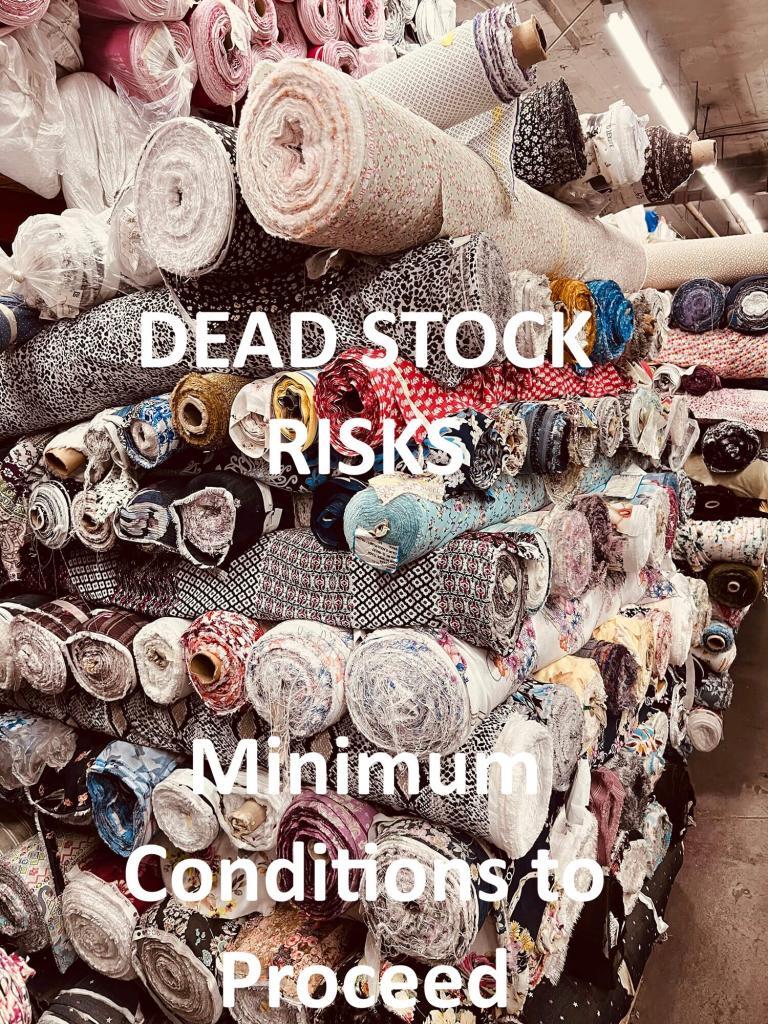
Deadstock No Thank You: ARNIA’s Deadstock Checklist (Minimum Conditions to Proceed)
Pre-Acceptance Documentation Checklist
- Material ownership and right-to-use declaration (client-owned deadstock, lawful possession).
- Lot identification: roll IDs, quantities, weights/lengths, photos, storage history where available.
- Fibre composition evidence: supplier technical sheet and/or independent lab test on the lot.
- Origin documentation: supplier declaration + supporting documents where available.
- REACH compliance evidence: written declarations and, depending on risk, laboratory testing.
- Destination market declaration: EU vs non-EU, and any retailer/platform compliance requirements.
Sampling & Production Checklist
- Quarantine the deadstock until documents and tests are validated.
- Red flag review: handfeel mismatch, unusual odour, coatings/finishes, very old stock, mixed lots.
- Label copy approval: brand provides and signs off all fibre composition text and required statements.
- No implied certification: ARNIA’s name/certifications must not be used to “validate” undocumented deadstock.
Pre-Shipment & Export Checklist
- HS code validation for garments (classification consistent with composition and construction).
- Commercial invoice consistency: descriptions, quantities, values, and composition statements aligned.
- Origin statement governance: only if fully supported; verify correct EU procedure (including REX if relevant).
- Customs procedure review: consider Inward Processing when importing non-EU fabric for re-export.
Deadstock No Thank You: Our Recommendation
At ARNIA, we believe that Made in Italy excellence requires documented, verifiable inputs. In most cases, deadstock without proven composition,
origin, and REACH-related compliance evidence should be avoided. The downside—consumer health exposure, reputational damage, customs blocks,
and unsellable inventory—is far greater than any short-term price advantage. For this reason, our professional position remains:
deadstock no thank you.
Compliance Is the Foundation of Made in Italy
True Made in Italy excellence is not only about craftsmanship — it is about documented compliance and supply chain governance. At ARNIA, our positioning as ambassadors of Italian textile excellence is built on traceability, certification integrity, and production transparency. Using undocumented deadstock undermines this framework and exposes brands to fibre labelling breaches under EU Regulation 1007/2011 and safety obligations under EU Regulation 2023/988. You can learn more about our manufacturing standards and positioning here: About ARNIA Made in Italy.
Sustainability Requires Traceability, Not Guesswork
Sustainability without verifiable data is not sustainability — it is risk. Small-lot deadstock without confirmed fibre composition or REACH-related compliance documentation cannot be considered circular economy. Circularity requires traceable inputs, documented chemical safety, and the ability to demonstrate conformity throughout the product lifecycle. Without this, the environmental narrative collapses under regulatory scrutiny and reputational risk. Explore our approach to responsible textile production and certification governance here: ARNIA Sustainability Framework.
Start here: read the onboarding options on our Cut & Sew page:
Cut & Sew Services — Onboarding.

Or contact us directly to schedule your FIRST CALL:
Contact ARNIA TEXTILE FASHION Team