
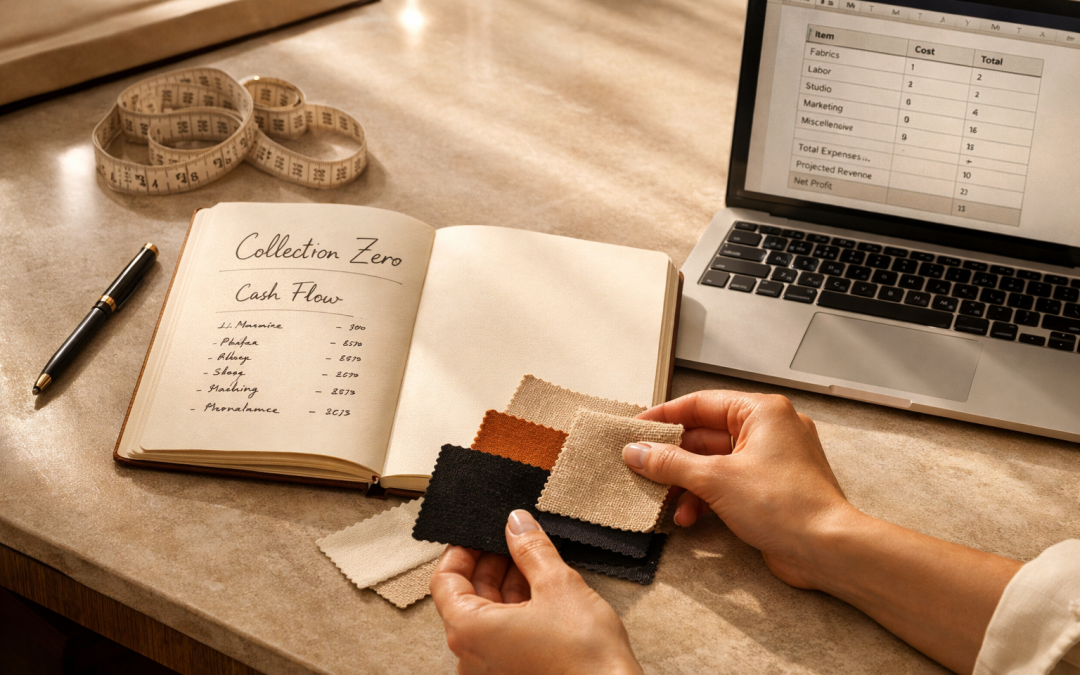
If you’re dealing with a fashion startup budget, you’re probably doing two difficult things at once:
- Creating a product universe (design, fabrics, fit, identity, storytelling).
- Building a micro-company (cash flow, supply chain, pricing, compliance, sales channels).
This is why a fashion startup budget is not “administration.” It’s your survival system. It protects your time, your reputation, and your ability to execute more than one season.
In this guide we’ll explain what a budget really is (financially), why it’s especially challenging in fashion, how to calculate a realistic fashion budget, and how to verify whether your budget for startups is actually adequate—or needs to be redesigned.

1) What a “budget” really is (financially): P&L, cash flow, and working capital
A budget is not a wish list. It’s a quantified plan
A budget is an estimation of revenue and expenses over a future period, compiled and re-evaluated regularly. In business, it becomes a management tool: goals, resource allocation, and performance measurement.
In fashion, you must budget in two parallel languages
- P&L (Profit & Loss): shows profitability (revenues – costs), but doesn’t show timing.
- Cash Flow: shows when money actually leaves and enters your bank account.
Many fashion founders fail not because their product is “bad,” but because they confuse profitability with liquidity. You can be profitable “on paper” and still run out of cash—because fashion requires paying long before you collect.
Working capital: the silent killer in apparel
Working capital is the gap between what you must pay (materials, production, logistics) and when you get paid (DTC after sales, wholesale after delivery + payment terms). Inventory and receivables can trap cash for months. A good fashion startup budget includes a working-capital plan, not just a cost list.
2) Why a fashion startup budget is harder than most startup budgets
Because the calendar is not “now” — it’s “months ahead”
In wholesale (B2B), retailers typically order 3–6 months before they want product in-store. That means your design, sampling, costing, and production decisions must happen far in advance.
Because you pay in stages (and often before production starts)
In garment and textile supply chains, payment structures commonly involve a deposit and a balance payment tied to production milestones and quality control. Your budget must be built as a payment timeline, not just a total number.
Because mistakes are expensive and multiply quickly
In fashion, an unclear brief or missing technical documentation can create sampling loops, delays, wrong fabrics, wrong trims, fit issues, and compliance surprises. Each loop burns budget and runway. A serious budget for startups includes a stage-gate development process (brief → feasibility → prototype → pre-production approval → bulk).
3) The “Collection Zero” strategy: how smart brands enter the market
What is Collection Zero?
Collection Zero (Numero Zero) is a market-entry collection designed to test your real target market with controlled risk. It’s not your “forever collection.” It’s your first proof that your product, pricing, and channel strategy work.
Choose your entry channel: B2B, B2C, or both — but budget the complexity
B2C (DTC/e-commerce) gives you pricing control and direct customer feedback. But you carry inventory risk and marketing costs.
B2B (wholesale) can bring volume and credibility, but it requires earlier commitments, line sheets, delivery reliability, and pricing discipline.
If you do B2B + B2C in the same season, you must manage pricing conflict
Selling the same collection to retailers and directly to consumers in the same season can create channel conflict:
- If your DTC price is lower, retailers will lose trust (and may drop you).
- If your DTC price is the same, you must still fund marketing, returns, and fulfillment—so your margin logic must be solid.
Best practice: either (a) differentiate assortments by channel, or (b) stagger timing by season drops, or (c) build exclusive DTC capsules that don’t undercut wholesale SKUs.
4) Why you should budget beyond Collection Zero: “Zero + 3 collections” runway logic
A realistic fashion startup budget should not assume that the first collection instantly funds the next one. If sales arrive early, great—but planning your brand’s survival on immediate sell-through is fragile.
Prudent founders build a budget that can finance:
- Collection Zero (market entry + learning)
- Collection 1 (refinement + credibility)
- Collection 2 (repeatability + distribution)
- Collection 3 (scale + optimization)
Why? Because brand building needs repetition: product iteration, content, customer trust, retailer relationships, operational reliability. One season rarely creates a stable business. Four seasons create momentum.
5) The fashion budget categories: what you must include (and what founders forget)
Below is a structured cost map. Some items are 100% collection-specific; others are brand-level costs you should allocate across multiple collections (because they create value beyond one drop).
A) Collection creation & product development (collection-specific)
- Design & collection development: concept, sketches, CAD, print placements.
- Technical documentation: tech packs, BOM, measurements, construction notes.
- Pattern making + grading: base patterns, size grading, marker optimization.
- Prototypes & sampling: Proto 1, Proto 2, fit sessions, corrections.
- Pre-production sample (PPS): the “final” sample that matches bulk.
B) Sourcing & supply chain setup (often underestimated)
- Sourcing (fabrics, trims, labels, packaging): sampling, lab dips, strike-offs.
- Project manager / production coordination: timelines, supplier alignment, risk control.
- Compliance & testing: labeling requirements, restricted substances alignment, wash tests, colorfastness, shrinkage, pilling, etc.
C) Materials & production (where cash flow matters most)
- Fabric purchasing: often includes deposit/balance milestones; plan the payment calendar.
- Trims & components: zippers, buttons, interlinings, elastics, hangtags, care labels.
- Cut & sew production: cutting, sewing, finishing, pressing, QC, packing.
- Rework & wastage buffer: defects happen—budget a contingency.
D) Logistics & go-to-market (the “launch reality”)
- Shipping, duties, and customs: freight, insurance, import VAT handling, brokerage.
- E-commerce operations (B2C): platform, apps, payment fees, fulfillment, returns.
- Marketing & sales promotion: content production, PR, paid media, influencers, events.
- Showroom costs (B2B): retainer + commission models, lookbooks, sales tools.
- Trade shows / fairs: booth, travel, samples, collateral, staffing.
E) Brand-level costs to allocate across multiple collections
- Brand identity: naming, logo, visual system, packaging design.
- Legal & IP: trademark searches/filings, contracts, NDAs, terms & conditions.
- Finance & admin: accounting, reporting, inventory systems, insurance.
- Team costs: founder time is “free” only on paper—budget sustainability matters.
6) How to calculate a fashion startup budget (step-by-step, with real finance logic)
Step 1 — Define your channel mix and your pricing logic first
Before you choose fabrics or factories, decide:
- Are you selling B2C, B2B, or both?
- What is your target MSRP (retail price) per product?
- What gross margin do you need to fund marketing, operations, and future collections?
Step 2 — Reverse-calculate your “allowable cost” (the non-negotiable number)
Use reverse costing to define the maximum cost you can afford per unit.
DTC example logic:
Allowable COGS = Retail Price × (1 – Target Gross Margin) – Variable fulfillment costs (packing, shipping subsidy, payment fees)
Wholesale example logic:
Wholesale Price is typically lower than MSRP to leave margin to retailers.
Allowable COGS = Wholesale Price × (1 – Target Wholesale Gross Margin)
Important: if your allowable cost is unrealistic, you don’t “negotiate harder.” You redesign: construction, fabric, trims, complexity, quantity, or channel strategy.
Step 3 — Build your Collection Zero architecture (minimum viable, but credible)
A smart Collection Zero is intentionally small. Aim for:
- Fewer styles, higher coherence.
- Shared fabrics across multiple pieces (to improve MOQs and reduce complexity).
- Construction repetition (same zipper, same lining, same thread palette).
Step 4 — Forecast volume with brutal honesty (base / worst / best)
Create three scenarios:
- Worst case: low sell-through, slow traction.
- Base case: realistic sell-through and reorder pace.
- Best case: strong demand (and the cash needed to fulfill reorders).
Then calculate cash needs on the worst + base case. The best case is not your funding plan.
Step 5 — Convert the budget into a cash timeline
Put every cost on a calendar month:
- Sampling months (often multiple iterations)
- Material booking and deposits
- Bulk production start
- Freight and duties
- Marketing ramp-up before launch (not after)
7) The “is my fashion budget adequate?” stress test checklist
Stress Test 1 — Runway (how long can you survive?)
Runway = Cash available / Monthly net burn.
If your runway is short, you will make rushed decisions (wrong fabrics, wrong timing, wrong marketing). A credible budget for startups includes runway and burn tracking.
Stress Test 2 — Margin discipline (can the business fund itself later?)
If your pricing cannot support healthy gross margins, you will “sell a lot and still die.” Check:
- Gross margin per product (DTC vs wholesale)
- Contribution margin after variable costs
- Operating expenses per season (marketing, content, tools, team)
Stress Test 3 — Working capital reality (can you pay before you get paid?)
Ask:
- How much cash is tied in inventory at any time?
- What happens if a retailer pays late, or returns increase, or shipments delay?
- Do you have a contingency buffer (typically 10–20% depending on complexity)?
Stress Test 4 — Seasonality clash (B2B vs B2C timing)
If you plan to do B2B and B2C, map the seasonal calendar clearly:
- B2B buying happens earlier; you may need samples and line sheets far in advance.
- B2C launches require content, inventory, and marketing ramp before drop date.
- Pricing must remain consistent to protect retailer trust and brand equity.
8) If the budget is not adequate, you have only two honest options
Option A — Redesign the plan (reduce scope, not standards)
- Reduce number of styles; increase fabric reuse.
- Choose constructions that are repeatable and reliable.
- Separate B2B and B2C assortments to reduce channel conflict.
- Delay expensive steps (e.g., trade shows) until product-market fit signals exist.
Option B — Increase the budget (and treat it as runway, not “spending”)
If you keep the same ambition, you need the capital to match it. Funding can come from founders, investors, or structured pre-order mechanisms—but your operational plan must not depend on “hoping sales arrive instantly.”
9) Sustainability claims and certifications: budget the compliance reality (avoid greenwashing risk)
Many early-stage brands assume that buying a “certified” fabric automatically makes the final garment certified. That is often incorrect and can be legally risky.
- If you are not certified in Chain of Custody, you generally cannot label the final product as certified—even if the fabric is.
- Certification bodies require minimum production quantities for certified runs. Small capsules may be impossible to certify at product level.
Budget implication: if certification is part of your positioning, you must plan volumes, documentation, and timing accordingly—or use accurate claims such as “made with certified fabric” (without misuse of logos).
For a detailed, plain-English map of rules and minimums, read:
Sustainability Practical Guide.
10) Where ARNIA supports serious startups: First Call, sourcing, project management, cut & sew
At ARNIA Textile Fashion, we work with founders who want to move from idea to bulk production with professional discipline—and without wasting months (and budget) in avoidable loops.
Start with a structured First Call (clarity-first)
Before any quotation, we use a paid onboarding step designed to make your project quote-ready and manufacturable. It’s not a generic commercial call. It’s a technical and financial reality check.
Learn more here:
- Cut & Sew Services (onboarding + MOQ + process)
- Cut & Sew for Startups: Why “Just a Quote” is NOT Enough
Fabric sourcing with traceability (and shorter supply chain control)
Good sourcing is not shopping. It’s risk management: lead times, compliance, quality, and claim-proof traceability. If you need a faster starting point, explore:
Cut & sew production calibrated for emerging brands
If your project fits our production scope, we can support small/medium series with clear process control. Our minimums can start from low quantities per style (depending on product and complexity). Details on the service page:
FAQ — Fashion startup budget questions founders ask (and should ask)
How many styles should Collection Zero have?
Fewer than you think. The right answer is: the smallest number that still looks like a brand, supports your pricing logic, and reduces sourcing/production complexity.
Can I do B2B and B2C with the same products in the same season?
You can, but it’s risky unless you manage pricing parity and avoid undercutting retail partners. Often it’s smarter to differentiate assortments or timing.
Can I rely on sales of Collection Zero to fund the next collection?
It’s possible, but not prudent. A resilient fashion startup budget plans runway for multiple collections. Early sales are upside, not the plan.
Can small capsules be “certified” (GOTS/GRS/FSC)?
Often no. Certifications require Chain of Custody continuity and minimum production volumes. Plan it early—or use accurate wording that doesn’t create greenwashing risk.

Next step: want to stress-test your fashion startup budget before you burn it?
If you’re building a serious brand and want an execution-ready plan (not guesses), start with our onboarding path:
Disclaimer: This article is educational and does not constitute financial, legal, or tax advice. Always validate compliance and contracts in your target markets.


