AI in Textile Fashion:
Why ARNIA Represents a New Made in Italy Model
Artificial intelligence is moving quickly from the margins of fashion into its operating core. In a market shaped by slower growth, more price-sensitive customers and rising pressure on differentiation, AI matters less because it can imitate creativity and more because it can improve discovery, decision-making and speed across the value chain. McKinsey’s recent analysis of fashion points to low-single-digit growth, stronger value sensitivity and a growing role for AI-powered curation, content and search, while earlier McKinsey work argued that generative AI can reshape product development, supply chain activity, marketing and customer experience across fashion and luxury.
For textile and fashion businesses, this shift is much bigger than image generation. Europe is pushing the sector toward traceability, circularity and more disciplined sustainability communication. The EU’s Sustainable and Circular Textiles Strategy includes measures such as the Digital Product Passport, ecodesign requirements, anti-greenwashing action and extended producer responsibility, while European Parliament research highlights the Digital Product Passport as a tool to strengthen traceability, transparency and circularity across the textile lifecycle. At the same time, OECD guidance keeps due diligence at the center of responsible garment and footwear supply chains. Taken together, these forces are changing what “innovation” really means in fashion.
AI is becoming valuable where complexity is highest
The most useful applications of AI in textile fashion are often not the most visible ones. They sit behind better search, sharper brief interpretation, faster supplier research, smarter inventory planning, multilingual first-contact support and improved knowledge retrieval. On the production side, AI-driven nesting and digital optimization are already being used to reduce cutting waste; EU industry material notes that scraps generated during cutting often account for 15%–25% of total material use in traditional manufacturing. In practical terms, AI can help fashion businesses protect both material efficiency and margin.
That opportunity is real, but adoption is still uneven. OECD data show that AI use across firms is growing, yet it remains relatively low compared with more mature digital tools, and the gap between large firms and smaller ones is still significant. In the OECD data cited in the 2025 report, 40% of large firms used AI versus 11.9% of small firms, and the share of firms using AI across OECD countries rose from 5.6% in 2020 to 14% in 2024. In the UK’s 2023 business survey, textiles recorded the highest AI adoption rate among manufacturing sectors, but that figure was still only 11%. The conclusion is clear: the transformation has started, but the maturity gap remains wide.
In fashion, AI without governance becomes a risk
This is why trust now matters as much as technology. Under the EU AI Act framework, transparency obligations apply to certain interactive AI systems and to AI-generated or AI-manipulated content. The European Commission’s guidance makes the logic explicit: users should know when they are interacting with AI and when content has an artificial origin, because transparency reduces deception and supports informed decisions. In a sector like fashion, where intellectual property, authorship, sustainability claims and brand reputation are highly sensitive, AI without governance is not innovation. It is exposure.
This is where the ARNIA case becomes interesting
ARNIA TEXTILE FASHION is not compelling because it “uses AI.” It is compelling because AI fits a model that was already built around traceability, technical alignment and responsible decision-making. ARNIA presents itself as a non-profit social cooperative rooted in the Lombardy textile district and positioned as a textile converter and industrial-strategic partner for brands seeking premium fabrics, sourcing support, sustainability guidance and small-batch cut & sew development. Its communication framework and company materials consistently position ARNIA as more than a generic fabric supplier or price-driven intermediary.
That distinction matters. Many converters are judged mainly on access, assortment and price. ARNIA’s difference is structural: it connects brands to the specialised capabilities of the Lombardy Textile District of Excellence, where cotton and viscose weaving, embroidery, silk jacquards, printing, prototyping and garment development coexist within a short-radius industrial geography. This is not just a sourcing advantage. It is a decision-making advantage for buyers, founders, designers and creative teams that need fast clarification, technical realism and lower execution risk.

What makes ARNIA different from many other converters
ARNIA’s model is not built only around moving fabric. It is built around reducing confusion before it becomes waste, delay or reputational damage. Publicly, the company organises its offer around integrated service lines such as Fabric Sourcing, Sustainability, Transparency, Fabrics Stock Supported and Cut & Sew Services. That already signals a different philosophy: not just “what fabric do you need?” but “what is technically feasible, commercially coherent and reputationally safe for your project?”
Even more importantly, ARNIA’s public educational content shows a strong anti-greenwashing position. Its Sustainability Practical Guide explains that certifications are governed by chain-of-custody rules, that product claims depend on who is certified across the chain, and that small certified micro-runs often face real technical minimums. This matters enormously in the AI era. If an assistant answers sustainability questions without understanding claim boundaries, it can create legal and commercial risk. ARNIA’s advantage is that its knowledge framework is built around verifiable limits, not vague promises.
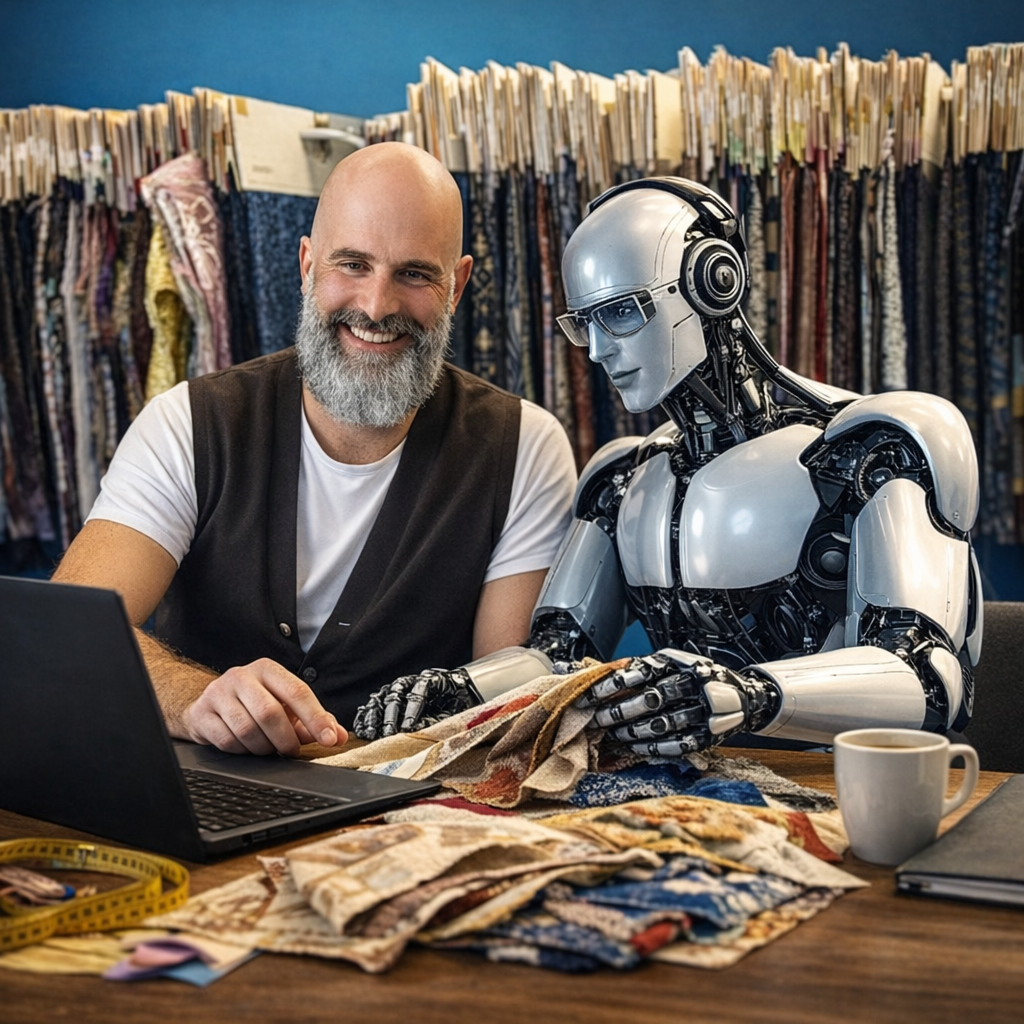
The AI assistant is not a gadget. It is a strategic interface.
The new ARNIA Textile AI Assistant should be read in exactly this way. Public search descriptions position it as first-contact support for premium textile projects, helping users with questions around MOQ, sampling, standard lead times and custom fabric development. ARNIA’s internal communication framework goes further: the assistant is designed to route requests across the company’s core service lines, maintain an anti-greenwashing approach, provide useful links, and escalate to the right human or process when technical or commercial complexity requires it.
That is a meaningful difference from the many generic chatbots now appearing across fashion websites. A generic assistant tries to answer everything. A strategic assistant helps users ask better questions sooner. It reduces friction for buyers, clarifies starting points for founders, helps designers navigate materials and feasibility, and supports creative teams without pretending to replace textile judgement. ARNIA already frames the First Call Fashion Production Onboarding as a structured, paid pre-feasibility step designed to protect time, budget and project seriousness. The AI assistant extends that logic by making ARNIA’s industrial knowledge accessible from the very first interaction.
ARNIA is part of a wider global change
This is why ARNIA can credibly be described as part of a broader transformation in textile fashion. The next generation of suppliers will not win simply because they can produce. They will win because they can combine specialised manufacturing, verifiable sustainability, data discipline, traceable relationships, compliance awareness and intelligent digital interfaces. AI does not make textile culture less important. It makes real expertise more valuable—because good AI only becomes useful when it is connected to real processes, real materials, real constraints and real accountability.
ARNIA’s model fits that future unusually well: a Made in Italy textile partner rooted in one of Europe’s most specialised districts, committed to short and monitored supply chains, social inclusion, technical onboarding, know-how protection and responsible sustainability communication. For buyers, founders, creatives and designers, that is the real promise of AI in textile fashion: not replacing human value, but making expertise more accessible, decisions more intelligent and supply chains more trustworthy. Explore the ARNIA Textile AI Assistant, Textile Converter, Fabric Sourcing, Sustainability, Transparency and Cut & Sew Services pages to see how that model is already taking shape.