
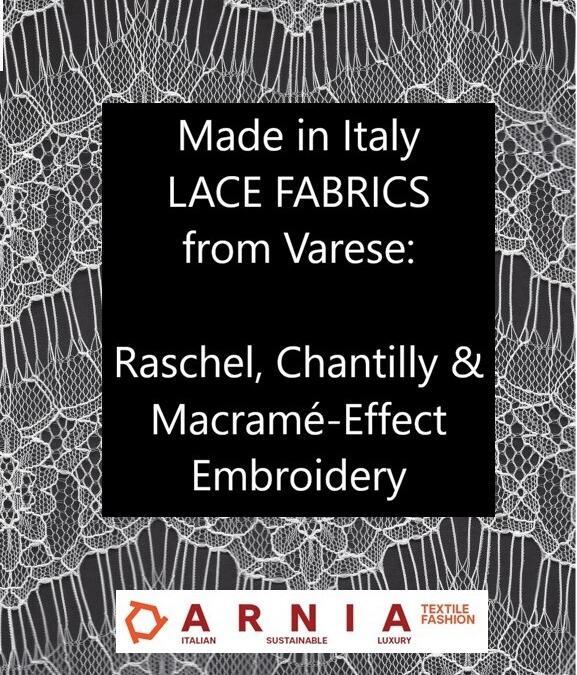
Made in Italy Lace is often described as romantic, feminine, delicate or decorative. But from a technical production point of view, lace is much more than an aesthetic category. It is a family of textile engineering solutions: open structures, controlled transparency, yarn tension, motif construction, ground stability, dye affinity, finishing behaviour and industrial setup.
For a fashion brand, choosing the right lace is not only a matter of beauty. It affects price, minimum order quantity, scalability, dyeing, printing, garment construction, compliance, durability and communication.
At ARNIA TEXTILE FASHION, lace is approached as a technical material, not just as an embellishment. Based in the Lombardy Textile District — between Varese, Como and Milan — ARNIA connects textile development, stock-supported bases, dyeing, printing, embroidery, foil coating and responsible sourcing within a short, specialist Made in Italy supply chain.
This guide explains the main differences between Raschel lace, Chantilly lace, traditional loom-made lace, embroidered tulle and macramé-effect embroidery. It also explains why ARNIA keeps selected lace bases available in greige, natural and black, and why this is strategically important for brands that need sampling, capsule development or custom colours without facing the extremely high technical minimums required to mount a dedicated lace loom.
Made in Italy Lace Is Not One Fabric: It Is a Technical Family
The word “lace” can refer to very different constructions.
A Raschel lace is generally a warp-knitted openwork fabric made on Raschel machines. A Chantilly lace is historically associated with fine bobbin lace, soft transparency, floral motifs, delicate ground and outlined pattern. A Leavers-style lace is produced on highly specialized lace machinery and is valued for depth, complexity and heritage. A macramé-effect lace may not be knotted by hand at all: in industrial fashion, it is often created through embroidery, cording, guipure or chemical lace techniques that imitate the dimensional look of macramé.
ARNIA’s own Laces and Fancy Knits page correctly frames lace as an ornamental openwork construction that can be created through embroidery, warp knitting or chemical etching, and places this family next to stretch lace, embroidered tulle, fancy meshes and textured knit developments. This is the right way to understand lace: not as a single product, but as a technical decision tree.
The main questions for a fashion brand are:
- What type of ground does the lace have?
- Is the motif knitted, woven, embroidered, corded or dissolved from a temporary base?
- Is the lace stretch or non-stretch?
- Is it polyester, polyamide, viscose, cotton, silk or a blend?
- Can it be piece-dyed?
- Can it be printed?
- Can it be laminated or foil-coated?
- Can it be certified, and under which chain-of-custody conditions?
- Can it be produced in realistic quantities?
The answer changes the entire development strategy.
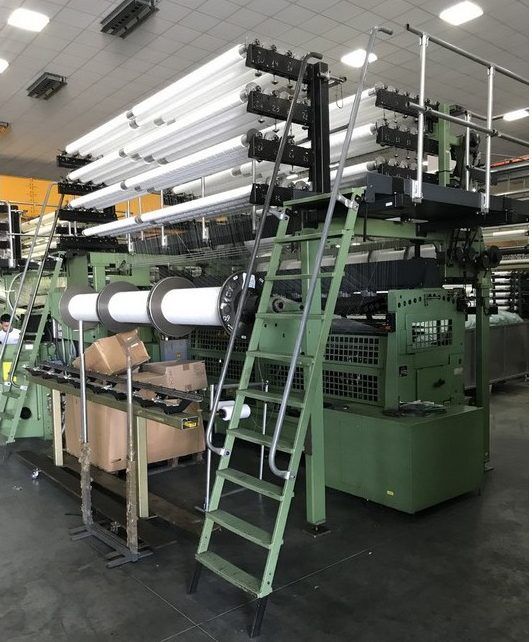
raschel loom lace made in italy
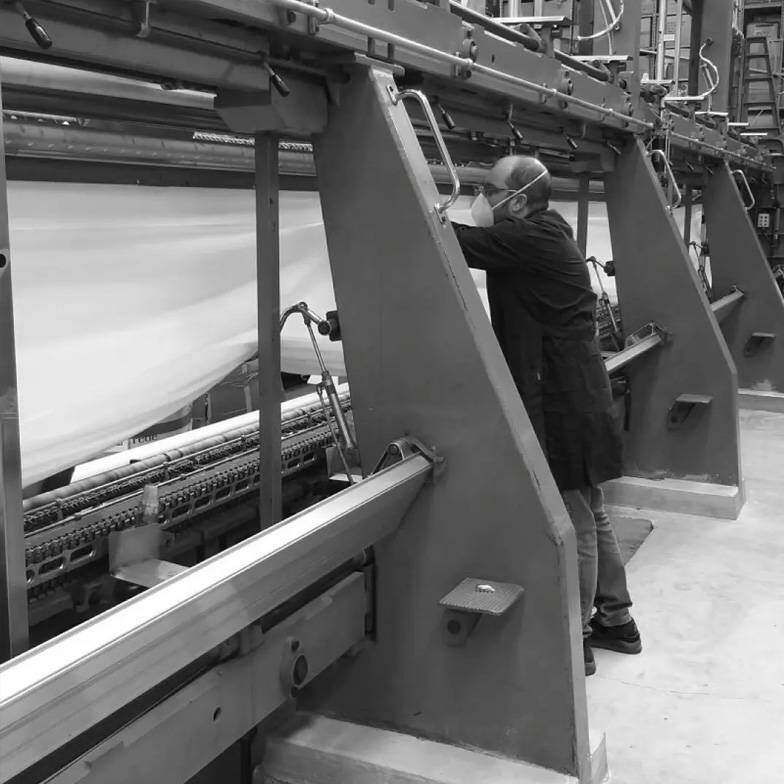
embroidery loom made in italy lace
1. Raschel Lace: Industrial Flexibility, Repeatability and Modern Fashion Use
Raschel lace belongs to the warp knitting family. In warp knitting, yarns are supplied lengthwise and form looped structures. Raschel machines allow open constructions, textured areas, net effects, elastic or stable grounds and complex decorative patterns. Technical literature describes the Raschel machine as relying on warp knits, with warp yarns laid diagonally and locked with adjacent loops, producing open and often coarser structures compared with other warp knits.
This makes Raschel lace one of the most important modern industrial lace categories.
Technical Construction
In Raschel lace, the design is created by the movement of guide bars and yarn paths. The number of bars, yarn types, machine gauge, lapping movement, stitch density and finishing determine the final result.
A Raschel lace may be:
- light and transparent;
- elastic when elastane is included;
- stable when produced without stretch yarns;
- flat and graphic;
- floral or geometric;
- suitable for lingerie, eveningwear, inserts, dresses, overlays, tops or decorative panels.
Modern Raschel lace is often made in polyester, polyamide or blends. This is important because synthetic lace bases can offer dimensional stability, easier maintenance, colour brightness and compatibility with certain printing or finishing processes.
Advantages of Raschel Lace
The first advantage is scalability. Raschel lace is technically suited to industrial production and repeatability. Once the machine is set, it can produce consistent yardage with reliable pattern continuity.
The second advantage is versatility. Raschel can create lace, nets, stretch lace, fancy meshes and lace-effect grounds. This makes it useful for fashion, lingerie-inspired details, layering, eveningwear and contemporary ready-to-wear.
The third advantage is cost-efficiency compared with slower traditional lace techniques. Raschel lace can offer a lace aesthetic with more accessible production logic.
The fourth advantage is compatibility with polyester and polyamide yarns. For ARNIA, this matters because polyester lace can be overprinted and used as a base for further creative transformation, subject to testing.
Limits of Raschel Lace
Raschel lace can look flatter than premium Leavers or handmade lace. The design may be beautiful, but the texture is often less dimensional unless special yarns, cording or finishing are added.
Another limitation is the setup. A new Raschel lace design is not a small artisanal action. It requires machine preparation, yarn planning, technical programming and industrial setup. For a completely new lace article, the minimum quantity to justify mounting the lace frame can be extremely high — around 5,000 metres depending on the design and machinery.
For emerging brands or capsule collections, this is often not realistic.
This is why ARNIA’s stock-supported lace strategy is important: instead of asking a brand to finance a new lace setup from zero, ARNIA keeps selected lace bases available in greige, natural and black, which can then be developed through dyeing, sample colouring, printing, lamination or finishing trials.
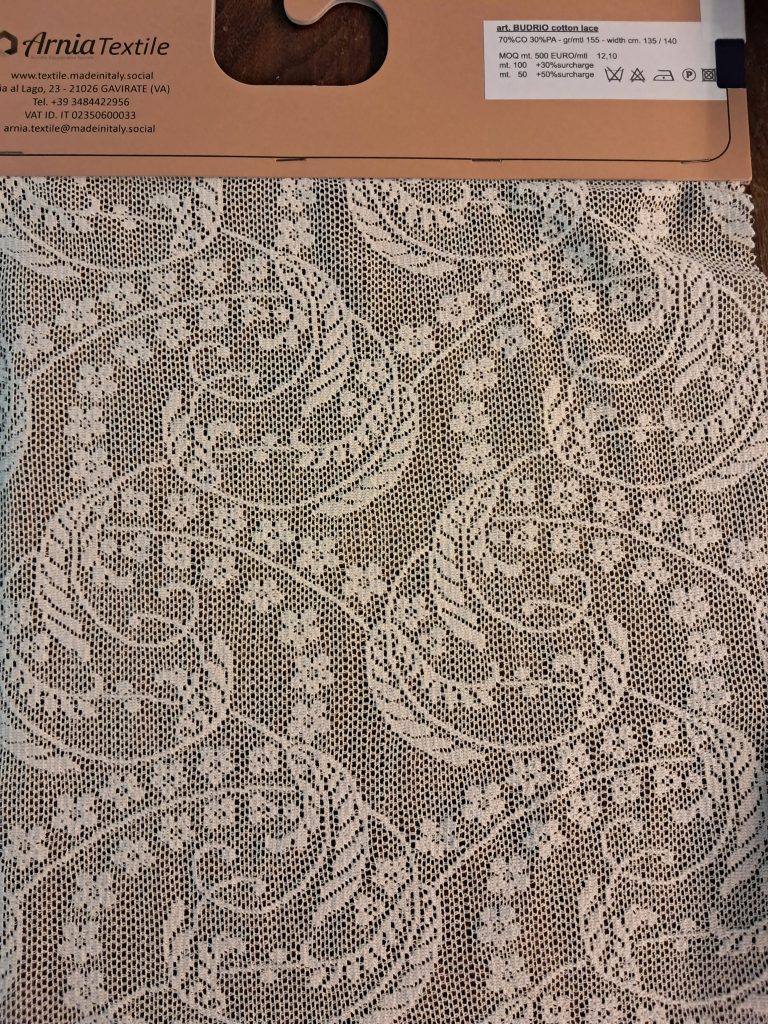
ART. BUDRIO – LACE MADE IN ITALY
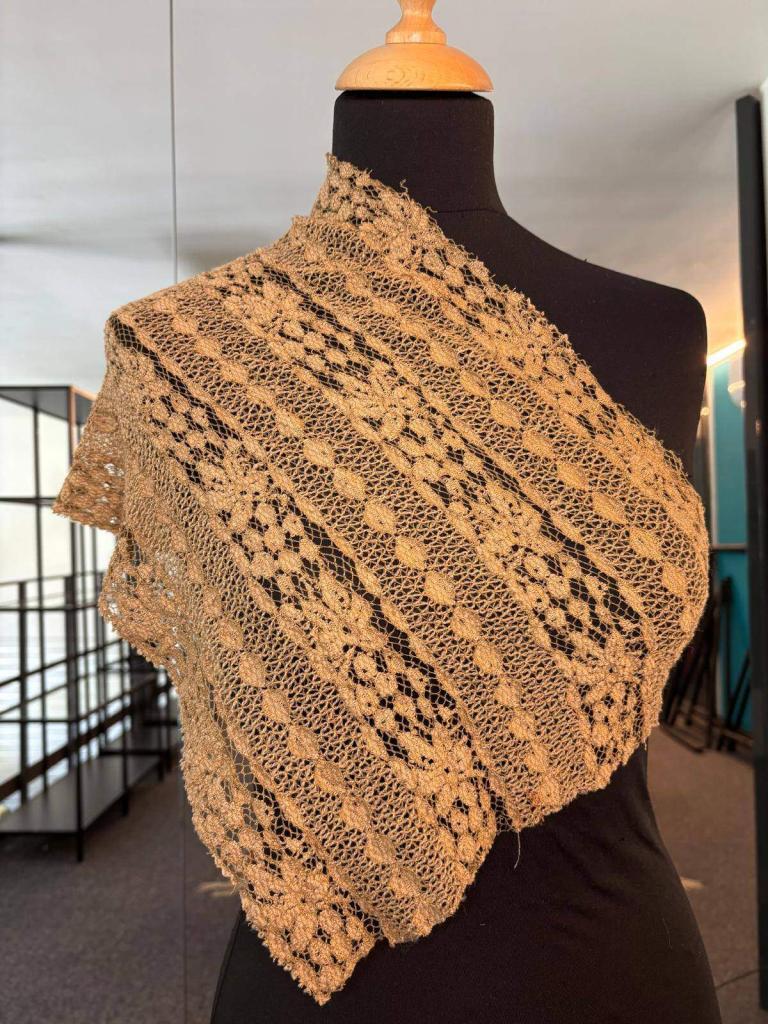
textile SOURCING – ART. NAVE
2. Chantilly Lace: Lightness, Fine Ground and Couture Emotion
Chantilly lace is not just “a floral lace.” Historically, Chantilly lace is a French bobbin lace popularized in the eighteenth century. It is identifiable by its fine ground, outlined pattern and abundant detail, and was traditionally often made in black silk thread.
In modern fashion sourcing, the term “Chantilly” is sometimes used more broadly. A supplier may describe a lace as Chantilly because of its visual language: fine net, delicate flowers, soft hand, scalloped edges and a subtle cordonnet outline. However, not every modern “Chantilly” is handmade bobbin lace. It may be made on Leavers machines, Raschel machines or other industrial lace technologies.
This distinction matters.
Technical Characteristics
A Chantilly-style lace usually has:
- a fine transparent ground;
- delicate floral or botanical motifs;
- soft drape;
- lightweight construction;
- outlined motifs, often with a slightly stronger yarn;
- a refined, romantic appearance;
- frequent use in bridal, eveningwear, lingerie-inspired fashion and luxury inserts.
The quality of a Chantilly-style lace depends on the fineness of the ground, the precision of the outline, the regularity of the motif, the softness of the hand, the stability of the edges and the way it behaves when cut and sewn.
Advantages of Chantilly Lace
Chantilly lace offers immediate luxury perception. It communicates delicacy, femininity, heritage and refinement. It is especially strong when used for transparent sleeves, overlays, bodices, dresses, trims, scarves and eveningwear details.
It also works well when the brand wants a “quiet luxury” textile surface: not heavy, not aggressive, but rich in detail.
In black, Chantilly lace can become sensual, graphic and dramatic. In ivory or natural tones, it becomes bridal, poetic and soft. In fashion colours, it can become contemporary and seasonal.
Limits of Chantilly Lace
The first limit is fragility. A very fine lace needs careful cutting, sewing, fusing, lining and seam placement.
The second limit is production cost. True high-end Chantilly or Leavers-style Chantilly can be expensive because the machines are slower, the patterning is more complex and the know-how is specialized.
The third limit is dyeing and finishing. Very fine lace can react differently depending on fibre composition. A polyester Chantilly-style lace can often be dyed or printed more predictably than a multi-fibre lace, but every development must be tested.
The fourth limit is communication. Brands should avoid vague claims. “Chantilly” should be used carefully: if the lace is Chantilly-inspired, Raschel-made or Leavers-made, the technical description should be accurate.
3. Leavers-Style Lace: Heritage, Depth and High Technical Barriers
Traditional machine lace reached an important turning point with the development of lace machines in Nottingham. Nottingham Castle’s Lace Gallery explains that John Leavers’ bobbin net machine, dating from around 1828 in the museum collection, allowed the later addition of Jacquard cards to directly pattern the lace rather than simply producing a stable net that had to be embroidered by hand.
Leavers lace is therefore historically linked to a highly specialized machine tradition that imitates aspects of bobbin lace logic while using industrial machinery.
Technical Identity
Leavers-style lace is not knitted like Raschel. It is based on a more complex interlacing logic, often using bobbins and Jacquard-controlled patterning. The result can be highly detailed, dimensional and refined.
This type of lace may show:
- depth in the motif;
- clear separation between ground and pattern;
- fine outline;
- rich texture;
- heritage value;
- excellent luxury perception.
Advantages of Leavers-Style Lace
The main advantage is prestige. Leavers-style lace has a level of refinement that many buyers still associate with couture, luxury lingerie and high-end bridal.
It can offer a tactile and visual depth that flat industrial lace often cannot achieve.
It is especially strong for brands that want to communicate craft, heritage and premium positioning.
Limits of Leavers-Style Lace
The limits are significant.
Machines are rare, slow and technically demanding. Skilled operators are not easy to replace. Setup is complex. Pattern changes are expensive. Minimums are often incompatible with micro-capsules. Lead times and costs can be high.
For this reason, a Leavers-style approach is rarely the best starting point for a young brand unless the project has strong budget, clear positioning and realistic production volumes.
For many fashion brands, a high-quality Raschel lace, embroidered tulle, corded lace or macramé-effect embroidery may offer a better balance between aesthetic value and production feasibility.
4. Embroidered Tulle and Lace-Effect Embroidery
Tulle is a key base for lace development. ARNIA’s Tulle page describes tulle as a light, transparent and versatile open-mesh fabric used for softness, layering, visual lightness and delicate volume. It also states that tulle can become a base for richer surfaces such as lace effects, embroidery and sequins.
This is crucial: many “lace” effects in fashion are not created by making the lace structure itself. They are created by embroidering onto tulle, mesh, organza or another transparent base.
Technical Construction
In embroidered tulle, the base remains part of the fabric. The embroidery is stitched onto the tulle, creating motifs, lines, flowers, borders or all-over patterns.
The embroidery may include:
- tonal thread;
- contrast thread;
- cording / soutage embroidery;
- matte or shiny yarns;
- viscose embroidery yarn;
- polyester embroidery yarn;
- metallic yarn;
- sequins;
- raised or embossed effects.
ARNIA’s embroidery page connects embroidery to the Busto Arsizio / Gallarate district and explains embroidery as a textile technique that decorates fabric by stitching designs onto it with threads, adding texture, depth and ornamental value.
Advantages of Embroidered Tulle
This technique gives strong design flexibility. A brand can develop motifs, borders, placements and colour stories with more creative control than with many pre-existing lace designs.
It is excellent for occasionwear, bridal-inspired fashion, transparent panels, sleeves, bodices and couture-like details.
It can also be combined with ARNIA’s other surface techniques: printing, foil coating, paillettes, layering and special finishing.
Limits of Embroidered Tulle
The base fabric remains visible. This can be beautiful, but it is technically different from guipure or chemical lace, where the ground disappears.
Embroidery also changes the hand. Dense stitches add weight and stiffness. Threads can pull the tulle if density is not balanced. Motifs can distort if the base is too elastic or too light.
Testing is essential: stitch density, thread shrinkage, tulle stability, colour fastness, seam allowance and cutting behaviour must all be checked before production.
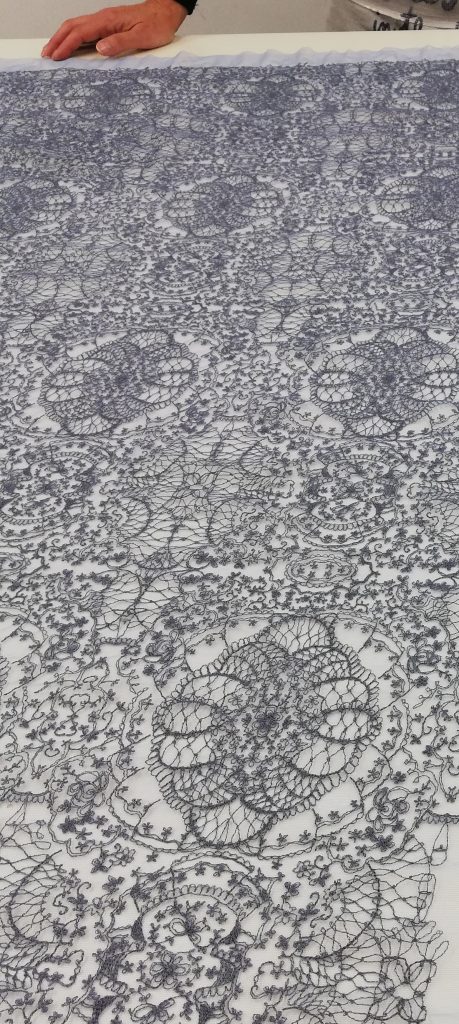
LACE MADE IN ITALY – EMBROIDERY ON TULLE MM121
5. Macramé-Effect Embroidery: Raised, Graphic and Couture-Like
True macramé is a knotting technique. It is built from knots rather than weaving or knitting. In industrial fashion, however, the term “macramé lace” is often used to describe a raised, corded, openwork lace effect. This may be produced through guipure, chemical lace, cord embroidery or dense embroidery on a temporary or permanent base.
This is why it is more accurate to speak about “macramé-effect embroidery” unless the piece is genuinely hand-knotted.
Technical Construction
A macramé-effect lace can be obtained through several routes:
- cord embroidery on tulle;
- dense embroidery on organza or mesh;
- guipure / chemical lace on a dissolvable base;
- corded lace produced on lace machinery;
- appliqué motifs later sewn onto garments.
Chemical or guipure lace is particularly relevant. In this process, the design is embroidered onto a temporary water-soluble or chemically removable base. Once the base is dissolved, only the embroidered structure remains. Technical sourcing literature describes chemical lace as a lace with no background mesh, where the embroidered design is connected by thread bars or bridges and the temporary base disappears during production.
Advantages of Macramé-Effect Embroidery
Macramé-effect embroidery has strong visual impact. It feels dimensional, tactile and decorative. It works well for statement garments, luxury trims, panels, bodices, cuffs, collars, hems and appliqués.
It can create a handmade perception while still being developed through controlled industrial processes.
It is also suitable for bold fashion identities: romantic, gothic, baroque, sensual, architectural or “bondage” depending on yarn, colour, scale and finishing.
Limits of Macramé-Effect Embroidery
It can be heavy. Dense embroidery consumes more yarn and machine time. If the lace is guipure-style, the connecting bars must be strong enough to hold the motif together after the base disappears.
It may have little or no stretch. It may need careful placement on the garment. It may require lining, stabilizing, edge control or hand-finishing.
It can also become expensive if the motif is complex or if a new design must be developed from zero.
For this reason, ARNIA’s approach is to evaluate the desired effect, the garment use and the target price before choosing whether macramé-effect embroidery, Raschel lace, embroidered tulle or a stocked lace base is the most intelligent route.
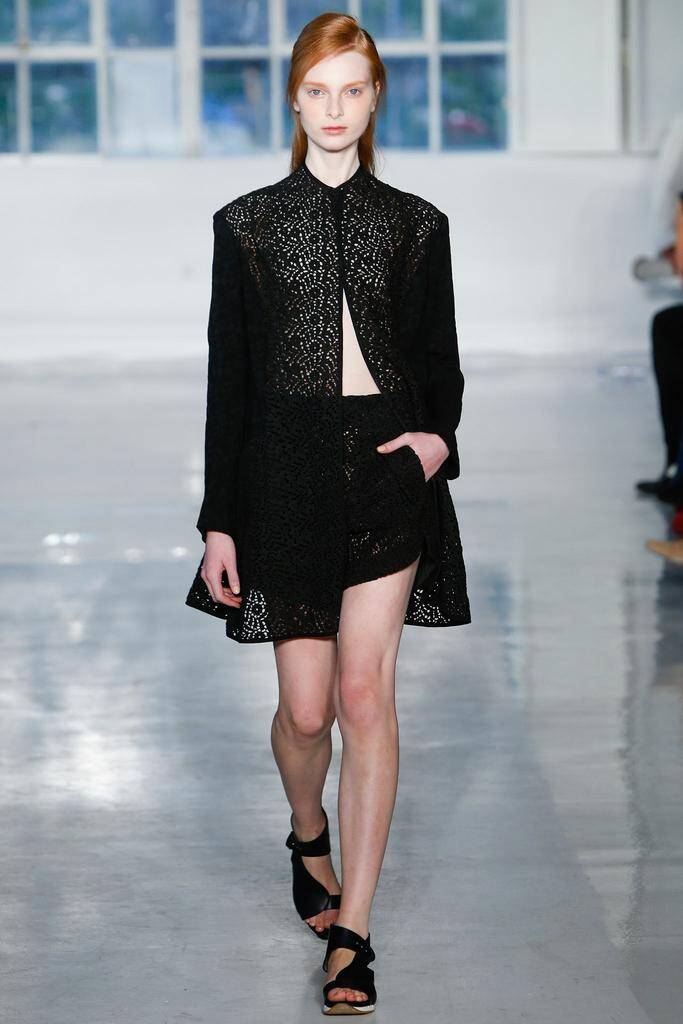
MACRAME EMBROIDERY
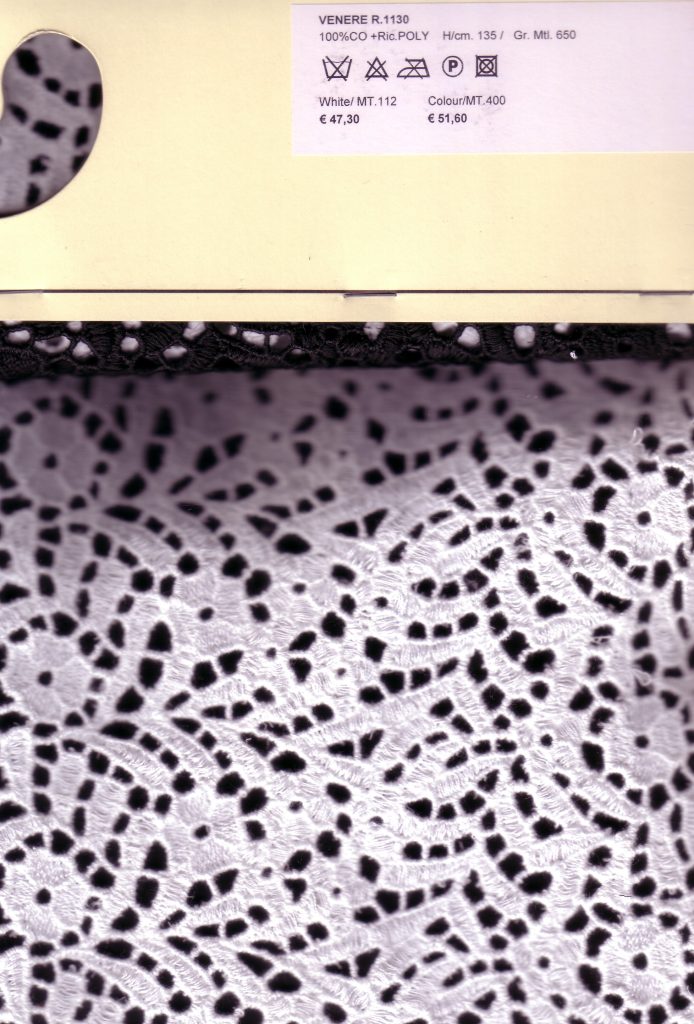
MACRAME EMBROIDERY – VENERE R1130
6. Why Tulle Belongs to the Lace Family
Although tulle often appears more regular, geometric and “net-like” than floral lace, it belongs to the same broader textile family of openwork and open-mesh fabrics. The difference is not in the presence or absence of transparency, but in how the transparency is engineered.
In classic lace, the open areas usually interact with ornamental motifs: flowers, scrolls, geometric patterns, corded outlines, embroidered reliefs or decorative repeats. In tulle, the structure is generally more regular: a fine mesh, often hexagonal or net-like, designed to create transparency, lightness, layering and controlled volume.
For this reason, tulle can be understood as the technical foundation of many lace-related developments. It may be used as a plain transparent fabric, but it can also become the base for embroidery, sequins, appliqué, flocking, foil coating, printing or lace-effect surface work. This is why, in fashion sourcing, tulle is frequently grouped together with laces, meshes and fancy knits: all these materials share an open structure, a relationship with transparency and a strong decorative or functional role in garment design.
At ARNIA TEXTILE FASHION, tulle is part of the same textile conversation as lace. Our Tulle Gallery presents stock-supported tulle articles for bridal, fashion, veils, overlays, corsetry details, decorative inserts and layering applications. The range includes different hands, fibres and constructions, from invisible and soft tulles to stretch power nets and more structured qualities.
This is technically important for brands. A lace development may start from a ready-made lace, but it may also start from a tulle base that is later transformed through embroidery, sequins, printing or lamination. In other words, tulle is not a “lesser” lace. It is often the architectural base that allows lace effects to exist.
For designers, the key distinction is:
Lace usually carries the ornament inside the structure itself.
Tulle usually provides the transparent ground on which ornament, volume or surface transformation can be built.
This makes tulle one of the most versatile materials in the lace-related product family. It can remain almost invisible, creating softness and diffusion, or it can become highly decorative when embroidered, printed, foiled or layered.
Explore ARNIA’s dedicated Tulle Gallery for available qualities and visual references, and read our blog article “Tulle Fabric: History, Uses, Technical Characteristics and Made in Italy Expertise” for a deeper technical and historical overview.
Suggested internal links in this section:
Tulle Gallery / Tulle Fabrics
Plain Laces Tulle & Mesh
Tulle Fabric: History, Uses, Technical Characteristics and Made in Italy Expertise
Laces and Fancy Knits
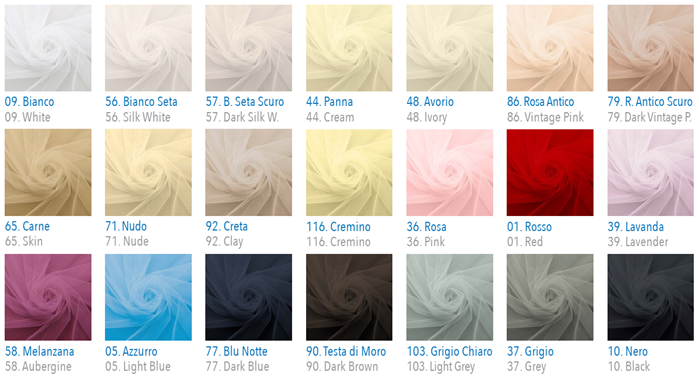
#TULLE 005 – INVISIBILE (well-known as “Marco Tulle”)
ARNIA’s Stock-Supported Lace Strategy: Why It Matters
One of the most important production realities in lace is the minimum required to mount a dedicated lace machine.
For a new custom lace, the technical minimum can be extremely high — often around 5,000 metres depending on construction, yarns, machine and design. This is not a commercial trick. It is linked to machine setup, yarn preparation, programming, testing, running efficiency and industrial economics.
For many brands, especially capsule collections, this is not realistic.
This is why ARNIA keeps selected lace bases available for clients in greige, natural and black. These bases can be used as a starting point for:
- sample dyeing;
- custom colour development;
- black eveningwear concepts;
- natural or raw-looking capsule directions;
- foil coating;
- overprinting;
- lamination;
- surface transformation;
- quick sampling and swatch review.
ARNIA’s Fabrics Stock Supported page explains the logic of stock-supported materials: ready-to-develop fabrics for sampling, capsule collections, colour trials, print trials and faster sourcing routes, subject to availability and technical validation.
This stock-supported strategy allows brands to work with real fabrics instead of abstract sketches. It reduces risk, accelerates decisions and avoids forcing a young collection into unrealistic industrial minimums.
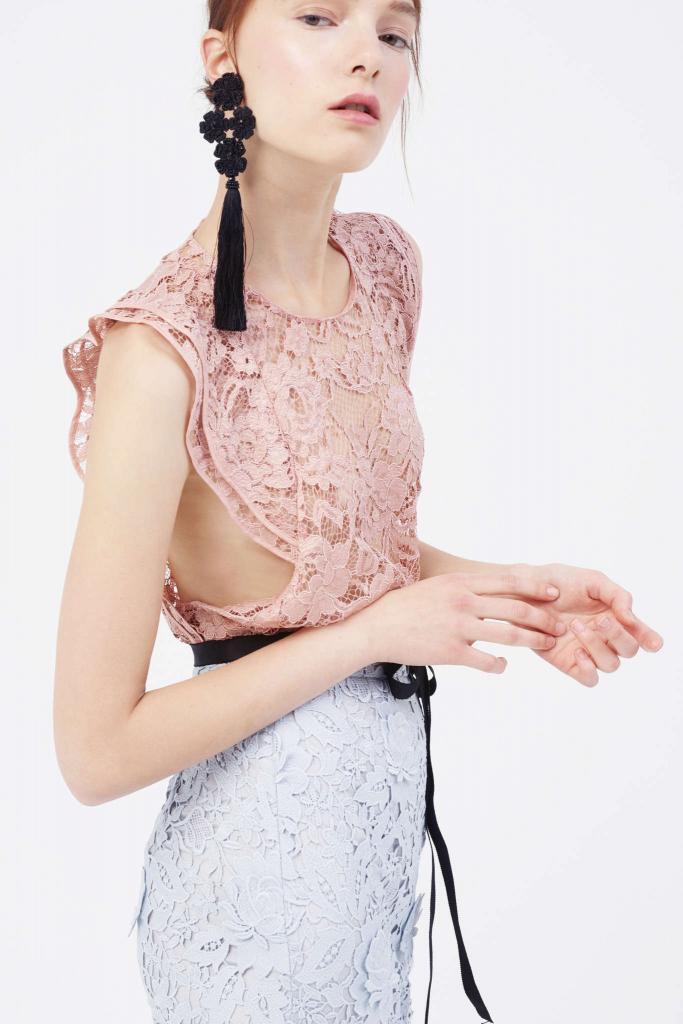
LACE MADE IN ITALY – ART. MILANO lace
Dyeing Lace: Greige, Natural, Black and Sample Colour Matching
Dyeing lace is technically more delicate than dyeing a plain woven fabric.
The open structure affects fabric movement in the dye bath. The yarn composition determines dye class. Polyester, polyamide, cotton, viscose and silk do not dye in the same way. Blends can create tone-on-tone effects or unwanted contrast if not managed correctly.
Polyester is generally dyed with disperse dyes and requires heat setting for dimensional stability. Polyamide behaves differently and often requires acid dye systems. Cellulosics such as cotton or viscose require reactive dyeing, while silk needs more delicate processing to preserve hand and drape. ARNIA’s Lombardy Textile District guide summarizes these different finishing routes for cellulosics, silk and polyester/blends.
Why Greige and Natural Bases Are Useful
A greige or natural lace base gives the brand creative flexibility. It can be dyed to sample, tested against a colour card, matched to a collection palette or transformed into seasonal colours.
This is especially useful when the brand wants:
- a custom colour but not a new lace design;
- a specific nude tone;
- ivory or off-white variants;
- seasonal fashion colours;
- soft pastel lace;
- deep saturated colour;
- colour matching to lining, jersey or woven fabric.
Why Black Lace Is Strategically Important
Black lace is not only a classic. It is one of the strongest bases for eveningwear, sensual fashion, gothic luxury, lingerie-inspired RTW and contemporary “bondage” aesthetics.
Black lace can also become the base for lamination, shiny effects, matte/gloss contrast, metallic treatments or tonal overprinting.
For ARNIA, black lace is particularly important because it connects with signature surface treatments such as glossy or matte foil bonding, metallic effects and high-impact fashion finishes.
Foil Coating and Lamination on Lace: Metallic, Matte, Glossy and Bondage Effects
Foil coating is one of the most powerful ways to transform lace.
ARNIA’s Foil Coating page explains that the technique transfers a thin metallic or pigmented foil onto the fabric surface using heat and pressure, creating shiny, reflective or metallic effects that can range from subtle shimmer to mirror-like finishes.
On lace, the effect can be even more expressive because the openwork structure creates contrast between surface and void.
Possible Effects
On lace, foil coating or lamination can create:
- metallic silver;
- metallic gold;
- gunmetal;
- black gloss;
- matte black;
- wet-look surfaces;
- bondage-inspired shine;
- cracked or partial foil;
- patterned foil;
- tonal surface contrast;
- luxury eveningwear effects.
These are signature ARNIA-style transformations because they move lace away from purely romantic codes and into a more contemporary fashion language.
Technical Risks
Foil coating on lace must be tested carefully.
The open structure means the foil may not transfer evenly unless pressure, adhesive, temperature and support are controlled. Too much heat can damage polyamide or elastane. Too much adhesive can stiffen the lace. A very open lace may show discontinuous foil transfer. A stretch lace may lose elasticity or recover poorly after lamination.
Care instructions, abrasion resistance, dry-cleaning behaviour and delamination risk must be evaluated.
For this reason, foil-coated lace should always be developed through sample trials before production approval.
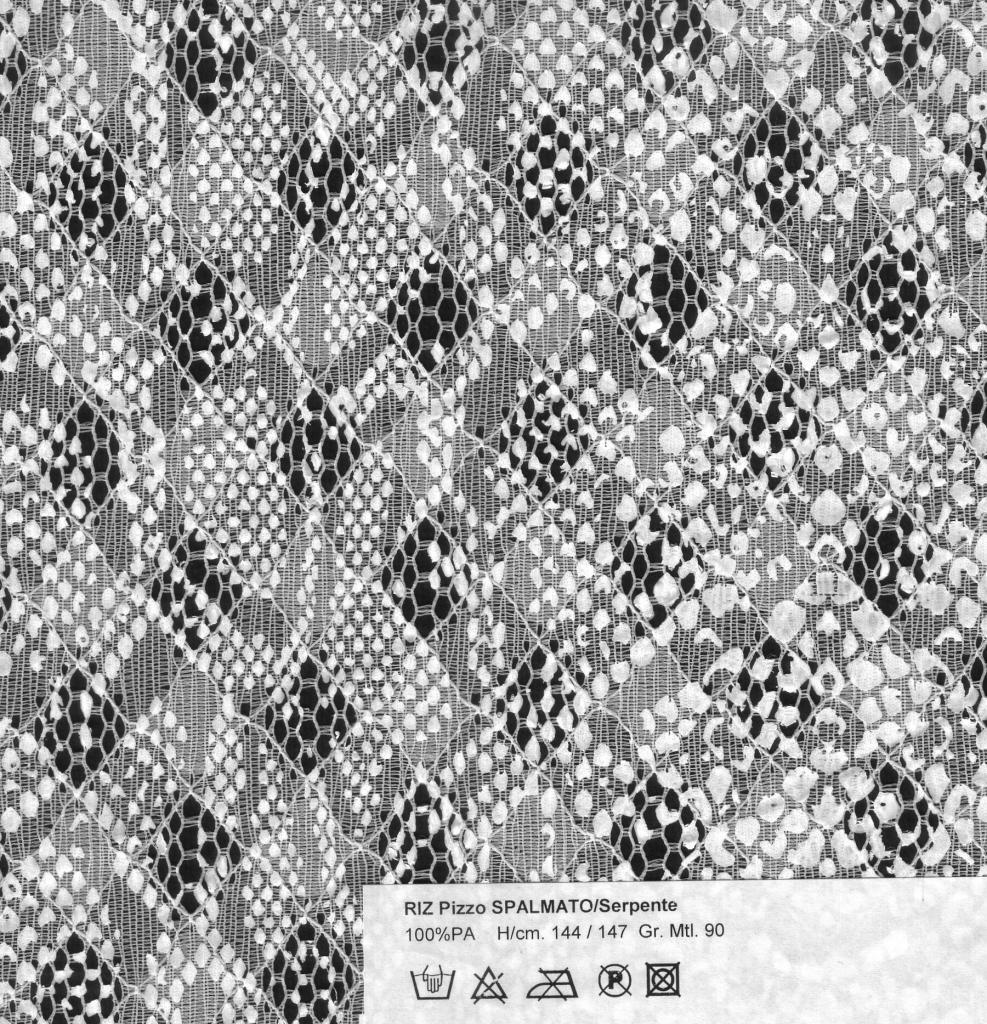
LACE MADE IN ITALY FOILED
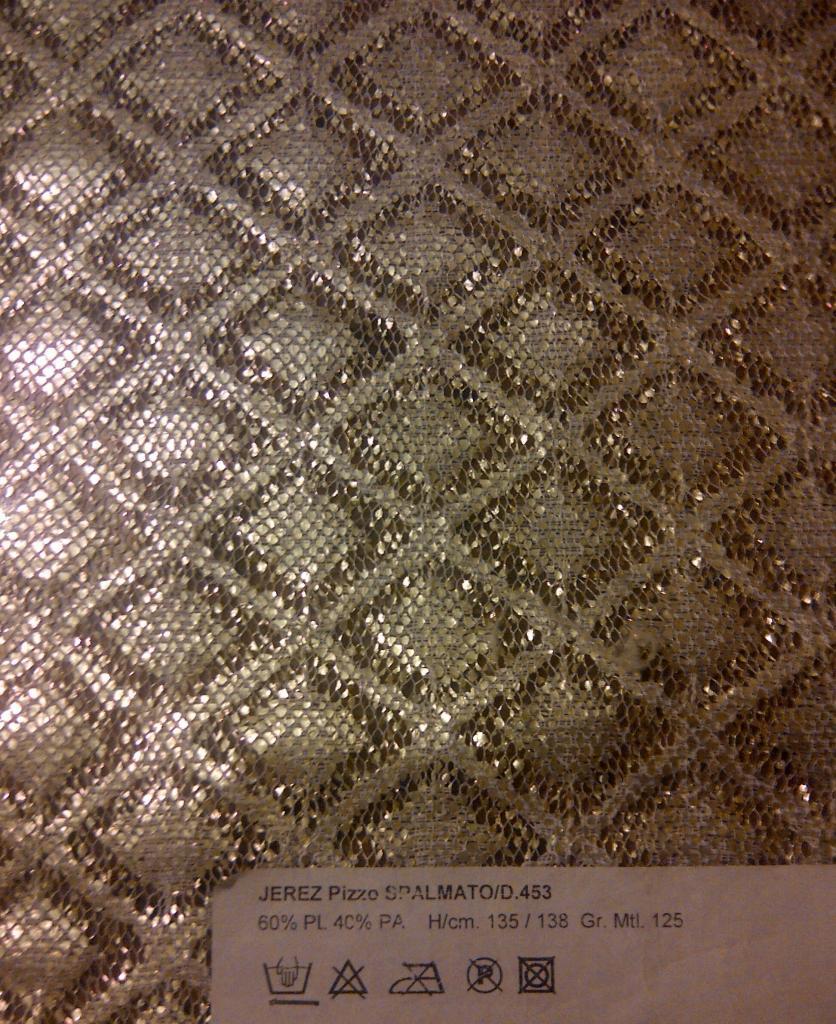
LACE MADE IN ITALY – FOILED
Printing on Polyester Lace: Overprint, Transparency and Optical Effects
Polyester lace can be overprinted, subject to construction and technical validation.
ARNIA’s Print Digital & Rotary page states that digital textile printing prints patterns directly onto fabric with high-precision inkjet technology, allowing fine detail, unlimited colours and complex motifs; rotary printing uses engraved cylindrical screens and is preferred for high-volume repeated patterns, colour penetration and durability. The same page confirms ARNIA’s experience with printing on polyester blends and base cloths.
Printing on lace, however, is not the same as printing on a flat fabric.
Why Lace Printing Is Special
Because lace has open spaces, the print only lands where yarn exists. The design interacts with transparency. A flower printed over a floral lace may create a layered optical effect. A stripe over open lace may become broken and graphic. A photographic print may lose definition if the ground is too open.
This can be a limitation or a creative advantage.
Best Uses
Printed polyester lace works well for:
- tonal overprints;
- animal effects;
- floral-on-floral layering;
- degraded colour;
- shadow effects;
- dark romantic prints;
- branding details;
- abstract surfaces;
- capsule collection statements.
Technical Checkpoints
Before printing lace, ARNIA would normally evaluate:
- fibre composition;
- print technology;
- ground openness;
- colour contrast;
- fixation temperature;
- fabric distortion;
- shrinkage;
- hand change after print;
- repeat placement;
- lining or backing colour;
- final garment use.
The goal is not simply to “print on lace.” The goal is to make the print, the lace and the garment work together.
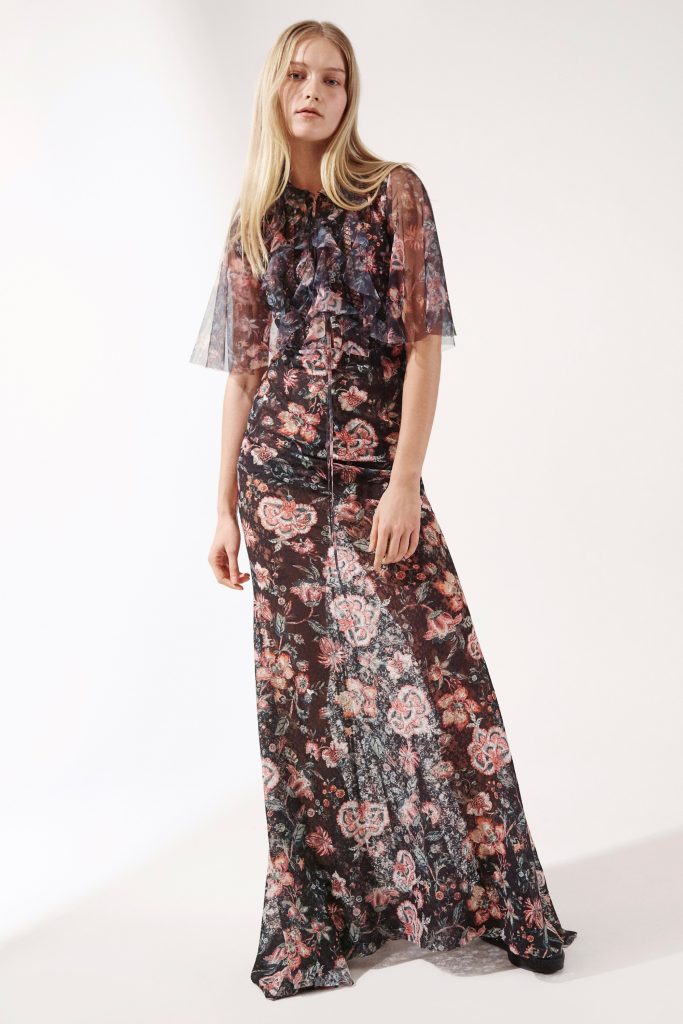
LACE MADE IN ITALY PRINTED
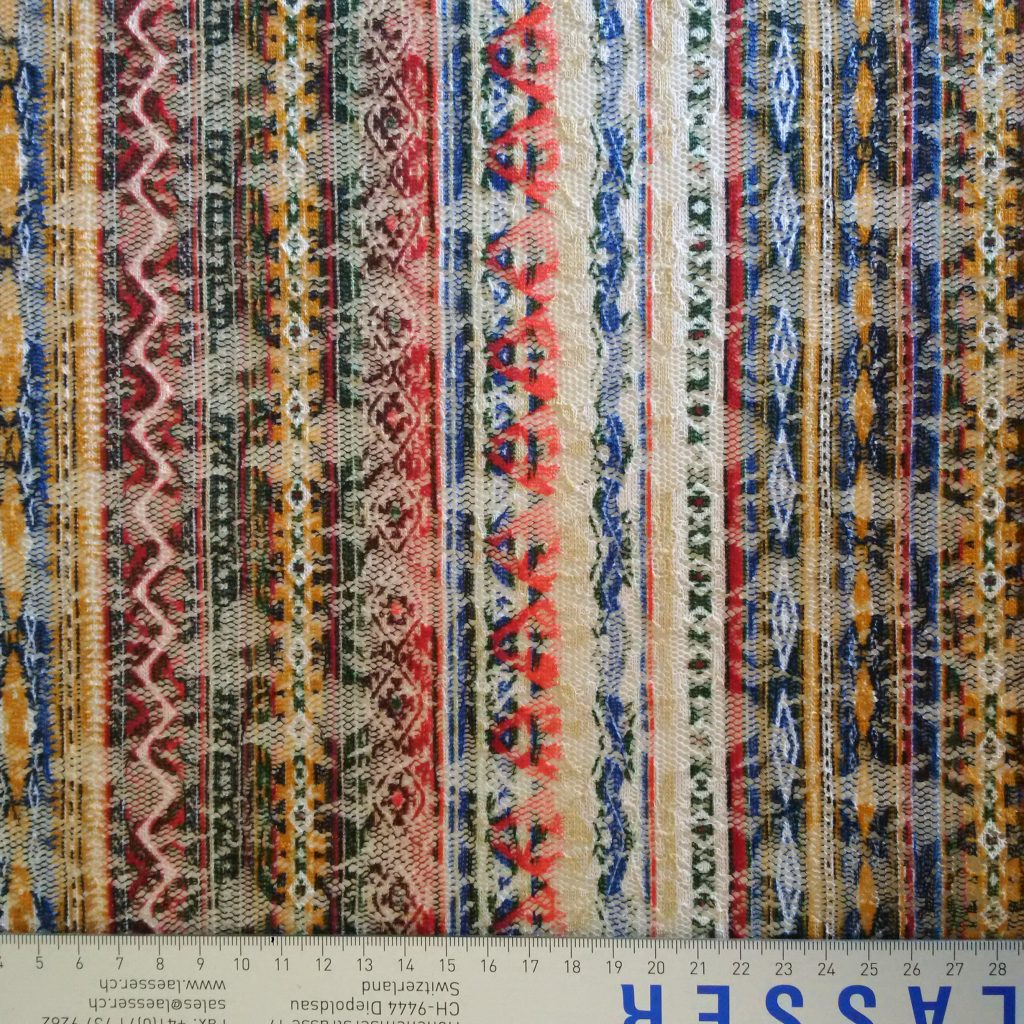
LACE MADE IN ITALY PRINTED
Production Comparison: Pros and Cons by Technique
| Technique | Best For | Main Advantages | Main Limits |
|---|---|---|---|
| Raschel lace | Modern fashion, stretch lace, all-over lace, accessible luxury | Repeatable, scalable, versatile, compatible with synthetic yarns, good for dyeing/printing depending on composition | Can look flatter than Leavers/Chantilly; new custom setup has very high minimums |
| Chantilly lace | Bridal, eveningwear, delicate luxury, transparent panels | Fine, romantic, lightweight, premium perception, strong emotional value | Delicate, often expensive, requires careful handling, “Chantilly” must be described accurately |
| Leavers-style lace | Couture, luxury lingerie, heritage lace, high-end bridal | Depth, refinement, tradition, high perceived value | Rare machinery, slow production, expensive, high setup barrier |
| Embroidered tulle | Decorative panels, sleeves, overlays, motifs, couture effects | Flexible design, can use colour/cording/sequins, strong customization | Base remains visible, embroidery can stiffen fabric, density must be controlled |
| Macramé-effect embroidery / guipure | Statement panels, appliqués, trims, sculptural lace | Raised texture, strong visual impact, handmade perception | Heavier, more expensive, low stretch, requires strong motif engineering |
| Foil-coated lace | Eveningwear, metallic effects, bondage-inspired fashion | High-impact surface, signature luxury effect, modernizes lace | Requires testing for adhesion, hand, stretch recovery and care |
| Printed polyester lace | Fashion prints, capsule stories, graphic lace | Creative layering, overprint effects, colour storytelling | Print definition depends on openness; fixation and distortion must be tested |
The Varese Connection: Lace Made in Italy, Embroidery and the Lombardy Textile District
Lace is not isolated from territory. It belongs to industrial ecosystems.
The Varese area — especially Busto Arsizio and Gallarate — has a deep textile identity. ARNIA’s Lombardy Textile District guide describes Northern Lombardy as a short-radius ecosystem with complementary capabilities developed over more than 150 years: cotton and viscose weaving and dyeing in Busto Arsizio, machine embroidery and dyehouses in Gallarate, silk weaving and printing in Como, and prototyping and garment construction in Milan.
This geography matters for lace because lace often needs more than one supplier.
A lace project may require:
- base selection;
- dyeing;
- heat setting;
- embroidery;
- washing;
- finishing;
- foil coating;
- printing;
- quality control;
- garment testing;
- claim verification.
Gallarate’s embroidery culture and Busto Arsizio’s textile and dyeing heritage create the technical environment where lace-effect surfaces can be developed, corrected and industrialized with real know-how.
Today, the district is no longer only a place of large industrial mills. It is also a network of specialized workshops, converters, dyers, finishers, embroidery specialists and fashion technicians. ARNIA’s role as a textile converter is to coordinate this complexity: choosing the right base, aligning the right process, checking quality and helping the brand avoid unrealistic or unsafe production decisions.
This is what Made in Italy means in practice: not a label, but a controlled technical ecosystem.
Lace made in Italy, Sustainability and Honest Claims
Lace is beautiful, but sustainability claims around lace must be handled carefully.
ARNIA stock-supported lace may be responsible, local, traceable at a supplier level or suitable for lower-waste development — but that does not automatically mean the final fabric or garment can be marketed as certified.
ARNIA’s Sustainability Practical Guide explains that product-level certification depends on chain of custody, transaction certificates and the certification status of the entities involved. It also states that small-lot certified productions can be technically difficult because certification requires segregation, documentation, traceability and sometimes dedicated machine cleaning or setup. These are not generic global rules. They are ARNIA’s operational minimums for certified production with reliable chain-of-custody and realistic industrial control.
For lace, the situation is even more delicate when a completely new machine setup is required. If the technical minimum to mount a lace loom is around 5,000 metres, a small capsule cannot realistically demand a new certified lace article in very small quantities.
The responsible route is to separate:
- aesthetic development;
- sample development;
- stock-supported material selection;
- certified production planning (if technically possible);
- truthful claim strategy.
A brand may be able to say “made with a selected Italian lace developed through ARNIA’s monitored supply chain,” or “made with a stock-supported lace base dyed in Italy,” if true and documented. But it should not claim “certified garment” unless the chain of custody and transaction documentation allow it.
This is not a limitation. It is brand protection.
How ARNIA Helps Brands Choose the Right Lace Made in Italy
ARNIA does not treat lace as a catalogue commodity. The right solution depends on the brand’s design, price target, quantity, garment construction and communication needs.
A brand may come with:
- a vintage lace sample;
- a moodboard;
- a photo;
- a colour target;
- a garment sketch;
- a fabric swatch;
- a desired hand feel;
- a sustainability request;
- a need for black lace;
- a request for foil coating;
- a request for printed lace;
- a request for macramé-effect embroidery.
ARNIA can then assess the most realistic route:
- stock-supported lace base;
- custom dyeing;
- overprinting on polyester lace;
- foil coating;
- stock supported plain solid tulle;
- embroidered tulle;
- macramé-effect embroidery;
- sourcing of a specific lace construction;
- coordination with cut & sew development.
This approach reduces risk because it starts from technical feasibility rather than from a purely aesthetic wish.
Conclusion: Lace Made in Italy Is Where Beauty Meets Industrial Truth
Lace has always lived between fragility and engineering.
Raschel lace offers modern industrial flexibility. Chantilly lace carries refinement and emotional elegance. Leavers-style lace preserves heritage and high-end depth. Embroidered tulle gives brands design freedom. Macramé-effect embroidery creates sculptural impact. Foil coating and printing transform lace into a contemporary fashion surface.
For brands, the real question is not “Which lace is the most beautiful?” The better question is:
- Which lace can deliver the right aesthetic, at the right quantity, with the right quality, within the right technical and reputational framework?
That is where ARNIA’s Made in Italy model becomes valuable.
By working from the Lombardy Textile District, and by keeping selected lace bases available in greige, natural and black, ARNIA gives brands a practical bridge between creativity and production reality.
A lace can be dyed. It can be printed. It can be laminated. It can become metallic, matte, glossy, romantic, sensual or architectural.
But it must first be understood technically.
That is the difference between simply buying lace and developing a lace-based fashion material with purpose.
FAQ – Lace Made in Italy
What is the difference between Raschel lace and Chantilly lace?
Raschel lace is generally a warp-knitted industrial lace made on Raschel machines. It is scalable, versatile and often used for modern fashion and stretch lace. Chantilly lace is historically a fine French bobbin lace known for delicate ground, outlined motifs and detailed floral patterns. In modern sourcing, “Chantilly” is often used to describe a fine, romantic lace aesthetic, but the actual production method should always be checked.
Is all Chantilly lace handmade?
No. Historical Chantilly lace was handmade bobbin lace, often in black silk. Today, many Chantilly-style laces are machine-made, sometimes on Leavers or Raschel machines. The word may describe the look, not always the original technique.
Why are custom lace minimums so high?
Mounting a new lace article requires technical setup, yarn preparation, machine programming, testing and industrial running efficiency. For some lace constructions, the minimum to justify mounting the machine can be around 5,000 metres. This is why ARNIA supports brands with selected stock-supported lace bases for sampling, dyeing, printing and surface development.
What does stock-supported lace mean?
Stock-supported lace means ARNIA keeps selected lace bases available for faster development, subject to availability and technical validation. This allows brands to work with real materials for sampling, capsule projects, dye trials, print trials or foil coating without starting from a full custom lace machine setup.
Can ARNIA dye lace to sample?
Yes, selected lace bases can be dyed to sample, depending on fibre composition, construction and technical validation. Polyester, polyamide, cotton, viscose and silk require different dyeing routes, so lab testing and colour approval are important.
Can polyester lace be printed?
Yes, polyester lace can be overprinted, subject to testing. Printing on lace creates special optical effects because the print only lands on the yarn structure, while open spaces remain transparent. This can be used creatively for layered fashion surfaces.
Can lace be laminated or foil-coated?
Yes, lace can be foil-coated or laminated when the construction allows it. ARNIA can develop shiny, matte, metallic or bondage-inspired effects by applying foil through heat and pressure. Testing is essential to check adhesion, hand feel, stretch recovery, abrasion and care performance.
What is macramé-effect embroidery?
Macramé-effect embroidery is an industrial technique that recreates the raised, corded, openwork appearance of macramé. It may be made through cord embroidery, guipure, chemical lace, embroidery on tulle or embroidery on a dissolvable base. It should not be confused with true hand-knotted macramé unless the product is genuinely made with knots.
Can stock-supported lace be sold as certified?
Not automatically. Certification depends on chain of custody, transaction certificates, article/lot traceability and whether the brand itself can make product-level claims. ARNIA’s Sustainability Practical Guide should be consulted before making any sustainability or certification statement.
Why is Varese important for lace and embroidery?
The Varese textile area, especially Busto Arsizio and Gallarate, has a long industrial textile and embroidery tradition. Together with Como for silk, jacquard and printing, and Milan for prototyping and garment development, it forms a short-radius textile ecosystem that supports luxury Made in Italy sourcing and production.
Is tulle considered a lace fabric?
Tulle is not lace in the strict ornamental sense, because it usually has a regular mesh structure rather than an integrated decorative lace motif. However, from a sourcing and product-family point of view, it belongs to the broader group of lace-related openwork fabrics. It shares the same language of transparency, lightness, layering and open construction, and it is often used as a base for embroidered lace, sequins, appliqué and other decorative developments.
What is the technical difference between tulle and lace?
The main difference is construction and visual function. Lace usually includes the decorative motif within the fabric structure itself, through knitting, weaving, embroidery, cording or guipure techniques. Tulle is generally a fine, regular open-mesh ground. It may remain plain and invisible, or it may become the support for embroidery, sequins, foil coating, printing or lace-effect developments. This is why tulle is often the starting point for more complex lace-inspired surfaces.
Need support selecting, dyeing, printing or transforming LACE Made in Italy, for your next collection?
Explore ARNIA’s stock-supported lace and tulle bases, or contact our team for a technical review of your project. From greige and black lace bases to foil coating, overprinting and macramé-effect embroidery, ARNIA helps fashion brands turn lace into a technically reliable Made in Italy material.
Contact ARNIA TEXTILE FASHION
https://madeinitaly.social/contact-arnia-made-in-italy/


