
Sustainable fashion due diligence, GOTS 8.0 and European supply chain compliance are no longer topics reserved for large corporations or legal departments. For emerging fashion brands and startups, they are becoming part of the product development strategy itself: how fabrics are sourced, how suppliers are selected, how claims are made, how certificates are used, and how brand reputation is protected before the first prototype reaches the showroom.
For many young brands, sustainability begins as a sincere vision. A founder wants to create a better product, avoid fast-fashion logic, work with responsible materials, support ethical production and communicate honestly with customers. That vision is valuable. But in today’s textile and fashion market, vision alone is not enough.
A sustainable fashion brand needs a system.
It needs textile sourcing choices that can be documented.
It needs a supply chain that can be assessed.
It needs claims that can be substantiated.
It needs a clear distinction between “responsible”, “certifiable”, “certified”, “organic”, “recycled”, “traceable” and “low-impact”.
It needs to understand that a certified fabric does not automatically make a certified garment.
This is where due diligence becomes essential.
At ARNIA TEXTILE FASHION, sustainability is approached as a measurable process, not as a marketing label. ARNIA operates as an Italian textile converter and non-profit social cooperative based in the Lombardy Textile District, supporting luxury, premium and emerging brands with Made in Italy fabrics, fabric sourcing, sustainable textile pathways, stock-supported bases and capsule development support. ARNIA’s internal framework identifies sustainability, certified supply chain due diligence, transparency, traceability, Italian craftsmanship and brand reputation protection as core values.
Explore ARNIA Sustainability
Read the Sustainability Practical Guide
Why due diligence matters in sustainable fashion
In simple terms, due diligence means that a brand does not simply trust a sustainability statement at face value. It asks questions, checks evidence, identifies risk, documents decisions and follows up when something is unclear.
In fashion, due diligence can apply to many areas:
- fiber origin;
- supplier qualification;
- chemical safety;
- labor rights;
- subcontracting;
- chain of custody;
- certification boundaries;
- labeling;
- environmental claims;
- social impact;
- traceability by lot or SKU;
- product communication.
This is particularly important because the fashion supply chain is often fragmented. A single product may involve fiber production, spinning, weaving or knitting, dyeing, printing, finishing, embroidery, cutting, sewing, labeling, packing and logistics. Each step can create quality risk, legal risk, social risk, environmental risk or communication risk.
For an established brand, due diligence protects reputation and compliance.
For a startup, due diligence protects the entire business model.
A young brand may not have a legal department, an ESG team or an internal sourcing office. But it still needs to avoid misleading claims, poorly documented materials, unsuitable suppliers, unrealistic certification promises and fragile production routes.
This is why responsible sourcing should begin before sampling, not after production.
GOTS 8.0: why it matters beyond the fabric
The Global Organic Textile Standard, commonly known as GOTS, is one of the most recognized standards for organic textiles. It defines environmental requirements along the textile production chain and includes social criteria; independent certification of the textile supply chain is central to the system. Public descriptions of the standard also highlight that GOTS applies to textiles made with a minimum organic fiber content and covers manufacturing, processing, packaging, labeling, trading and distribution of textile products.
For emerging brands, the most important point is this: GOTS is not just about buying an “organic fabric”. It is about controlling the chain of custody and verifying that the certified claim is supported at the correct level of the supply chain.
In practice, a brand should understand three separate questions:
- Is the material eligible for a GOTS route?
- Is the specific fabric lot covered by the correct documentation?
- Can the final garment be claimed as GOTS certified?
These are not the same question.
A fabric may come from a certified supplier, but that does not automatically mean the finished garment can be marketed as certified. The final claim depends on the applicable standard, the certified actors involved, transaction documentation, chain-of-custody requirements and the certification status of the brand or final product supply chain.
ARNIA’s compliance framework states this principle clearly: chain-of-custody rules apply, and if the final brand is not certified to a given standard, the final product cannot be claimed as certified even if upstream fabrics are. It also notes that minimum technical order sizes may be required because of dedicated machinery and segregation protocols.
This is a crucial lesson for startups.
A sustainability claim is not a mood.
It is not an intention.
It is not a line in a brand manifesto.
It is a statement that must be supported by documentation.
What GOTS-style due diligence means in practice
Under a serious GOTS-style due diligence approach, the brand or textile partner should not only ask whether a fabric is “certified”. It should build a documented path.
ARNIA’s technical compliance framework describes a due-diligence programme integrating risk identification, prevention and mitigation, audit and monitoring, stakeholder communication and remediation pathways. Its focus areas include labor rights, health and safety, subcontracting oversight and chemical conformity across partners.
For a fashion brand, this translates into practical checkpoints.
Material eligibility
The first question is whether the selected material can follow the requested certification route. For GOTS, this normally concerns organic natural fibers and specific textile processing conditions. For other materials, different standards or pathways may be more relevant.
For example, ARNIA’s public materials identify GOTS routes for cotton, linen and silk; FSC-related routes for certain cellulosics through partners; and GRS routes for recycled polyester and polyamide. ARNIA also provides REACH and brand RSL/MRSL conformity declarations, and can provide OEKO-TEX® Standard 100 Class I/II testing on request while clarifying that ARNIA is not OEKO-TEX certified.
Supplier and process control
Due diligence requires understanding which actors are involved in the textile chain and whether they can support the relevant standard, documentation and quality expectations.
In fashion, this includes:
- weaving or knitting;
- dyeing;
- printing;
- finishing;
- embroidery;
- washing or special treatments;
- garment manufacturing;
- labeling and packing.
Each additional step may affect claim eligibility.
Lot traceability
Sustainability communication is strongest when connected to a specific lot or SKU, not only to a general supplier statement.
ARNIA can provide, on request and when compatible with the project, per-SKU or lot traceability datasets including article code, description, color or print, lot number, fiber composition, origin and supply-chain information, process facilities, chemical auxiliary families, labeling or claims admissible under active certifications, logistics and deviations or notes.
Chemical compliance
Responsible textile sourcing also involves chemical safety. A fabric may be visually beautiful but still require compliance checks depending on market, product category and customer requirements.
This is particularly relevant for babywear, skin-contact garments, performance products or brands working with strict RSL/MRSL policies.
Social criteria and labor risk
Due diligence also concerns people.
It is not enough to say that a supply chain is “local” or “artisanal”. The brand should understand whether labor conditions, subcontracting, working hours, health and safety and legal compliance are monitored.
ARNIA’s model is built around a selected and monitored production network. Its operational model states that ARNIA does not simply intermediate manufacturing: it coordinates, controls, organizes and retains responsibility for quality, traceability, customer relationship and ethical compliance. The model also emphasizes that sustainability is not exhausted by certifications, but comes from the union of certification, daily control, internal due diligence, work ethics and respect for people.
Certified fabric vs certified garment: the mistake many brands make
One of the most common mistakes in sustainable fashion is confusing a certified input with a certified final product.
A brand may buy fabric from a certified route and then assume that the finished garment can be marketed as certified. This can be wrong.
The difference is essential.
Certified fabric
A certified fabric claim may refer to a specific textile material, lot or transaction covered by the appropriate documentation.
Certified garment
A certified garment claim usually requires the entire relevant chain, including garment-making and labeling rules, to be covered under the applicable certification requirements.
Certified brand communication
A brand communication claim must be supported by what the brand is actually allowed to say. The wording may need to be more cautious than the founder expects.
For example, a brand may be able to say that a fabric was sourced through a certified route, or that a fabric lot was covered by specific documentation, but it may not be able to say that the final garment is certified if the chain of custody does not support that statement.
This is why ARNIA’s Sustainability Practical Guide is so important: it helps brands understand the difference between responsible sourcing, certified fabric, certifiable route, transaction documentation and final product claims.
Read ARNIA’s Sustainability Practical Guide
Why small capsules and prototypes cannot always be certified
Many emerging brands start with small capsule collections. This is often the right strategic choice. A startup should not overdevelop a full collection before testing its product direction, buyer interest and production feasibility.
However, certification introduces a technical reality: very small lots, prototypes and sample developments cannot always be certified in the way a founder imagines.
There are several reasons.
First, certified production may require segregation of materials and processes.
Second, certain operations may need dedicated handling or dedicated machinery.
Third, documentation must match the actual lot and transaction.
Fourth, the cost and complexity of certification may be disproportionate for a very small sample run.
Fifth, if the final brand is not certified, the claim on the final garment may still be limited.
ARNIA’s materials explain that small lots and sample developments cannot automatically be treated as certified when traceability and dedicated-machine requirements cannot be maintained. The same materials state that for production with Transaction Certificate, technical minimums may apply; for GOTS, the indicated minimum is 1,000 meters.
This does not mean startups cannot work responsibly. It means they must communicate correctly.
A small capsule can be responsible.
A small capsule can use carefully selected materials.
A small capsule can be developed with traceability awareness.
But a small capsule should not claim certification unless the documentation and chain of custody support it.
This distinction protects the brand.
European law: why sustainability claims must be concrete
The European legal direction is clear: sustainability claims must be specific, substantiated and not misleading.
The EU Corporate Sustainability Due Diligence Directive, adopted in 2024, creates a framework requiring large companies to assess and address human rights and environmental impacts across their operations and supply chains. Even where smaller brands are not directly within the legal scope, they can be indirectly affected because larger clients, retailers, investors and distributors increasingly request supply-chain evidence from their partners.
For startups, this means due diligence is not only about legal compliance. It is also about market access.
A buyer may ask:
- Who is your fabric supplier?
- What documentation supports your material claim?
- Is the garment certified or only the fabric?
- Can you provide a transaction certificate?
- Is the brand certified?
- What is the chain of custody?
- How do you control subcontracting?
- How do you avoid greenwashing?
- What happens if a claim is challenged?
The EU framework around greenwashing is also becoming stricter. Directive (EU) 2024/825, often referred to as the Empowering Consumers Directive, amends EU consumer law to strengthen protection against misleading environmental claims, including generic claims, unverified sustainability labels and certain claims based on future environmental performance. Legal commentary also notes that the directive introduces environmental claims into the unfair commercial practices framework and increases the need for substantiation.
For fashion brands, the practical message is simple:
Do not say “sustainable” when you mean “selected with care”.
Do not say “certified” when only the upstream fabric has documentation.
Do not say “organic garment” if the garment claim is not supported.
Do not say “low impact” without evidence.
Do not use generic claims when a more precise claim is possible.
Precision is not a limitation. It is protection.
European case law: the direction of travel on greenwashing
European courts and national authorities are increasingly attentive to environmental claims that are vague, exaggerated or unsupported.
A widely discussed example is the 2024 Dutch court ruling against KLM’s “Fly Responsibly” campaign. The court found that some advertisements were misleading because they gave consumers an overly positive impression of the environmental impact of flying and the effect of measures such as sustainable aviation fuels and offsetting. The ruling did not concern fashion, but the principle is relevant across sectors: sustainability communication must be concrete, balanced and not exaggerate what the evidence supports.
For fashion brands, this creates an important lesson.
If a company in a high-impact sector makes broad claims about responsibility, climate neutrality, sustainability or positive environmental impact, those claims may be scrutinized not only for what they literally say, but also for the impression they create.
This matters for emerging brands because early communication often becomes part of brand identity.
A startup founder may write:
“Our collection is fully sustainable.”
“Our garments are certified.”
“Our supply chain is transparent.”
“Our materials are eco-friendly.”
“Our brand is ethical.”
Each of these statements can be risky if not carefully defined.
Better alternatives may be:
“Our collection uses selected materials with documented sourcing pathways.”
“This fabric lot can be assessed for a certified route, subject to chain-of-custody requirements.”
“Our supply chain is designed for controlled disclosure and traceability documentation.”
“We work with suppliers selected for technical reliability and responsible production practices.”
“Our sustainability communication is based on evidence, not generic claims.”
The difference is not cosmetic. It is legal, reputational and commercial.
Greenwashing-elisabetta cicigoi
What emerging brands and startups should understand
Emerging brands often have a strong creative vision. They want the product to express values: responsibility, beauty, craftsmanship, inclusion, lower impact, respect for people and material quality.
This is positive. But the contemporary fashion market requires founders to connect vision with infrastructure.
A brand is not sustainable because it says so.
A brand becomes credible when it can show how decisions are made.
Startups need a responsible sourcing roadmap
A responsible sourcing roadmap helps the founder avoid confusion between aesthetic ambition and operational reality.
It should answer:
- What type of product are we developing?
- Which materials are technically suitable?
- Which materials can support our sustainability direction?
- Which claims are admissible?
- Which documentation do we need?
- What quantities are realistic?
- What certification route is possible?
- What cannot be certified at this stage?
- What should we avoid saying?
This is especially important for capsule collections.
A capsule collection has fewer styles, but each decision carries more weight. If a small brand builds its first capsule around an unsupported claim, the entire brand identity can become fragile.
Startups should not overpromise
Founders often want to communicate strongly. They need to attract customers, buyers and investors. But overpromising creates risk.
The safest approach is to use progressive language:
- “responsible material selection”;
- “traceability-aware sourcing”;
- “certifiable pathway, subject to article and lot validation”;
- “certified fabric available for eligible production routes”;
- “documentation available on request for confirmed production lots”;
- “claims to be confirmed according to chain-of-custody requirements”.
This language may sound less dramatic than “100% sustainable”, but it is much stronger in a professional buyer conversation.
Startups should treat certification as a project condition
Certification cannot be added at the end of the process.
A brand should decide early whether certification matters for:
- internal values;
- buyer requirements;
- retail positioning;
- online communication;
- hangtags;
- wholesale documentation;
- export market requirements;
- investor or impact reporting.
If certification matters, the product development process must be structured accordingly.
This includes material selection, supplier selection, production quantities, transaction documentation, labeling review and chain-of-custody checks.
Startups should separate product truth from brand narrative
A strong brand story is important. But it must not exceed product truth.
A founder can speak about purpose, values and ambition. But product claims must be narrower and evidence-based.
For example:
Brand narrative: “We are building a responsible luxury capsule rooted in Italian textile know-how.”
Product claim: “This fabric was sourced through a documented Made in Italy supply chain.”
Certification claim: “Certification applicability is subject to lot, quantity, article and chain-of-custody validation.”
These three levels should not be mixed.
Why due diligence is also a design tool
Due diligence is often perceived as administrative. In reality, for a fashion startup, it can become a design tool.
It helps the founder choose better.
A material may be beautiful but not suitable for the claim.
A fabric may be certified but not compatible with the garment.
A supplier may be fast but unable to document the process.
A deadstock opportunity may look sustainable but create continuity, labeling and repeatability problems.
A low MOQ may seem attractive but make certification technically impossible.
When due diligence is introduced early, the design team can avoid false starts.
This is why textile sourcing should not be treated as a last-minute purchasing activity. It should be integrated into product strategy.
ARNIA’s Fabric Sourcing service is built around this logic: transforming a brief, reference swatch, moodboard or product need into a realistic textile pathway.
Explore ARNIA Fabric Sourcing
Read: 48Hour Fabric Shortlist
The role of a TEXTILE CONVERTER in Sustainable Fashion Due Diligence
A textile converter is not only a fabric seller.
A textile converter coordinates the transformation of a material idea into a textile product: base cloth, yarn, weaving, dyeing, printing, finishing, embroidery, surface effect, quality control and delivery logic.
When sustainability and certification are involved, the converter’s role becomes even more important.
The converter helps the brand understand:
- which route is realistic;
- which supplier or process can support the desired outcome;
- which documentation is needed;
- which claims are too broad;
- which quantities are technically coherent;
- which risks must be managed before production.
ARNIA’s profile defines the company as a textile converter and B2B production partner for brands, operating with local, traceable and documentable supply chains. Its activities include textile development, sourcing, sustainability and compliance support, stock services, Cut & Sew, small batch production, quality control, due diligence and know-how protection.
This is why a startup should not choose a partner only by asking “how much does it cost?”
A better question is:
“Can this partner help us avoid technical, compliance and reputational mistakes?”
Sustainable Fashion Due diligence and the hidden risk of deadstock
Many startups associate deadstock with sustainability. The logic seems simple: if a fabric already exists, using it must be more sustainable than producing a new one.
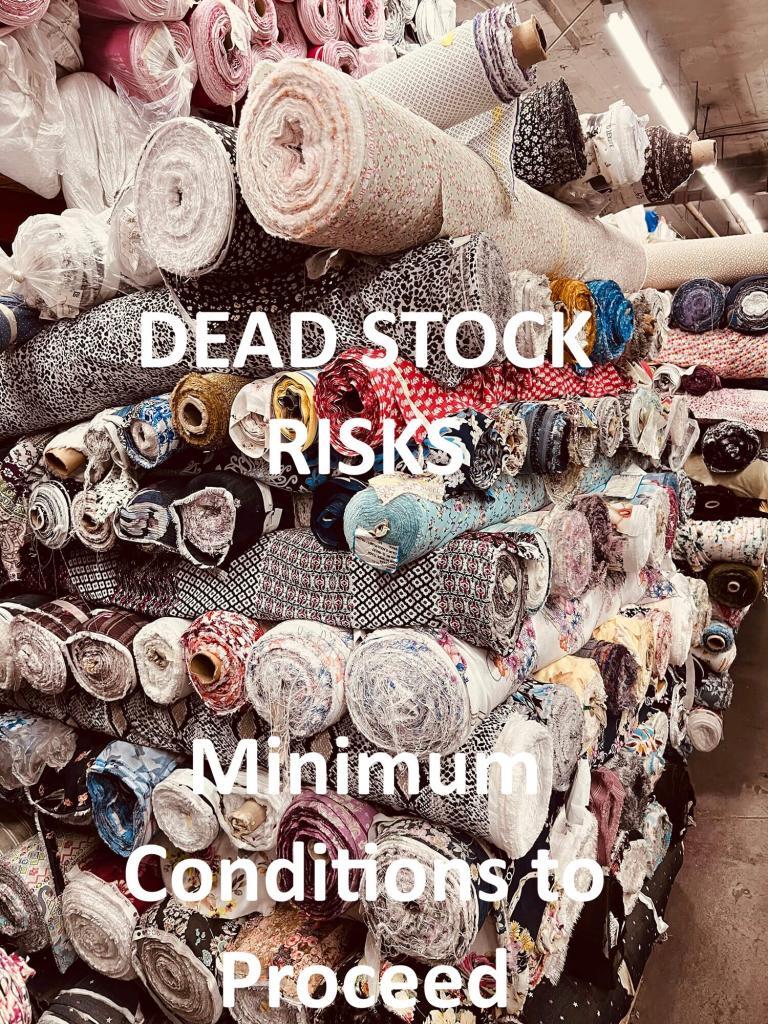
In some cases, deadstock can reduce waste. But for a structured brand, it can also create serious problems:
- uncertain composition;
- incomplete documentation;
- limited continuity;
- lack of repeatability;
- unclear chemical history;
- weak labeling support;
- inability to issue reliable certificates;
- inconsistent quality;
- difficulty reordering;
- unsupported environmental claims.
This is why ARNIA generally does not build collections on deadstock as a standard development route. ARNIA’s internal policy states that deadstock can create critical issues in traceability, continuity, labeling compliance, environmental claims and commercial repeatability, and that any exception should be assessed only case by case.
For a startup, the key lesson is not “never use available fabrics.” The lesson is: do not confuse availability with due diligence.
ARNIA’s Fabrics Stock Supported line is a more structured alternative. It focuses on selected fabrics and base cloths that may help accelerate sampling, capsule development, color trials, print trials and production planning, subject to availability and technical confirmation.
Explore Fabrics Stock Supported
Read: Textile Deadstock vs Just-in-Time
#image_title
A practical due diligence checklist for emerging brands
Before launching a sustainable capsule collection, an emerging brand should prepare a basic due diligence checklist.
1. Define the claim before sourcing
Do not start with “we want sustainable fabrics.” Start with the intended claim.
Examples:
- organic cotton fabric;
- GOTS-certified fabric route;
- recycled polyester fabric;
- GRS route;
- FSC-related viscose route;
- responsible Made in Italy sourcing;
- traceability-supported production;
- social impact supply chain.
Each claim requires different evidence.
2. Identify the product category
A fabric may be responsible but unsuitable for the product.
A dress, robe, kimono, blouse, trouser, skirt, top or outerwear piece may require different weight, drape, care performance, construction behavior and finishing.
3. Map the supply chain
Even a simplified map helps:
- fiber;
- yarn;
- fabric production;
- dyeing or printing;
- finishing;
- garment making;
- labeling;
- packing.
The map should identify where documentation is needed.
4. Check certification boundaries
Ask whether the certification applies to:
- the supplier;
- the process;
- the fabric lot;
- the transaction;
- the final garment;
- the brand’s own communication.
Do not assume.
5. Check MOQ and technical feasibility
Certified production may require minimum quantities, segregation or dedicated handling. If the brand is producing a very small capsule, certification may not be technically or economically coherent.
6. Prepare a claim matrix
A claim matrix is a simple table that separates what can be said at each level:
| Level | Example | Risk |
|---|---|---|
| Material | “Fabric sourced through a documented route” | Lower |
| Lot | “Lot covered by specific documentation” | Medium |
| Garment | “Certified garment” | Higher |
| Brand | “Sustainable brand” | Very high if generic |
7. Keep documentation
At minimum, keep:
- technical data sheets;
- material composition;
- supplier declarations;
- certificates where applicable;
- transaction documents where applicable;
- lab tests where required;
- approval emails;
- claim review notes.
8. Review communication before publication
Before publishing a product page, hangtag or campaign, review every sustainability statement.
Ask:
- Is it specific?
- Is it supported?
- Is it exaggerated?
- Does it imply more than we can prove?
- Would a buyer, lawyer or consumer protection authority read it differently?
What due diligence means for buyers
For buyers and sourcing managers, due diligence is about risk reduction.
A buyer must protect:
- delivery;
- quality;
- documentation;
- supplier reliability;
- brand reputation;
- legal compliance;
- consumer trust.
The buyer’s question is not only:
“Is this fabric beautiful?”
It is also:
“Can I put this fabric into the collection without creating future problems?”
This is why professional buyers ask about certification status, transaction documentation, lead time, MOQ, repeatability, chemical compliance, supplier structure, traceability and claims.
A textile partner who gives overly easy answers may not be the safest partner.
A partner who explains limits clearly may be protecting the brand.
What due diligence means for design teams
Design teams often approach sustainability through materials, texture and emotional language. That is natural. Designers need to imagine the product before it exists.
But the material direction must be compatible with the claim direction.
A design office should ask:
- Is the fabric suitable for the silhouette?
- Does the material support the intended quality level?
- Is the surface treatment compatible with the sustainability claim?
- Does the finishing require additional chemical checks?
- Can the material be repeated?
- Can the fabric be certified or only sourced responsibly?
- What happens if the design changes after prototype?
In luxury fashion, due diligence and design are connected.
A responsible product is not only a certified product. It is a product designed with technical, environmental and social awareness from the beginning.
What due diligence means for founders
For founders, due diligence is a way to build trust.
A founder does not need to become a certification expert. But a founder must understand the difference between ambition and evidence.
The founder should know:
- what the brand wants to claim;
- what the supply chain can support;
- what the material documentation says;
- what the final garment can legally communicate;
- what should remain an internal ambition rather than a public claim.
This is especially important in the first years of a brand.
Early mistakes can become expensive. A misleading claim can damage investor trust, buyer relationships and customer confidence. An unsupported claim can also create friction with retailers, marketplaces or wholesale partners.
A careful due diligence approach helps founders build a stronger brand from the beginning.
Read: Fashion Production for Startups
Read: Fashion Startup Budget
Read: Guide for Textile Startup
The ARNIA TEXTILE FASHION approach: responsible luxury with evidence
ARNIA’s model is built on three connected dimensions: textile know-how, responsible supply-chain coordination and social inclusion.
ARNIA is a non-profit social cooperative based in the Lombardy Textile District, working with luxury and premium brands through Made in Italy textile development, sourcing, sustainability pathways, stock-supported fabrics and Cut & Sew support. Its mission is to offer a production model that is beautiful, ethical and sustainable, while empowering disadvantaged individuals and preserving the local textile district.
This matters because sustainability is not only environmental.
It is also social.
It is also organizational.
It is also contractual.
It is also reputational.
ARNIA’s operational model includes an internal team with know-how, experience, coordination capacity, documentation management, quality control and sustainability competence. It also relies on a selected, qualified and monitored production network where ARNIA maintains responsibility for quality, traceability, client relationship and ethical oversight.
For brands, this means ARNIA can support more than material selection. It can support the reasoning behind the material.
The goal is not to make sustainability look easier than it is.
The goal is to make it manageable, documented and realistic.
Transparency does not mean exposing the whole supply chain without control
Another point emerging brands often misunderstand is transparency.
Some founders think that transparency means publicly naming every supplier, every subcontractor and every process detail. But in professional fashion supply chains, transparency must be balanced with know-how protection, confidentiality, anti-circumvention and protection of other clients’ work.
ARNIA’s supply-chain policy states that supplier identities and sensitive process details are disclosed selectively, under controlled conditions, typically after NDA and supply-chain protection clauses are in place. The rationale is clear: the supply chain is not only a list of names; it is technical know-how, commercial investment and reputational asset.
A responsible brand should not confuse transparency with uncontrolled disclosure.
A more mature approach is:
- disclose compliance logic;
- provide documentation where relevant;
- protect confidential supplier identities at early stages;
- use NDA where necessary;
- disclose more detail only when the project, audit or certification requires it.
This protects both parties.
Read: Protecting Know-How and Fashion Legality
Read: Industrial Property and NDA in Fashion
Why sustainable fashion due diligence should be discussed before the prototype
Many brands discuss sustainability after they have already selected the fabric, developed the prototype and prepared the campaign.
That is too late.
Due diligence should start before the prototype because the prototype itself may depend on:
- fabric availability;
- certification route;
- MOQ;
- construction feasibility;
- chemical requirements;
- dyeing or printing process;
- finishing compatibility;
- labeling expectations;
- final claim.
If a brand wants a certified route, the material and production plan must be aligned early.
If a brand wants a small capsule, the certification strategy must be realistic.
If a brand wants to communicate sustainability, the wording must be built from available evidence.
If a brand wants to avoid greenwashing, the claim must be designed before the marketing campaign.
This is why ARNIA’s technical strategy approach is useful for founders and brands: it helps clarify feasibility, sourcing options, MOQ alignment, certification limits and the roadmap before resources are committed.
Explore First Call Fashion Production Onboarding
Explore Textile Project Manager
Responsible luxury: what brands should say instead of generic claims
A responsible brand should avoid generic sustainability language when more precise language is possible.
Instead of “100% sustainable”
Use:
Developed through a responsible sourcing process with documented material selection and supply-chain review.Instead of “certified collection”
Use:
Selected materials may follow certified pathways, subject to article, lot, quantity and chain-of-custody validation.Instead of “GOTS garment”
Use only when the final garment claim is supported by the full certification route. Otherwise, use:
Fabric sourced through a GOTS-related pathway, subject to transaction documentation and chain-of-custody requirements.Instead of “eco-friendly fabric”
Use:
Fabric selected for specific material characteristics and documentation pathway, with sustainability claims reviewed against available evidence.Instead of “transparent supply chain”
Use:
Supply-chain documentation can be defined per order and lot, with controlled disclosure under appropriate confidentiality conditions.This type of language may be less emotional, but it is much more credible.
A founder’s roadmap for sustainable textile sourcing
An emerging brand can approach sustainable textile sourcing through a simple roadmap.
Step 1: Define the collection strategy
Is the brand developing:
- a capsule collection;
- a pre-collection;
- a cruise collection;
- a limited drop;
- a wholesale sample range;
- a first production run?
Each route affects sourcing and certification.
Step 2: Define the sustainability priority
Is the priority:
- organic fibers;
- recycled fibers;
- FSC-related cellulosics;
- social impact;
- local production;
- traceability;
- chemical compliance;
- low-risk claims;
- buyer documentation?
A brand cannot optimize everything at once.
Step 3: Select the textile route
The route may involve:
- existing ARNIA collections;
- fabric sourcing;
- stock-supported base cloths;
- custom development;
- certified or certifiable materials;
- special finishes;
- Cut & Sew support.
Step 4: Validate technical feasibility
Before committing to a claim, check:
- drape;
- weight;
- handfeel;
- construction;
- care requirements;
- repeatability;
- MOQ;
- prototype behavior.
Step 5: Validate documentation
Check what evidence is available:
- certificates;
- transaction documents;
- data sheets;
- supplier declarations;
- test results;
- traceability dataset;
- claim limits.
Step 6: Write claims carefully
Use specific, evidence-based language.
Avoid generic environmental claims.
Step 7: Keep a record
Every sourcing decision should be documented. This is especially important for startups, because the founder may later need to explain decisions to buyers, retailers, investors or customers.
Due diligence is not bureaucracy. It is brand protection.
Many founders fear that due diligence will slow them down.
In reality, the opposite is often true.
A clear due diligence process can prevent:
- wrong fabric choices;
- misleading product pages;
- unsupported hangtags;
- buyer distrust;
- certification misunderstandings;
- supplier confusion;
- production delays;
- reputational damage.
The more structured the sourcing process, the less fragile the brand becomes.
For luxury and premium brands, due diligence is not the enemy of creativity. It is what allows creativity to become credible product.
Final thought: sustainability is not a label, but a disciplined way of making decisions
Sustainable fashion due diligence, GOTS 8.0 and European greenwashing rules all point in the same direction: brands must move from intention to evidence.
This is especially important for emerging brands and startups.
A young brand can be visionary.
It can be poetic.
It can be disruptive.
It can be beautiful.
But if it wants to speak about sustainability, it must also be precise.
The strongest brands will not be those with the loudest claims.
They will be those with the clearest evidence.
At ARNIA TEXTILE FASHION, we believe that responsible luxury is possible when textile know-how, supply-chain control, documentation, social inclusion and honest communication work together.
This is why we help brands transform sustainability from a promise into a structured development path.
Contact ARNIA
Explore ARNIA Sustainability
Read the Sustainability Practical Guide
SUSTAINABLE FASHION DUE DILIGENCE
FAQ
What is sustainable fashion due diligence?
Sustainable fashion due diligence is the process of identifying, assessing, documenting and managing social, environmental, chemical, certification and supply-chain risks before and during product development. It helps brands avoid unsupported claims, weak documentation and reputational risk.
Is GOTS only about organic fabric?
No. GOTS is not only about organic fiber content. It also concerns textile processing, environmental requirements, social criteria, labeling, chain of custody and independent certification across the relevant textile supply chain.
Can a GOTS-certified fabric make the final garment GOTS certified?
Not automatically. A certified fabric does not automatically make a finished garment certified. Final product claims depend on chain of custody, transaction documentation, applicable standard requirements and the certification status of the brand and supply-chain actors involved.
Can startups create certified capsule collections?
Potentially, but certification depends on the article, lot, quantity, supply chain, documentation and technical feasibility. Very small capsules, prototypes and sample lots may not be technically or economically suitable for certification.
What is the difference between certified and certifiable?
“Certified” means the product, lot or process is covered by the required documentation under the relevant standard. “Certifiable” means that a route may be possible, but it still requires validation, correct quantities, chain-of-custody control and documentation.
Why are European greenwashing rules important for emerging brands?
European rules and case law increasingly require sustainability claims to be specific, substantiated and not misleading. Emerging brands may not always be directly covered by every corporate due diligence obligation, but they are affected by buyer expectations, consumer law and reputational standards.
What should a startup prepare before requesting sustainable textile sourcing?
A startup should prepare a product brief, target garment category, expected quantity, preferred materials, target market, intended sustainability claim, launch timing and any certification or documentation requirements.
Why does ARNIA avoid generic sustainability claims?
ARNIA takes an anti-greenwashing approach. Sustainability claims must be supported by evidence, documentation, certification boundaries and chain-of-custody rules. This protects both the brand and the supply chain.
Does ARNIA TEXTILE FASHION support emerging brands?
Yes. ARNIA supports emerging brands and startups through textile sourcing, material selection, stock-supported bases, sustainability guidance and, where technically coherent, capsule development and Cut & Sew support.
Where can I learn more?
Start with ARNIA’s Sustainability, Transparency and Sustainability Practical Guide pages.


